


Many animals try to win a mate by displaying spectacular ornamentation – such as the famous tail of male peacocks. However, these impressive traits can have negative consequences, even hindering movement or making individuals easier for predators to find. New research has revealed a previously undocumented example of this: the feather ornamentation on the heads of male Chrysolophus pheasants restricts their field of view.
We know surprisingly little about how birds see the world. To get a good overview, we are measuring the visual fields of many bird species. These two were part of that, and that’s when we discovered this oddity.
Senior researcher Dr Steve Portugal, Department of Biology
Animals, including us, have a certain field of view that determines how much of the world they can see at once. Up to now, researchers have not found any major differences in how males and females see in terms of their visual fields. However, for the first time ever, the new findings reveal that the cranial feathers of male golden (C. pictus) and Lady Amherst’s (C. amherstiae) pheasants are so much more exaggerated than their female counterparts that this impedes their ability to gather information from the world about them.
This effect is most extreme in the vertical axis, where the males have a field of view 30° or 40° less in golden and Lady Amherst’s pheasants respectively. This difference was not seen in two closely related species also measured in this study, silver pheasants (Lophura nycthemera) and green pheasants (Phasianus versicolor), meaning that the finding is, so far, unique.
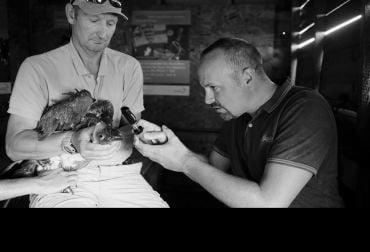 Professor Steve Portugal using an ophthalmoscope with a vulture.
The researchers made the discovery by chance while investigating why some bird species are so prone to flying into man-made objects such as wind turbines and power lines, while others spot the threat and take evasive action to avoid the collision. The aim is to use this information to design better mitigation strategies and patterns (that could be applied to objects such as wind turbines) to reduce bird collisions.
Senior researcher Dr Steve Portugal (Department of Biology) said: ‘We know surprisingly little about how birds see the world. To get a good overview, we are measuring the visual fields of many bird species. These two were part of that, and that’s when we discovered this oddity.’
He added: ‘For the birds, it is a little bit like a trip to the opticians. They are held in place, and using an ophthalmoscope, we shine a light into their eyes, looking for flashback. This flashback is a little like what you see when driving at night and an animal is in the headlights. Through moving around the bird’s head – all around, up and over – you can measure the region around the head that the bird can see!’
Importantly, this method quantifies three components of the visual field, the monocular region (where one eye can see), the binocular region (where both eyes can see), and the blind region (where no eyes can see).
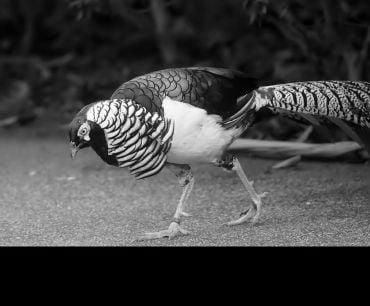 A male Lady Amherst’s pheasant. Credit: vinsky2002, via Pixabay.
It is possible that this newly found trait may form part of the ‘handicap hypothesis.’ This proposes that females find apparently costly or exaggerated features on males attractive, because they suggest that the males who can survive and flourish despite having them must have superior genes. Besides the peacock’s tail, another classic example is the antlers on male deer.
Why this strange trait has evolved in just these two species of pheasant is not entirely clear. Dr Portugal said: ‘One idea is that it’s perhaps to do with the habitat they live in. Both golden and Lady Amherst’s pheasants live in dense forest. Perhaps they can’t see very far anyway due to a cluttered environment of trees, shrubs and plants – making the consequences of their feathers not as significant as they otherwise might be.’
For their wider project on reducing bird collisions, Dr Portugal and his colleagues plan to look in more depth at how different species perceive and see objects ahead of them.
The study ‘The visual impediment of cranial ornamentation in male Chrysolophus pheasants’ has been published in Biology Letters.
For more information about this story or republishing this content, please contact [email protected]
“The University of Oxford is a collegiate research university in Oxford, England. There is evidence of teaching as early as 1096, making it the oldest university in the English-speaking world and the world’s second-oldest university in continuous operation.”
Please visit the firm link to site