


The UK is facing a national emergency not only because the climate is changing, but because the living systems that regulate that climate, protect our homes, and feed our people are breaking down. This is exposing our country to escalating risks: floods, fires, heatwaves, food insecurity, and economic instability.
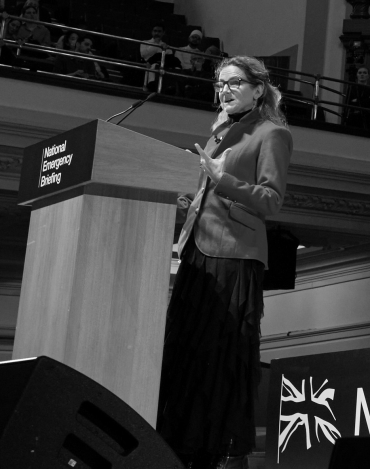 Professor Nathalie Seddon speaking at the National Emergency Briefing. Credit: National Emergency Briefing.
The facts are sobering: the UK is one of the most nature-depleted nations on Earth, ranking in the bottom 10% of countries globally on the Biodiversity Intactness Index. Monitored wildlife populations have declined by around 19% since 1970, and one in six species is now at risk of extinction. Only 14% of rivers in England are in good ecological health, with chemical pollution, sewage discharge, soil erosion and agricultural runoff literally choking the arteries of our landscapes. Our peatlands, which store vast amounts of carbon, are now emitting millions of tonnes of CO₂ a year and increasing wildfire risk. Meanwhile, only 7% of our woodlands are healthy, and only 2.8% of our lands are considered effectively protected for nature.
This isn’t just a loss of beauty or heritage, critically important though that is, it is also a loss of the key functions that nature provides. Pollinators, for instance, contribute over half a billion pounds annually to UK agriculture, and their decline is resulting in less resilient food systems. When rivers fail, so does our resilience to droughts, floods, and water scarcity for agriculture and industry. The lack of trees and green space leaves many UK towns dangerously exposed to extreme heat.
Recent analysis by the Green Finance Institute and others suggests that if we continue to degrade nature, nature-related risks could cut UK GDP by around 5% (up to 12%) over the coming decade – a macroeconomic shock on the scale of a major financial crisis.
So, this is not an environmental issue on the margins of policy. It is a national security issue. But our current economic system is exacerbating these systemic risks by subsidising pollution, rewarding short-term extraction, and discounting the future.
Without a living healthy biosphere there is no stable economy, no food or water security, and no public health resilience.
Professor Nathalie Seddon
The central task for the next decade is to reform the rules and incentives of the economy so that they reward stewardship and regeneration rather than degradation and delay. My own experiences with citizens’ assemblies (including as science co-lead for the UK’s first People’s Assembly for Nature) show that this is a change that the British public want. Further surveys have found that more than half of Britons think the Government is not doing enough to protect and restore nature, and almost half of those who expressed an opinion want more support to reduce their environmental impact.
The scientific evidence points to the following solutions:
- Consider nature as critical infrastructure
Nature must sit alongside transport, energy, and digital systems in national resilience planning. Treasury guidance already allows this. We just need to use it consistently; valuing the avoided costs of floods, heat deaths, water treatment, and soil erosion, not only the price of building things. There is a large and growing evidence base, in part developed by my own team at the NbSI, that nature-based solutions are key to climate resilience in the UK and beyond.
2. Stop funding harm, reward restoration
We must end perverse subsidies, strengthen enforcement, and apply a simple, universal test to all spending and investment: Does it harm the biosphere, or help it? At the same time, we must reward protection and restoration. Environmental Land Management schemes offer a promising framework, but they need stability, simplicity, scale, and multi-year budgets so farmers and land managers can plan and invest.
We need to treat nature as the essential life-support system it is — stop funding its destruction, invest in its repair, and make it the foundation of our economic and security strategy.
Professor Nathalie Seddon
3. Redirect finance and measure what matters
The Bank of England and the Prudential Regulation Authority need to stress-test nature-related risks just as they do for climate. Major businesses should disclose these risks through the Task force for Nature-related Financial Disclosure framework. This is not red tape; it is basic market transparency.
4. Cultivate a culture of care
We need nature woven back into daily life: children learning outdoors, schools surrounded by shade and green space, cities planned as places that cool, heal and connect. When people have regular contact with nature, they care for it – and care for each other.
5. Create an economy that values nature not as a resource to extract, but as a partner in prosperity
At the moment, our economy is unravelling the web of life it depends on: subsidising pollution, rewarding short-term extraction and discounting the future. The task before us is to reform the rules and incentives of the economy so they reward stewardship, reciprocity and regeneration.
Taking such an approach would bring countless benefits we would all feel, for instance:
This isn’t about choosing between the economy and the environment. It’s about recognising that the economy is embedded in the environment, and that the health of the nation depends on the living systems that sustain us and that we are part of.
For more information about the importance of working with nature in a warming world, please visit the Nature-based Solutions Initiative (NbSI) website.
You can find out more about the National Emergency Briefing on the event website. Videos of the expert briefings will be made available soon on the event’s YouTube channel.
For more information about this story or republishing this content, please contact [email protected]
“The University of Oxford is a collegiate research university in Oxford, England. There is evidence of teaching as early as 1096, making it the oldest university in the English-speaking world and the world’s second-oldest university in continuous operation.”
Please visit the firm link to site