

Physicists at the University of Oxford have contributed to a new study which has found that iron-rich asteroids can tolerate far more energy than previously thought without breaking apart – a breakthrough with direct implications for planetary defence strategies. The findings have been published in Nature Communications.
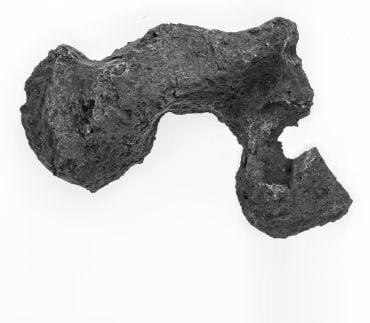 The Campo del Cielo iron meteorite used in the study. Credit: Eric Halwax.
Recent missions such as NASA’s Double Asteroid Redirection Test (DART), which successfully nudged the asteroid Dimorphos in 2022, show that redirecting an asteroid is possible. But to do it reliably, scientists must understand how asteroid materials behave under intense, fast heating – conditions very different from slow, destructive lab tests.
In the new study, an international team including Oxford Physicists used CERN’s High Radiation to Materials (HiRadMat) facility to irradiate a sample of the Campo del Cielo iron meteorite (a stand-in for metal-rich asteroid) using extremely energetic 440 GeV proton beams.* By employing laser Doppler vibrometry (where lasers are used to measure tiny vibrations on the sample surface), they captured real-time data on how the material responded to the rapid build-up of stress. The test was non-destructive, allowing the researchers to measure stress, strain, and deformation as they happened, rather than only before and after.
The results demonstrate that asteroid materials can absorb significantly more energy than conventional models suggest, without fragmenting – and may even become tougher through the process. This appears to be because asteroid materials behave like complex composites whose internal structure redistributes and amplifies stress in unexpected ways. A particularly surprising discovery was that the meteorite showed strain-rate dependent damping: the faster it is stressed, the better it dissipates energy.
The findings have important implications for asteroid-deflection strategies. In particular, they indicate that it is possible to deliver energy deep inside an asteroid without breaking it apart. This opens the door to new deflection methods that push the asteroid more effectively while keeping it intact.
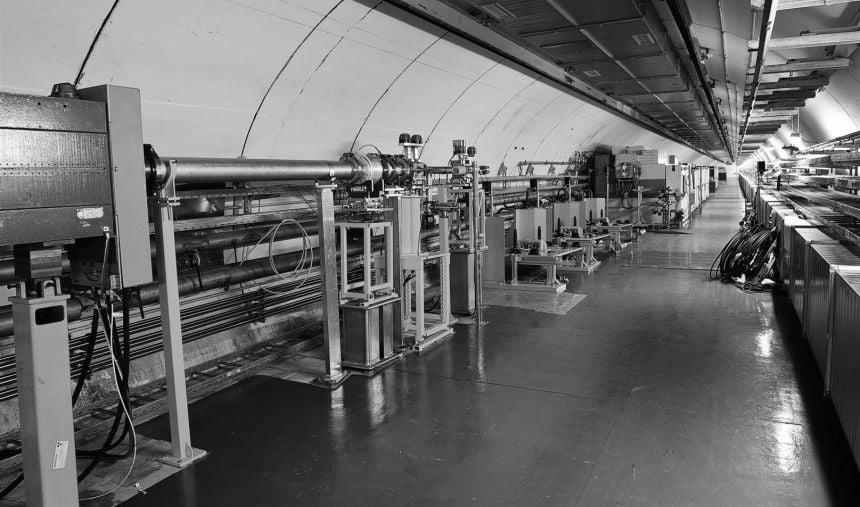 The HiRadMat (High Radiation to Materials) facility at CERN. ©CERN
This is the first time we have been able to observe – non-destructively and in real time – how an actual meteorite sample deforms, strengthens and adapts under extreme conditions.
Professor Gianluca Gregori (Department of Physics, University of Oxford)
Study co-author Professor Gianluca Gregori (Department of Physics, University of Oxford) said: ‘Until now, we have relied heavily on simulations and static laboratory tests to understand how asteroid materials behave under impact or radiation. This is the first time we have been able to observe – non-destructively and in real time – how an actual meteorite sample deforms, strengthens and adapts under extreme conditions.’
The study addresses a long-standing challenge in planetary defence science: discrepancies between laboratory measurements of meteorite strength and the much lower values inferred from how meteors break up in Earth’s atmosphere. The new data show that these differences can be explained by how stress is internally redistributed across the heterogeneous microstructure of meteorites.
The study was developed in partnership with the Outer Solar System Company (OuSoCo), which is investigating the feasibility of in-space high-energy proton beam systems.
The paper ‘Dynamical development of strength and stability of asteroid material under 440 GeV proton beam irradiation’ has been published in Nature Communications.
For more information about this story or republishing this content, please contact [email protected]
“The University of Oxford is a collegiate research university in Oxford, England. There is evidence of teaching as early as 1096, making it the oldest university in the English-speaking world and the world’s second-oldest university in continuous operation.”
Please visit the firm link to site