

Around 4600 years ago, the Shijiahe developed an advanced, complex culture in China’s Middle Yangtze River region – complete with palaces, city walls, sophisticated water management, and jade and pottery industries. But within a thousand years, this culture had collapsed and migrated out of the region. Until now, the reason behind this was unclear – could this civilization have been driven out by raiders from the Central Plains? Or were major changes in climate and rainfall to blame?
To investigate, the research team analysed a stalagmite from Heshang Cave in the middle Yangtze Valley to create a precisely dated “rainfall yearbook”. Stalagmites grow as rainwater droplets fall from the roof of a cave, and the dissolved minerals within deposit new layers of calcium carbonate. These accumulate to form stalagmite cave features that rise up from the floor below.
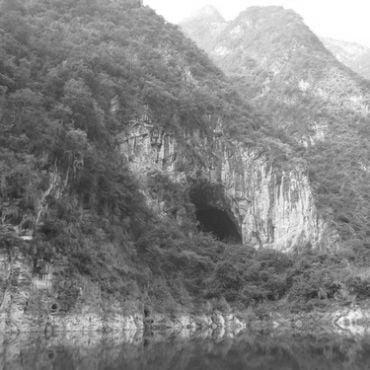 Heshang Cave, in the middle Yangtze River valley
The team performed high-precision measurements on the chemical makeup of these layers to determine their age and the amount of rainfall at the time they formed. A total of 925 sample measurements were used to infer how much yearly rainfall the middle Yangtze Valley received over a thousand-year period.
Their reconstruction showed that the valley experienced three low-rainfall intervals (less than 700 mm of rain per year) which lasted between 40 and 150 years, and two high-rainfall intervals (more than 1,000 mm per year) which lasted 80 and 140 years respectively. Comparing this to archaeological data from the region revealed that these high-rainfall periods were associated with increased flooding, widespread wetland expansion, and a significant decline in population within the valley.
The area experienced a particularly large climate and cultural shift 3,950 years ago, which coincided with the start of the longest high-rainfall interval reconstructed by the research team. During this period, excess rainfall caused lakes across the Middle Yangtze valley to expand, low-lying areas to become waterlogged, and suitable land for settlement and farming to sharply diminish. The impact of this change was significant for the Shijiahe culture; a decline in the number of archaeological remains from this time onwards indicates a pronounced drop in population which persisted for centuries. Evidence suggests that the post-Shijiahe population abandoned their urban centre in the valley and dispersed into surrounding higher elevation regions.
The work builds on Oxford’s ‘Environmental Proxies’ and ‘Climotope’ research groups’ leading excellence in pioneering and developing quantitative reconstructions of past environments. This includes ongoing research into new geochemical techniques, and continued development of mass-spectrometry and geochemistry approaches. For instance, these groups were the first to pioneer the use of calcium isotope measurements of cave stalagmites to reconstruct rainfall amount, in readily understood units (i.e. mm of rainfall per year).
Corresponding author Dr Christopher Day (Department of Earth Sciences) said: ‘It is fabulous to see this 1000-year record of rainfall-amount now available to the scientific community. Such robust data sets are fundamental for understanding the functioning of our environmental systems in times of rapid change. They also enable close collaboration with a multitude of University of Oxford research teams working to tackle environmental challenges (e.g. environmental scientists, archaeologists, climate modellers).’
The new study stems from a long-standing collaboration between Oxford and a leading paleoclimate group at China University of Geosciences, Wuhan. This enabled lead author Dr Jin Liao (China University of Geosciences) to visit the Oxford team and use their specialist milling equipment to sample a stalagmite at very-high resolution. Isotope tools developed here in Oxford were then applied to provide accurate dates and a quantitative reconstruction of past rainfall.
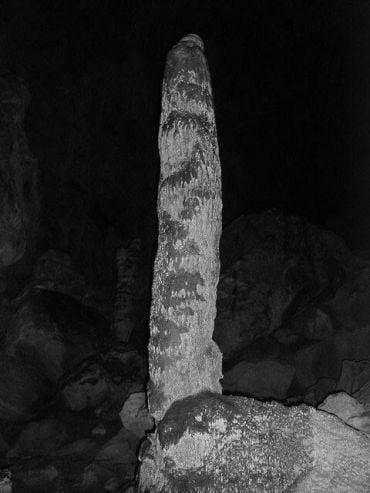 The HS4 stalagmite which was used to create the ‘rainfall yearbook’
Co-author Professor Gideon Henderson (Department of Earth Sciences) said: ‘We’ve worked with our Chinese colleagues to understand Chinese climate change for many years, but only recently extended this work to assess how past societies in central China were impacted by changes in monsoon rainfall. The data, and the knowledge Jin brought about the Shijiahe culture, enabled us to demonstrate, for one of the first times, that high rain can cause problems for past societies, as well as drought conditions.’
According to the researchers, the findings offer valuable insights for addressing current and future environmental change. The analysis reveals that even the highest annual levels of rainfall during the period associated with the collapse of the Shijiahe civilization (1200 mm/yr) are lower than the highest yearly rainfall amounts recorded over the past 120 years (1500 mm/yr). Although modern water-management techniques have enabled this region to become a key rice-producing region in China, rising temperatures due to climate change are likely to increase the intensity of extreme floods, putting local populations at risk.
Dr. Jin Liao (China University of Geosciences, Wuhan), lead author of the study, said: ‘This not only reflects the limited adaptive capacity of ancient societies, but also highlights the critical importance of modern-day water management infrastructure, agricultural innovations, and governance systems in mitigating climate risks and safeguarding food security. Effectively managing these climate-driven extremes will thus become an essential challenge for achieving sustainable societal development in a climate-changing world.’
The study ‘Precise chronology of hydrological changes at ∼4.2 kyr in Central China to assess the impact of flooding on Neolithic societies’ has been published in National Science Review.
For more information about this story or republishing this content, please contact [email protected]
“The University of Oxford is a collegiate research university in Oxford, England. There is evidence of teaching as early as 1096, making it the oldest university in the English-speaking world and the world’s second-oldest university in continuous operation.”
Please visit the firm link to site