

By James Pennington, Global Sustainability Services Director, Lenovo
Sustainability continues to be listed among the top priorities for global business leaders, and spending on it is increasing. But is it always clear how businesses can plan, deliver, and measure the positive impact that they aim for?
Getting sustainability right isn’t easy. Environmental impact is shaped by thousands – maybe millions – of decisions made across the IT lifecycle. This is from how devices are designed and manufactured to how they’re used, repaired and eventually recovered. When those decisions are disconnected and disjointed, progress can end up being slow and hard to measure.
That’s why Lenovo’s circular economy strategy is structured around the R.E.A.L. Framework, an operating model that connects design, materials, business models, and lifecycle data into a single system.
R.E.A.L. stands for:
- Responsible Design – Embedding circularity into product architecture from the outset, ensuring durability, repairability, and lifecycle value are engineered in.
- Ethical Materials – Scaling recycled and renewable inputs to reduce reliance on virgin resources.
- Accountable Models – Aligning incentives with longevity and recovery through service-based and lifecycle-driven offerings.
- Lifecycle Intelligence – Using component-level data and advanced analytics to measure, compare, and optimize environmental impact before products are built.
Together, these pillars move circularity from aspiration to execution – ensuring that sustainability decisions are intentional, measurable, and economically aligned across the full IT lifecycle.
Addressing environmental impact at the start of the journey
The first step towards turning sustainability ambition into action is realizing that the environmental footprint of IT is determined long before a device reaches a customer. Overproduction, excess inventory, inefficient logistics and misidentified parts can quietly drive waste and emissions at scale. To tackle this, Lenovo has been transforming its global supply chain using AI and advanced technologies that allow better decisions earlier in the process.
At the core is our Planning Decision Center (PDC), which is an AI-driven forecasting ecosystem that replaces reactive, historical planning with real-time insight. This means businesses can anticipate demand more accurately. PDC reduces excess and obsolete inventory, unnecessary inter-warehouse transfers and overproduction.
Alongside this, Lenovo’s AI Sub System improves parts identification accuracy, which makes sure that the right component reaches the right device the first time. Ultimately, this reduces returns, extra shipments and waste.
Advanced technologies such as AR/VR are also helping cut emissions during service and logistics. AR/VR self-repair guidance enables many repairs to be completed remotely, avoiding engineer travel and saving time and money with transportation. Then we also have Smart Packaging which uses AI to optimize carton configuration, reducing packaging materials usage by over 35% and related carbon emissions by 50,000 kgs.
Rethinking how organizations consume and manage IT
Even with a more efficient supply chain, the way organizations procure and manage devices has a significant impact on sustainability. Traditional ownership models often lead to over-purchasing, short refresh cycles and fragmented end-of-life processes.
Last year, we launched Lenovo TruScale Device as a Service (DaaS) for Sustainability which was designed to address this challenge by rethinking the relationship between organizations and their technology. Instead of buying devices outright, customers subscribe to technology through a flexible, pay-as-you-go model.
Lenovo manages deployment, support, maintenance and responsible end-of-life recovery, shifting lifecycle responsibility away from customers and embedding sustainability into every stage.
What makes TruScale DaaS for Sustainability different is its modular sustainability stack. Customers can combine services such as carbon tracking through the Carbon Impact Portal, Lenovo Certified Refurbished devices, CO₂ Offset Services, and Asset Recovery Services into bundles aligned to their specific sustainability goals.
Customers adopting as a service models have seen up to 35% reductions in device-related IT costs and meaningful progress toward both financial and environmental targets.
Turning IT end-of-life into a circular advantage
The final stage of the IT lifecycle is often where sustainability efforts break down. Device retirement. This can be fragmented, manual and compliance-heavy, leading to premature disposal and data risk.
Lenovo Asset Recovery Services (ARS) addresses this head-on. Operating across 49 markets globally, ARS provides a brand-agnostic, end-to-end recovery service covering logistics, certified data erasure, refurbishment, recycling and transparent reporting.
Since 2020, Lenovo has helped customers reuse or recycle more than 94,000 metric tons of IT equipment, with 71% of collected devices refurbished or reused for parts.
Recent innovations have made ARS even more impactful. Prepaid ARS credits allow organizations to plan circularity in advance, rather than reacting to decommissioning need. The Intelligent Asset Manager within Lenovo Service Connect replaces manual spreadsheets with real-time visibility, allowing customers to track assets, schedule pickups and access compliance and impact reports instantly.
Together, these capabilities turn IT end-of-life from a risk and cost center into a strategic contributor to sustainability and value recovery.
Built upon R.E.A.L, recognized by SEAL
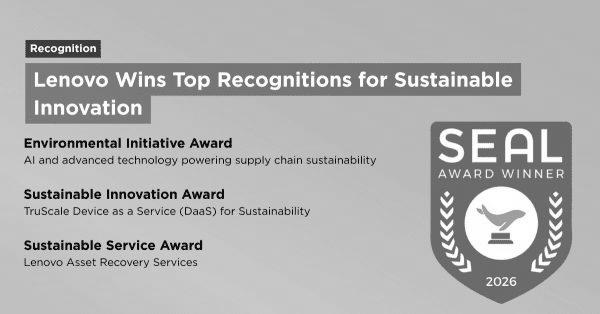
The measurable impact, driven by our R.E.A.L approach to sustainability, has led to Lenovo recently be recognized at the SEAL Business Awards 2026. We were honored across three categories: Environmental Initiatives (Lenovo’s AI and advanced technology powering the supply chain), Sustainable Innovation (Lenovo TruScale Device as a Service for Sustainability) and Sustainable Service (Lenovo Asset Recovery Services).
Lenovo was pleased to be listed among other reputable honorees ranging from global infrastructure and industrial leaders to fast-growing climate and sustainability innovators.
The challenges facing businesses are only intensifying. However, through Lenovo’s supply chain intelligence and IT circularity services, organizations can turn sustainability ambition into measurable action.
For more information about Lenovo Sustainability Solutions, visit:
https://www.lenovo.com/us/en/solutions/sustainability-solutions/
Lenovo StoryHub
Please visit the firm link to site