

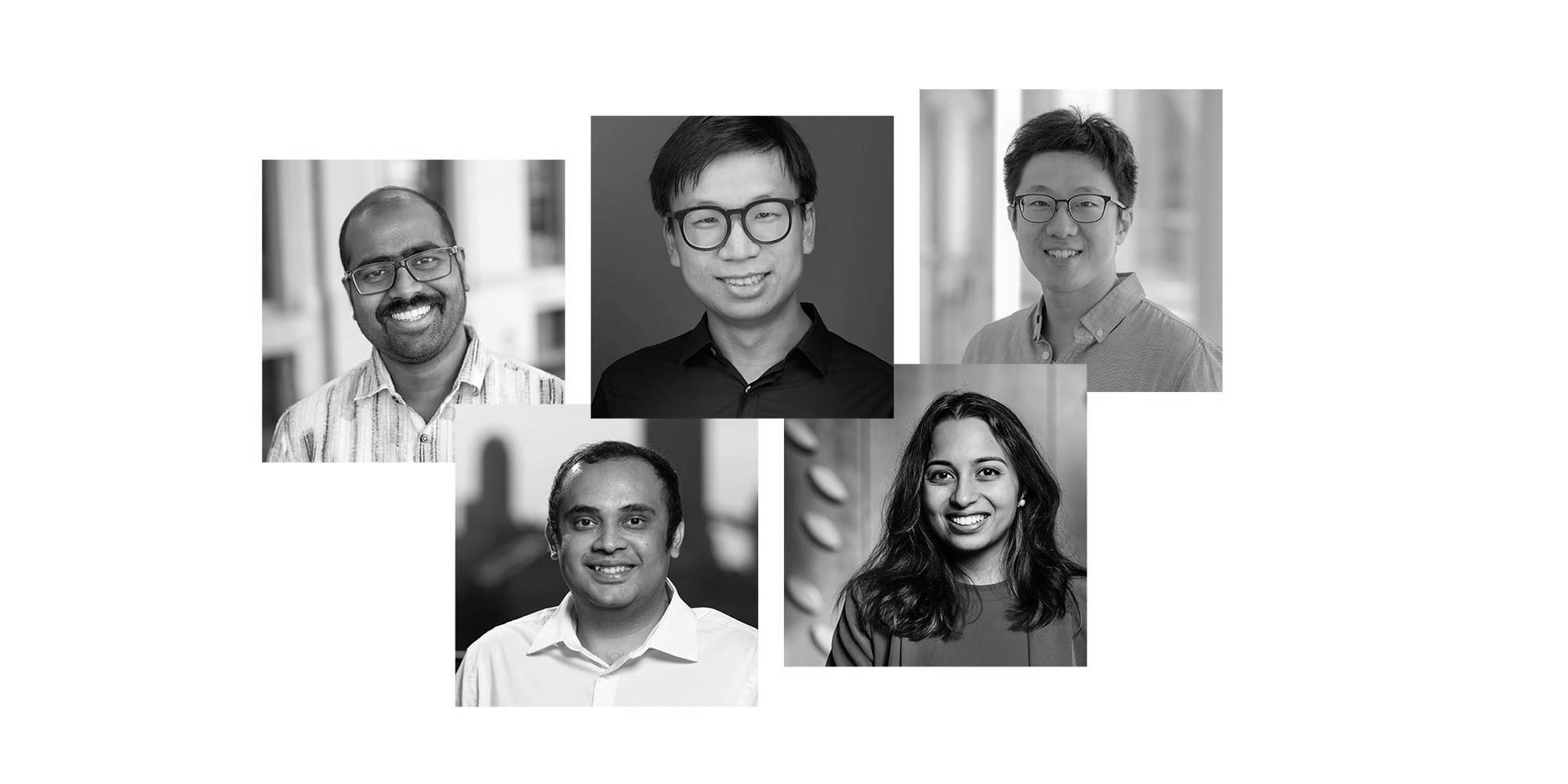
Five Carnegie Mellon University faculty members from the School of Computer Science(opens in new window), Mellon College of Science(opens in new window) and Dietrich College of Humanities and Social Sciences(opens in new window) are among the 126 recipients of 2026 Sloan Research Fellowships, which honor early career scholars whose achievements put them among the best scientific minds working today.
Christopher Eur(opens in new window), an assistant professor in the Department of Mathematical Sciences(opens in new window), Aayush Jain(opens in new window), assistant professor in the Computer Science Department(opens in new window); Arun Kumar Kuchibhotla(opens in new window), associate professor in the Department of Statistics & Data Science(opens in new window); Aditi Raghunathan(opens in new window), assistant professor in the Computer Science Department and Jun-Yan Zhu(opens in new window), Michael B. Donohue Assistant Professor of Computer Science and Robotics(opens in new window), are part of a cohort drawn from 44 institutions across the United States and Canada.
“The Sloan Research Fellows are among the most promising early-career researchers in the U.S. and Canada, already driving meaningful progress in their respective disciplines,” said Stacie Bloom, president and chief executive officer of the Alfred P. Sloan Foundation. “We look forward to seeing how these exceptional scholars continue to unlock new scientific advancements, redefine their fields, and foster the wellbeing and knowledge of all.”
A Sloan Research Fellowship is one of the most prestigious awards available to young researchers, in part because so many past Fellows have gone on to become distinguished figures in science.
Since the first Sloan Research Fellowships were awarded in 1955, 78 faculty from Carnegie Mellon University have received a Sloan Research Fellowship.
A full list of the 2026 fellows(opens in new window) is available online.
Christopher Eur
Eur’s research focuses on algebraic geometry and its intersection with combinatorics, the study of counting of objects. He takes a particular interest in matroid theory, a way mathematicians describe the property of independence in a space, with uses across mathematics, physics, computer science and more. In 2023, Eur was awarded National Science Foundation funding to further understanding of matroid theory. He is delving deeper into discrete structures through geometry, and probes the boundary between the two. His project, “Positive Vector Bundles in Combinatorics,” applies algebraic geometry to understand combinatorial objects. The research seeks to understand objects like graphs and matchings through the geometric constructions called positive vector bundles.
Aayush Jain
Aayush Jain studies theoretical and applied cryptography and its connections with related areas of theoretical computer science. His research investigates the mathematical foundations that make modern cryptography secure, with a focus on identifying new and underexplored sources of computational hardness. Jain aims to strengthen the long-term security of encrypted computation and address critical gaps in post-quantum cryptography. He also trains graduate students in foundational cryptographic theory.
Arun Kumar Kuchibhotla
Arun Kumar Kuchibhotla’s research addresses foundational challenges in statistical inference and predictive learning. Kuchibhotla’s work has many applications in machine learning and artificial intelligence, and he specializes in the development of robust, “assumption-lean” frameworks for uncertainty quantification. His research also has utility in financial time series forecasting and significance testing in causal inference under potential interference. Kuchibhotla develops “honest inference” procedures — like the Hull-based Confidence Method, or HulC — that remain valid in high-dimensional and irregular settings where classical tools, like the bootstrap or Wald intervals, frequently fail.
Aditi Raghunathan
Aditi Raghunathan focuses on identifying where and understanding why AI systems fail, and building models that remain safe, accurate and dependable in real-world settings. Raghunathan’s work helps ensure that advanced AI can be trusted by identifying hidden weaknesses in how systems are trained and tested. She leads the AI Reliability Lab, which builds reliable, aligned and trustworthy AI through rigorous analysis and principled methods. Raghunathan’s work has earned awards at prestigious conferences and continues to help shed light on responsible AI system design and deployment.
Jun-Yan Zhu
Jun-Yan Zhu’s research develops human-centric generative AI frameworks that give creators greater control over model outputs, allow them to adapt models for new use cases, and support fair credit for creators whose work contributes to AI training. Zhu leads the Generative Intelligence Lab, where students and researchers use generative models to empower human creators, bringing them from the digital world into the physical world and making them more accessible to everyone.
“Carnegie Mellon University is a private research university in Pittsburgh, Pennsylvania. The institution was originally established in 1900 by Andrew Carnegie as the Carnegie Technical School. In 1912, it became the Carnegie Institute of Technology and began granting four-year degrees.”
Please visit the firm link to site