

No matter how carefully it’s crafted, regulation has unintended consequences. When daycares tried to curb tardiness by charging parents who showed up late to get their children, the number of tardy parents doubled. Attempts to reduce housing discrimination by forbidding landlords from conducting criminal background checks appear to actually increase discrimination against Black men.
“What we do as researchers is look into the unobvious consequences of regulation,” says Professor Raphael Duguay. “Whatever the intended goal of a regulation, we are curious about outcomes that the policymaker or regulator perhaps didn’t anticipate.”
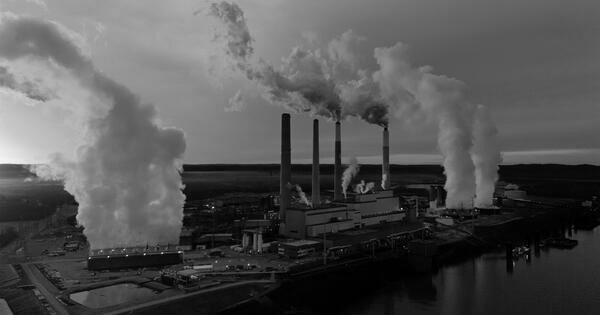
It has been established, for instance, that the federal Greenhouse Gas Reporting Program (GHGRP), which requires companies with greenhouse gas emissions above a certain threshold to report them, is effective at its stated goal: decreasing emissions. A newly published study by Yale SOM postdoctoral scholar Chenchen Li, Professor Frank Zhang, and Duguay, however, also demonstrates that the GHGRP has a secondary effect: encouraging the formation of new businesses.
The GHGRP, which took effect in 2010, requires any facility that emits more than 25,000 metric tons of carbon dioxide equivalent per year to report these emissions on an annual basis. To examine the program’s effect on business creation, the researchers gathered county-level data from the Statistics of U.S. Business database, which categorizes businesses by sector. They started their collection in 2009, three years before the GHGRP began, and ended in 2014, three years after its inception. The data shows that business births increase by about 3% in regulated sectors after the introduction of the GHGRP, compared to a control group of industries, like arts and entertainment, that generate minimal greenhouse gases and do not meet reporting thresholds.
The researchers find two distinct mechanisms that explain new business formation. The first has to do with a reduction in production by incumbent firms.
“As the Reporting Program got underway and companies had to report their emissions, those who pollute were pressured and shamed by the media and other campaigns to pollute less,” Duguay says. These companies tended to divert some of their revenue to research and development, or to investment in lower-emissions technologies. “This creates opportunity for other companies to enter, as supply drops and prices go up.”
The second mechanism has to do with the kind of information that is disclosed under the GHGRP, which covers not only carbon dioxide, but other pollutants, like methane. Because many manufacturing processes are governed by fixed chemical equations, competitors can use disclosure to reverse-engineer how much of something a company is producing and which methods they are using to produce it. This gives entrepreneurs valuable—and otherwise proprietary—insight into a market.
The researchers’ findings come in the wake of a 2025 announcement by the Environmental Protection Agency that EPA would seek to repeal the GHGRP. In announcing the move, EPA administrator Lee Zeldin said that the reporting program “does nothing to improve air quality.” Instead, he went on, “it costs American businesses and manufacturing billions of dollars, driving up the cost of living, jeopardizing our nation’s prosperity and hurting American communities.”
The new study does, in fact, reveal some ambiguity about the environmental benefits of the GHGRP. Prior work examining the GHGRP and other transparency initiatives like it has focused on existing firms. “In that picture, it looks like total emissions are going down, but, in reality, we don’t know how much this change is being offset by pollution from the smaller facilities,” Duguay says. “We can’t observe their emissions.”
Remember, the GHGRP only requires companies that emit more than 25,000 metric tons to report their numbers. That is a significant amount of emissions; the researchers find that the median firm in their sample crosses this threshold 16 years after its initial public offering, which itself often comes several years after the company’s founding. In short, new companies can fly under the radar of the GHGRP for roughly two decades before their emissions are counted.
“These new companies would be polluting all during that time, displacing some of the benefits we see from the GHGRP, but we can’t observe this displacement,” Duguay says. “This is an important blind spot in the policy.”
But Zeldin’s assertions about the economic effects of the GHGRP aren’t borne out by the study. Duguay notes that the creation of new businesses leads to fiercer competition.
“Business entry is a popular measure for economists, as it ties into competition, and more competition usually means more productivity and better prices for consumers. It’s good for the economy generally,” Duguay says. “If some policy causes more entries—and the GHGRP does this—then we can generally expect certain economic benefits to follow.”
“The Yale School of Management is the graduate business school of Yale University, a private research university in New Haven, Connecticut.”
Please visit the firm link to site