


Downed power lines, flooding and collapsed buildings are dangerous obstacles emergency responders must navigate when searching for survivors of catastrophic events. But robots that can overcome these challenges could save lives without putting human rescuers at risk. Soon, search-and-rescue robotics researchers at Carnegie Mellon University will be able to build on their work at the Robotics Innovation Center(opens in new window) (RIC) to test their inventions.
Flying robots to the rescue
Researchers at CMU’s Airlab(opens in new window) are building smarter drones to help out from above during emergencies.

“Drone swarms are a hot topic in our research right now and could have search-and-rescue implications,” said Steven Willits(opens in new window), a project scientist at the Robotics Institute(opens in new window)‘s Airlab. “Think about what happens in the movies when rescuers look for somebody lost in the woods. They create a human line of people and all start walking and looking for the missing person. You can do something similar if you have a swarm of drones with day and night vision cameras and you spread them out over a certain area. That could be an important use of this technology.”
Researchers at Airlab develop autonomous drones that work together to explore outdoor areas, inside buildings, and even underground caves and mines. These drones act as scouts, communicating vital data to help rescue teams stay safe after disasters like earthquakes.
The drones navigate by processing data from sensors like cameras and LiDAR to track their relative locations and identifying features such as a person, object, or the paths forward like going through doorways. Additional sensors for collecting biometric and environmental data may also be used. In this way, rescuers can have situational awareness of where to go or what to expect when they arrive on scene.
[embedded content]
Willits said he’s excited about using the RIC’s two new large drone cages for testing. The indoor cage is equipped with motion capture cameras for tracking and recording drone motions in 3D space with sub-millimeter level accuracy. The outdoor drone cage can safely test much larger drones using real-time kinetic GPS to achieve centimeter-level accuracy.
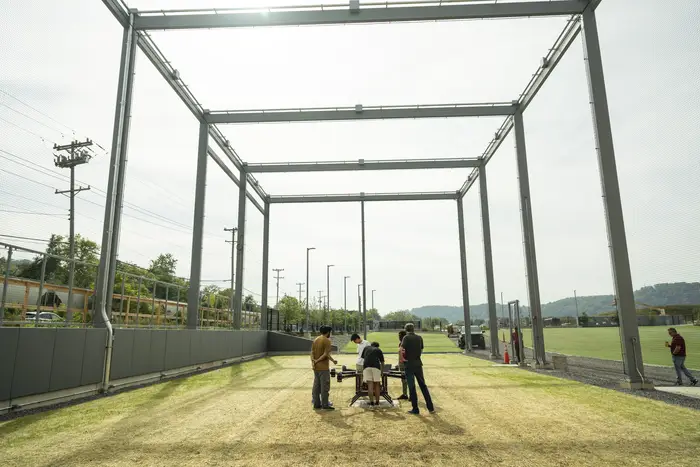
“We need that accuracy to get a good baseline of a drone’s capabilities and how precise its movements can be before we test it in other real-world scenarios such as cluttered environments where collisions could occur if not navigated accurately,” Willits said. “Having an infrastructure there that can provide those kinds of things is a big advantage.”
Robots that climb cliffs and dig through debris
Robots can also help search-and-rescue teams access disaster scenes on the ground.

“If a person can’t get somewhere safely, a robot is a compelling option,” said Aaron Johnson(opens in new window), a professor of Mechanical Engineering(opens in new window) at the College of Engineering(opens in new window) who works on search-and-rescue robotics. “Someone might be stranded on a steep cliff or trapped underneath rubble that a human rescuer just can’t get to.”
Johnson and his collaborators focus on the places that are most hard-to-reach after a natural disaster. They make robots that can handle the mobility challenges that come with these scenarios. Last year, they created Zippy, the world’s smallest, fastest two-legged robot(opens in new window). At just 1.5 inches tall, it can navigate small spaces that often come with emergency situations.
“For search and rescue, size is often a constraint,” Johnson said. “It fits through places a dog or even other robots can’t reach. We were really excited about that.”
Zippy has rounded feet and weighted arms, and walks by lifting its front leg and shifting its center of gravity forward. That momentum creates enough space for Zippy’s other leg to swing and take a step forward.
[embedded content]
“The key thing for search-and-rescue robots is access,” Johnson said. “Where can you get in? How can you get in safely? And what kind of equipment — like cameras and microphones — can you bring along to gather important information?”
Johnson said the Robotics Innovation Center will make it easy to test robots in an outside environment.
“The outdoor running room is what I’m most excited about,” Johnson said. “We’ll be able to set up outdoor tests and play with different kinds of terrain. We can plant real bushes and trees and make scenarios that are very realistic.”
“Carnegie Mellon University is a private research university in Pittsburgh, Pennsylvania. The institution was originally established in 1900 by Andrew Carnegie as the Carnegie Technical School. In 1912, it became the Carnegie Institute of Technology and began granting four-year degrees.”
Please visit the firm link to site