

Using samples from the Apollo missions, the researchers found that at times the Moon had an extremely strong magnetic field- even stronger than Earth’s. But these periods were very short and the exception – for most of the time, the Moon had a weak field.
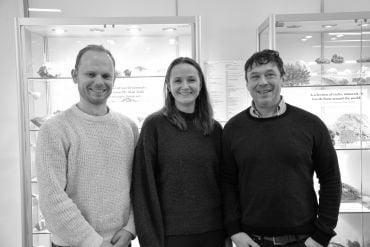 From left to right: Dr Simon Stephenson, Professor Claire Nichols, Associate Professor Jon Wade. Credit: Charlie Rex.
The reason the debate persisted is because the Apollo missions all landed in the same place, with a high concentration of rocks that happened to capture these rare events of strong magnetism.
Lead author Associate Professor Claire Nichols (Department of Earth Sciences, University of Oxford) said: ‘Our new study suggests that the Apollo samples are biased to extremely rare events that lasted a few thousand years – but up to now, these have been interpreted as representing 0.5 billion years of lunar history. It now seems that a sampling bias prevented us from realising how short and rare these strong magnetism events were.’
Despite the strong magnetism of the Apollo lunar samples, many scientists believed that the Moon could only have a weak or non-existent magnetic field, arguing that the relatively small size of the Moon’s core (around 1/7th of its radius) prevented it from generating a strong field. However, the new study proposes a mechanism for how a strong field could be temporarily generated and preserved.
The research team analysed the chemical makeup of a type of lunar rock – known as the Mare basalts – and found a new correlation between their titanium content and how strongly magnetised they are. Every lunar sample which had recorded a strong magnetic field also contained large amounts of titanium – and the samples containing less than 6 wt.% titanium were all associated with a weak magnetic field.
We now believe that for the vast majority of the Moon’s history, its magnetic field has been weak, which is consistent with our understanding of dynamo theory. But that for very short periods of time – no more than 5,000 years, but possibly as short as a few decades – melting of titanium-rich rocks at the Moon’s core-mantle boundary resulted in the generation of a very strong field.
Associate Professor Claire Nichols, Department of Earth Sciences
This suggests that the formation of high-titanium rocks and the generation of a strong lunar magnetic field are linked. The researchers believe that both were caused by melting of titanium-rich material deep inside the Moon, temporarily generating a very strong magnetic field.
Because the Mare basalts were an ideal landing site for the Apollo missions, due to being relatively flat, the astronauts brought back far more of the titanium-rich basalts (containing evidence for a strong magnetic field) than are representative of the lunar surface. As a result, large numbers of these rocks have been analysed by scientists back on Earth, and this was previously interpreted to mean that the lunar magnetic field was strong for long periods of its history.
Models developed as part of this study confirm this bias, and suggest that if a random suite of samples were measured, it would be almost impossible for any of them to have recorded such rare strong magnetic field events.
Co-author Associate Professor Jon Wade (Department of Earth Sciences, University of Oxford) said: ‘If we were aliens exploring the Earth, and had landed here just six times, we would probably have a similar sampling bias especially if we were selecting a flat surface to land on. It was only by chance that the Apollo missions focussed so much on the Mare region of the Moon – if they landed somewhere else, we would likely have concluded that the Moon only ever had a weak magnetic field and missed this important part of early lunar history entirely.’
Co-author Dr Simon Stephenson (Department of Earth Sciences, University of Oxford) added: ‘We are now able to predict which types of samples will preserve which magnetic field strengths on the Moon. The upcoming Artemis missions offer us an opportunity to test this hypothesis and delve further into the history of the lunar magnetic field.’
The study ‘An intermittent dynamo linked to high-titanium volcanism on the Moon’ has been published in Nature Geoscience.
For more information about this story or republishing this content, please contact [email protected]
“The University of Oxford is a collegiate research university in Oxford, England. There is evidence of teaching as early as 1096, making it the oldest university in the English-speaking world and the world’s second-oldest university in continuous operation.”
Please visit the firm link to site