



“Today, this facility is bringing state-of-the-art infrastructure together with the ability to tap into the nation’s and region’s most comprehensive regional network of robotics testing sites. And it demonstrates how a university can invest locally and meet national needs while enhancing our economic competitiveness and national security,” CMU President Farnam Jahanian said. “What excites me most about this space is the serendipity it will spark: Researchers crossing paths with entrepreneurs, students learning alongside practitioners, ideas conceived of and brought to reality in indoor, outdoor, aquatic and virtual environments. Because breakthroughs rarely happen in isolation. They happen in communities of brilliant thinkers, dreamers and do-ers. This building, and this site, was designed to make those collisions possible.”
The facility features a variety of specific research-enabled spaces, including an open layout wet lab, 75,000-gallon water tank, reconfigurable high bays, a 1.5-acre, large-footprint outdoor lab with a 6,000-square-foot drone cage, tens of thousands of square feet of additional indoor testing space and space for additional corporate partners.
Aside from the physical spaces, the RIC will also complement the work of CMU’s National Robotics Engineering Center(opens in new window) and the university’s Manufacturing Futures Institute(opens in new window). The new facility will also encourage more workforce and economic development through stronger partnerships with the Advanced Robotics for Manufacturing Institute(opens in new window), Catalyst Connection(opens in new window) next door at Mill 19 and the University of Pittsburgh’s BioForge(opens in new window).

“When I was a student here, robotics was still a fledgling field, and few could have imagined the scale of impact and leadership CMU would have in the world,” said David Coulter, chair of the CMU Board of Trustees. “Yet through collective vision, persistence and bold leadership, this university built modern robotics. From pioneering autonomous vehicles and space robotics to transforming manufacturing, health care and national security, CMU researchers and students have consistently asked — and answered — the most complex questions. This new Robotics Innovation Center ensures that we will continue to lead well into the future.”
Investment spurs innovation
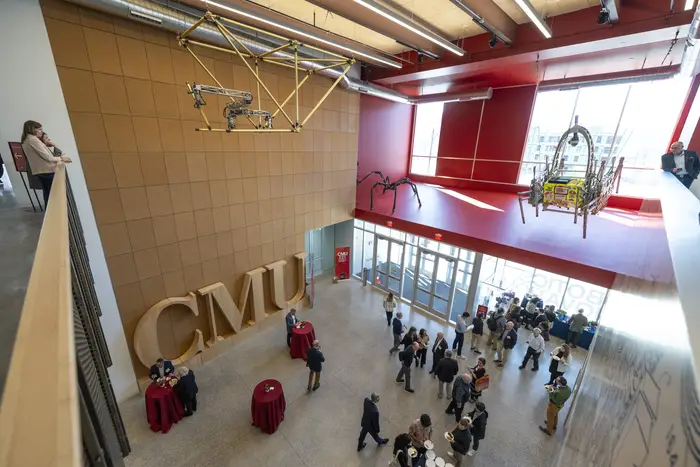
Developers broke ground on the RIC in late 2023 and construction, supported by a $45 million lead grant from the Richard King Mellon Foundation(opens in new window), began in January 2024. The final steel beam, forged in Pennsylvania and signed in July that year, is now visible as part of the second-floor ceiling structure, symbolizing the project’s comprehensive purpose.

“The Trustees of the Richard King Mellon Foundation approved this extraordinary grant because of our conviction that Pittsburgh’s rightful place is to lead, nationally and internationally, in the most promising economic sectors of our time,” said Sam Reiman, director of the Richard King Mellon Foundation. “Thanks to Carnegie Mellon University’s unmatched stature in robotics, the RIC will put Pittsburgh at its vanguard. When people want to see the future of robotics, they will look to Pittsburgh. That leadership will create widespread economic-development benefits for the greater Pittsburgh region. And it will help to create greater prosperity for Hazelwood — a community that helped to lead the nation’s technological revolution in centuries past, and now is poised to do so once again.”
The project has also received generous support from the Heinz Endowments, Claude Worthington Benedum Foundation and numerous other partners. Investments in resources like the RIC now to make a deeper impact tomorrow are just one way CMU fosters support and develops partnerships from across the nation and region, including those in the innovation ecosystem that turn research and ideas into for-profit companies to accelerate progress. CMU-spurred startups have a cumulative value of more than $650 billion and have raised more than $40 billion.

“None of this would be possible without the extraordinary generosity of our supporters,” said David Bennett, vice president for University Advancement. “We are especially grateful for the leadership of the Richard King Mellon Foundation, whose commitment to innovation and to this region helped make the Robotics Innovation Center a reality. We are also thankful to the many donors, partners and trustees whose belief in CMU’s mission continues to move us forward as an institution committed to changing the world for the better.”
Physical AI(opens in new window) will be critical in boosting future economic growth of the United States. Innovations created at the RIC will ensure the Pittsburgh region is well-positioned to lead in this space.
CMU’s Campus Design and Facility Development staff worked in conjunction with the following organizations to complete the project:
- Perkins Eastman, Pittsburgh, PA – Principal Architect (Prime Designer)
- Gilbane Mosites Joint Venture, Pittsburgh, PA – Construction Manager
- Tishman Speyer, Pittsburgh, PA – Developer
“Pittsburgh has always been a place of innovation, and the Robotics Innovation Center carries that legacy forward. At Perkins Eastman, we are proud to have designed the RIC as a flexible, high-performance environment that can evolve with the rapid pace of AI and robotics research. Congratulations to CMU — the RIC is an exciting new chapter in the University’s — and Pittsburgh’s — story of innovation.”
— Jeff Young, AIA, executive director at Perkins Eastman and managing principal of the firm’s Pittsburgh studio
“Carnegie Mellon University continues to set the standard for innovation while remaining deeply committed to developing and retaining local talent. The Robotics Innovation Center reflects that balance, pairing world-class research with a strong workforce development focus that engaged local contractors, trades and community partners. Mosites was proud to partner with CMU in supporting and advancing this mission. It’s exciting to see a project that not only advances innovation but also strengthens the region’s workforce and future. Projects like this ensure that Pittsburgh’s innovation economy is built by and for the people of this region.”
— John Wattick, vice president of preconstruction, Gilbane | Mosites
“Pittsburgh has built a legacy of innovation and reinvention, driven in large part by the investment and collaboration of leading local institutions such as Carnegie Mellon University and the Richard King Mellon Foundation. CMU’s Robotics Innovation Center is a cornerstone of the sustainable hub of discovery and community we are building together at Hazelwood Green.”
— Nooshin Felsenthal, managing director, Tishman Speyer
“Carnegie Mellon University is a private research university in Pittsburgh, Pennsylvania. The institution was originally established in 1900 by Andrew Carnegie as the Carnegie Technical School. In 1912, it became the Carnegie Institute of Technology and began granting four-year degrees.”
Please visit the firm link to site