

“Pittsburgh’s strength has always been translating ideas into impact,” said Farnam Jahanian(opens in new window), president of Carnegie Mellon University. “With the NFL Draft coming to our city, it is a fitting moment to highlight how sport — through play, performance, engagement, and entertainment — has become a proving ground for the next era of AI. There is no better place to tell that story than the Robotics Innovation Center, where CMU is convening partners to advance AI systems that are reshaping every sector of our economy and ensuring that its benefits are shared broadly across communities, industries and society.”
The RIC is a cornerstone of Carnegie Mellon’s global leadership in AI, robotics and autonomy. Purpose-built to support large-scale experimentation, industry collaboration and real-world testing, the RIC brings together researchers, startups and partners working across robotics, simulation, digital twins, intelligent infrastructure and AI systems that interact continuously with the physical world.
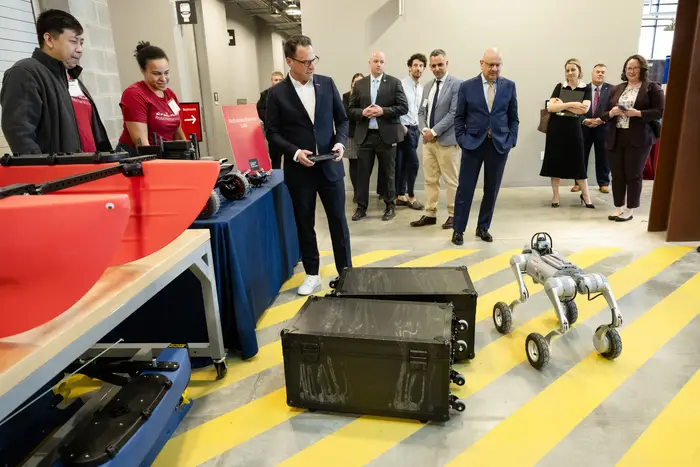
This work is often referred to as physical AI — a class of AI that moves beyond pre-programmed systems to sense, reason and adapt in dynamic environments. At Carnegie Mellon, leadership in this domain is defined not by hardware alone, but by software-driven intelligence deployed reliably at scale.
A National Convening with Long-Term Impact
Building on the AI Strike Team’s flagship platform, AI Horizons, the Draft Week Showcase brings Pittsburgh’s AI ecosystem into the national spotlight.
“Artificial intelligence is transforming the NFL, with millions of data points each game reshaping how teams compete and how fans engage,” said Steelers Vice President of Strategy Dan Rooney. “It’s fitting that the NFL Draft is coming to Pittsburgh at such a pivotal technological and economic moment. Built on steel and reinvented through robotics and AI, this region is leading again. Today, we are the Steel and AI City, and the Steelers are proud to help showcase how Pittsburgh is shaping the future of sport and technology.”
Aligned with the Draft, the invitation-only, three-hour program convenes founders, investors, technologists, and Pittsburgh diaspora leaders — alongside executives from government, industry, academia and professional sports — for live demonstrations and senior-level discussions on AI deployment, performance and competitive edge.
A centerpiece of the Draft Week Showcase will be finalist pitches for the $1.275 million prize, a national startup competition spotlighting companies deploying AI in real-world environments across performance analytics, simulation, robotics, smart venues, digital twins and intelligent operations.
The pitch competition will leverage the expertise of company-building from CMU’s Swartz Center for Entrepreneurship(opens in new window) and Magarac Venture Partners. Special consideration will be given to applicant companies that commit to establishing a meaningful presence in Pennsylvania, reinforcing the region’s focus on long-term company formation, talent attraction and economic growth.
“This is bigger than a single event — it’s about winning the next era of innovation,” said Joanna Doven, CEO of the AI Strike Team. “More than ever, we have to connect our AI builders with industry — here in Pennsylvania and across global sport. Pittsburgh is outperforming major tech hubs in AI venture investment, and we’re the most affordable major tech city in America. Founders here don’t just talk about innovation — they build it, test it and deploy it in the real world. The Draft gives us a national stage to show that Pittsburgh isn’t chasing the future of AI — we’re leading it.”
The event is made possible through the generosity of AWS, Magarac Ventures and Blue Tree Venture Partners.
Additional nationally recognized investors, technology founders and professional sports leaders will be announced in the coming weeks.
“Carnegie Mellon University is a private research university in Pittsburgh, Pennsylvania. The institution was originally established in 1900 by Andrew Carnegie as the Carnegie Technical School. In 1912, it became the Carnegie Institute of Technology and began granting four-year degrees.”
Please visit the firm link to site