


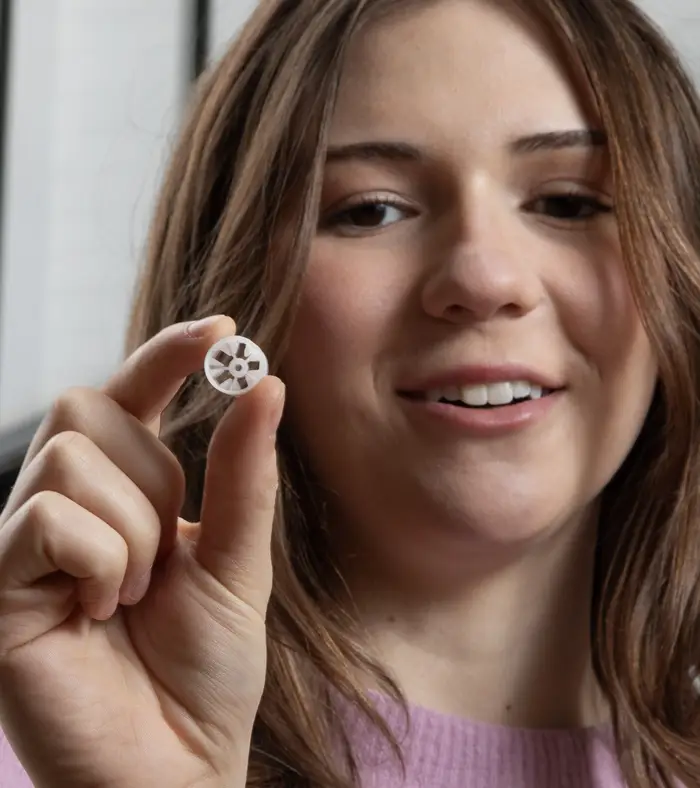
Olivia LaFond, a Carnegie Mellon University senior majoring in biomedical and chemical engineering, created a 3D-printed device that one day could be used to reduce the need for invasive procedures or could help deliver medication directly inside the body over time.
The design of the device, meant to attach to the small intestine, is inspired by tapeworms.
People may eat food, especially meat, where the parasites have laid microscopic eggs that then grow in to the tapeworms. There, they thrive by absorbing nutrients(opens in new window) from the small intestine, where they are embedded.
Similarly, the small, round device is designed to attach to the small intestine, but could instead deliver sensors or medication over time. Unlike pills that pass through and then are absorbed by the digestive tract, LaFond’s prototype is meant to stay put.
“Gut health can really affect your whole body,” LaFond said. “The possibilities are endless.”
Additionally, with the help of the device, doctors could save time, since patients potentially wouldn’t have to do in-office visits for testing, or even someday, undergo invasive procedures like colonoscopies. The device could help with other procedures, such as electrostimulation of the vagus nerve(opens in new window) in the brain, which treats epilepsy, depression and the effects of stroke.
“The goal in the future would be to be able to swallow the device and forget about it,” LaFond said. “We are aiming for a device that is less work for health care workers, where many similar devices still have to be led by doctors or monitored. Our goal is for it to stay in the body for upwards of a year.”
Last year, she was considering medical school and began exploring research opportunities. That led her to apply for a Summer Undergraduate Research Fellowship(opens in new window).
Once accepted into the program, LaFond worked on the project with engineering Ph.D. student Fokion Sanoudos-Dramaliotis in the Zoom Lab(opens in new window), part of CMU’s Robotics Institute(opens in new window).
As the device passes through the digestive system, sugar holding a spring mechanism melts to release tiny hooks. These anchor the device in the intestinal wall, deep enough to stay in place during peristalsis, the muscular contractions of digestion, but not so deep as to cause damage.
LaFond said designing the hooks, which are how a tapeworm attaches itself to an intestine wall, were the focus of her prototypes, as well as an accurate representation of the small intestine.
“The villi (tiny, hair-like projections) cause just enough extra surface area for absorption in your small intestine, but it’s harder to hook in to, so it was an interesting challenge,” she said.
LaFond previously worked on an artificial lung in the lab of Keith Cook(opens in new window), the David Edward Schramm Professor and head of the Department of Biomedical Engineering(opens in new window) in the College of Engineering(opens in new window). Meant for people with chronic lung conditions, the compact external device(opens in new window) is designed to circulate blood outside the body, oxygenate it, and return it, allowing for greater survival, mobility and independence.
Sanoudos-Dramaliotis said LaFond’s enthusiasm, curiosity and focus moved the project forward in meaningful ways.
“What impressed me most was her ability to take general guidance and independently transform it into tangible progress,” he said. “Beyond her own research, Olivia contributed to the lab’s overall energy, helped with organization and shared thoughtful ideas on other projects. She has a real knack for biomedical device innovation, and I’m excited to see where her passion for research takes her next.”
LaFond presented her work at a September panel hosted by the CMU Biomedical Engineering Society(opens in new window) and at MIT’s Undergraduate Research Technology Conference in October. She hopes to continue refining the device during a master’s degree program.
As for her future, LaFond is considering pursuing an MD-Ph.D. to combine clinical practice with research. But since participating in SURF, LaFond has reshaped her trajectory, and encourages other students to consider doing the same with their own project.
“This was not on my radar,” she said. “And I am so happy I got to be a part of it.”
“Carnegie Mellon University is a private research university in Pittsburgh, Pennsylvania. The institution was originally established in 1900 by Andrew Carnegie as the Carnegie Technical School. In 1912, it became the Carnegie Institute of Technology and began granting four-year degrees.”
Please visit the firm link to site