


At Carnegie Mellon University, researchers are helping cities learn how to make room for too much of a good thing: renewable energy.
Shixiang (Woody) Zhu(opens in new window), an assistant professor of data analytics within the Heinz College of Information Systems and Public Policy(opens in new window), is using his expertise in statistics and operations research to help one Midwestern city, Indianapolis, rethink its grid.
Zhu and his research colleagues partnered with utility company AES Indiana, the primary electricity provider for the city, to develop data-driven models that help utilities anticipate and manage projected increases in energy from renewables. Their early findings have been officially incorporated into AES Indiana’s latest Integrated Resource Plan(opens in new window), marking a major success for the researchers.
The models look at renewables such as rooftop solar, wind generation, and other distributed energy resources (DERs).
“We wanted to understand: What happens to the grid as renewable adoption accelerates, and how can utilities plan for that future responsibly?” Zhu said.
In places with preexisting grid infrastructure, adding large numbers of new DERs can introduce operational, planning and reliability challenges not captured by traditional planning models. Their work focused on building predictive models that support both near-term operational decisions and long-term infrastructure investments, helping utilities anticipate unintended consequences before they emerge.
“If you have too much renewable energy in the system — which is a good thing — you are creating more fluctuation in the power supply,” Zhu said. “The issue is not the amount of clean energy itself, but the increased variability and uncertainty in net load and power. You’re adding more uncertainty to a system, because these resources are weather-dependent, spatially heterogeneous, and only partially observable to utilities. This makes forecasting, protection and infrastructure planning more complex.”
Avoiding instability means understanding the effects of renewable growth at multiple scales, from individual neighborhoods to substations, and at the system level. Working closely with AES Indiana, the research team transformed over 15 years of customer and grid data into a framework that forecasts not just expected growth, but uncertainty and risk.
“AES Indiana wanted to ensure the grid is prepared and that upgrades are targeted where they are most needed,” Zhu said. “Our models help identify where DER growth is likely to concentrate, how uncertain those projections are, and what that means for planning decisions.”
Student research meets the real world
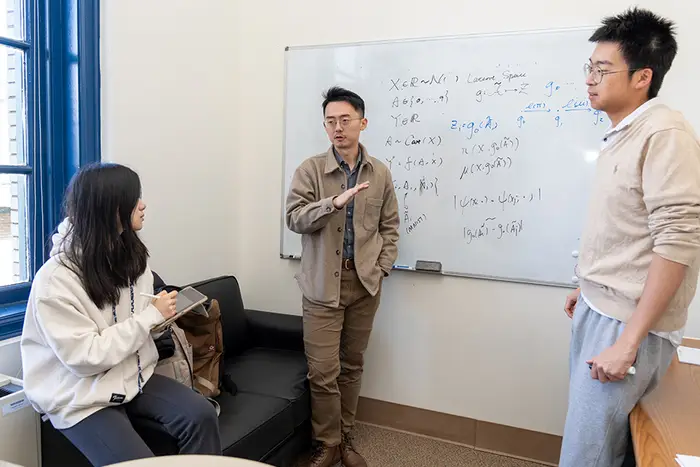
After taking a statistical inference course, Wendy Wang, a junior in the Mathematical Sciences Department(opens in new window) within the Mellon College of Science(opens in new window), realized she wanted to engage in research and gain a real-world perspective on her major.
“I chose to pursue mathematics and statistics because they are the fundamental languages for understanding many more complex systems,” Wang said. “I’ve always been curious about many different fields, and a strong quantitative background can really help me be versatile. It gives me the tools to model real-world, messy problems, which truly excites me.”
Zhu brought Wang aboard with the help of a Summer Undergraduate Research Fellowship(opens in new window) (SURF) grant, allowing her to conduct paid research on campus over the summer under the guidance of Ph.D. student Wenbin Zhou(opens in new window).
On the project, Wang first conducted a literature review on DER forecasting, grid planning under uncertainty, and causal analysis in energy systems. She then explored statistical methods that could be integrated into the modeling framework.
Traditional statistical inference methods often focus on identifying correlations in historical data. However, Zhu explained that “when studying unprecedented levels of DER adoption, purely correlational approaches are insufficient.”
“This is a future we haven’t fully observed yet,” Zhu said. “You can’t rely only on historical trends. You need methods that explicitly account for uncertainty, dependencies across regions, and confounding factors such as income, housing stock, and policy incentives.
To address this, the team incorporated causal inference — a field that seeks to view problems through a lens of cause and effect rather than estimation — which allowed researchers to assess how different communities respond to policy and economic changes, rather than simply extrapolating past patterns.
Data-driven decision-making
The final research framework combines forecasting and analysis to help utilities evaluate the risks and trade-offs associated with rapid renewable integration. Zhu said these tools enable planners to understand the evolving landscape of energy generation and its associated risks while strategically adopting necessary resources.
“It’s not just about adding renewables” he said. “It’s about doing it in a way that preserves reliability and resilience. That requires understanding both the benefits and the risks.”
For Wang, participating in this research helped her see the impact of her studies and interests in the real world.
“I see this research as a tool to help utilities make smarter data-driven decisions.” Wang said. “Right now, the grid is becoming decentralized with DERs, and utilities are struggling to plan for it. A framework like ours can help them untangle all the complex factors and understand the true causal effects. This would allow them to make targeted infrastructure upgrades and ultimately support more renewable energy by building a smarter, more resilient grid around it.”
While the findings are already informing planning decisions in Indianapolis, Zhu emphasized that the broader implications extend well beyond a single city.
“This research helps utilities nationwide understand how distributed energy resources are reshaping the grid,” Zhu said. “By explicitly modeling uncertainty and causal drivers, we provide tools that support more robust and equitable infrastructure planning.”
Zhu credits Carnegie Mellon’s interdisciplinary environment for making the collaboration possible.
“At CMU, engineering, statistics, public policy, and the sciences all intersect,” he said. “That combination allows us to tackle problems that are both technically complex and socially important.”
Wang encourages other students to take advantage of this environment, and to also take the initiative in participating in research.
“My biggest piece of advice is to be proactive and don’t be afraid to reach out,” she said, “Find some topics or professors whose work excites you, and then send cold emails. You might feel like you don’t know enough, but the genuine curiosity is what professors are looking for in undergraduates. You just have to be willing to put yourself out there.”
“Carnegie Mellon University is a private research university in Pittsburgh, Pennsylvania. The institution was originally established in 1900 by Andrew Carnegie as the Carnegie Technical School. In 1912, it became the Carnegie Institute of Technology and began granting four-year degrees.”
Please visit the firm link to site