

Researchers from Carnegie Mellon University attest that while the United States needs to lower system-wide costs and air pollution to shape the future of energy, the core priority should be ensuring individuals can afford and access that energy.
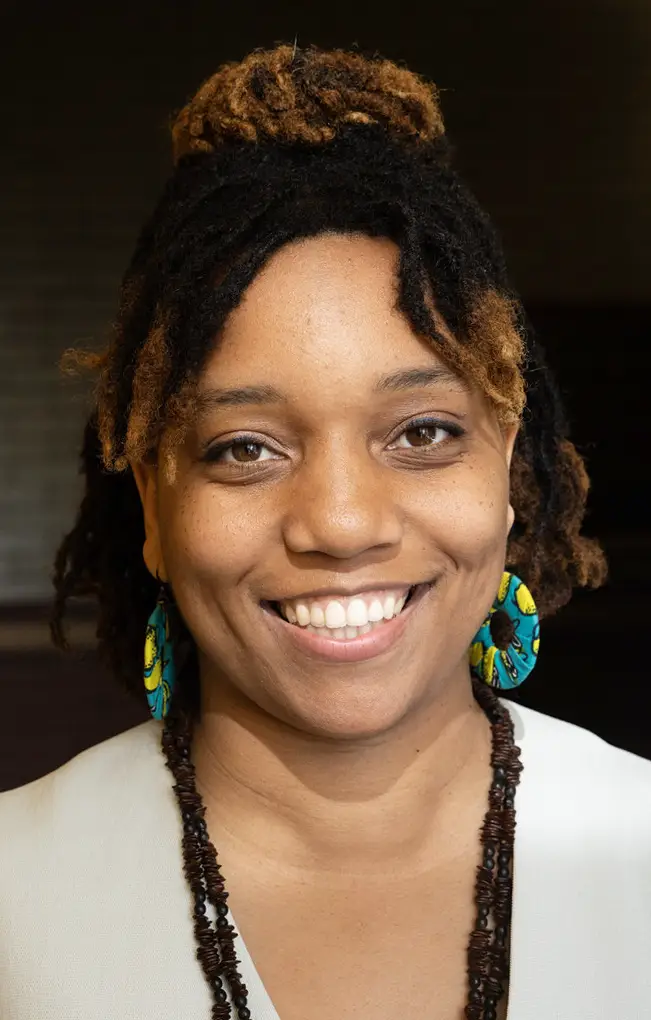
Destenie Nock(opens in new window), assistant professor of civil and environmental engineering(opens in new window) and engineering and public policy(opens in new window), leads a research group comprised of graduate students at CMU that has created ways to find people struggling with energy poverty and lack of access to energy, and they use computer models to design power systems that are fairer for everyone. Her team has proven that using mathematical modeling and energy policy can help plan for a sustainable future.
“The most important thing that the energy system does is it makes sure that people can live a healthy, safe, sustainable, modern life in their homes,” Nock said.
For example, they have found that low-income households use less energy during the summer to save money on their bills, which could put these households at risk of heat stroke.
“A lot of times, when I talk to people in the energy space, conventional wisdom is always, let’s use less, use less, use less,” she said. “But there are some people who don’t use that much, and might see their pipes freeze in the winter. Those people often get missed.”
To help address this gap, Nock founded Peoples Energy Analytics(opens in new window), a company that uses energy data to locate vulnerable residents and link them to services that can help them afford and safely maintain their energy needs.
In a pilot program with People’s Natural Gas in Pennsylvania, outreach targeted 2,000 homes identified as at-risk of defaulting on energy bills then connected them with assistance. This increased assistance program applications by 80% and program enrollments for tracked households more than doubled, rising 135%.
“I want to examine how modernizing the grid can be done in a way that fairly allocates costs while also protecting vulnerable households,” Nock said.
Utility companies have data that can be used in more effective ways to reach either those households who are using less energy to save money and inadvertently putting themselves at a health risk, as well as those who are using too much energy because their homes are inefficient.
[embedded content]
“Demand is going to grow, particularly as we are looking at more extreme weather events with heat waves and deep freezes,” Nock said. “As infrastructure is expanding, we need to make sure that we don’t bake in current inequities into that future grid.”
Innovation in the energy industry can only take place if everyone has access to energy when they need it, which means keeping it affordable.
“Energy is a lifesaving support mechanism,” Nock said. “It is the essential service that enables all other essential services.”
More extreme weather events may mean more people in need
In late February, Nock spoke at the National Academies of Sciences, Engineering, and Medicine(opens in new window) in Washington, D.C., for a daylong workshop(opens in new window), “Understanding and Addressing Energy Affordability in the United States.”
Nock said lower energy system costs don’t automatically mean lower customer bills. Because utility prices don’t always rise with inflation, companies can try to make up the difference by spending on improvement projects and charging customers for it.
“Any time you are building out infrastructure like that can be used as a justification to increase residential rates,” Nock said.
Additionally, as extreme weather events become more common, such as air quality affected by wildfire smoke, more people will be forced to stay inside and use more energy, Nock said.
“The recommendation is often for people to stay inside for health reasons,” she said. “Yet, not everybody can use or afford their energy in the same way as we are staying inside.”
As part of CMU Energy Week 2026(opens in new window) hosted by the Wilton E. Scott Institute for Energy Innovation(opens in new window) from March 17-20, Nock will lead a panel discussion titled: “Keeping energy affordable: How can the U.S. reinvent the power grid without making electricity unaffordable for customers?”
Themed “Reinventing the grid for our electrified future,” CMU Energy Week 2026 aims to explore how enhancing the grid’s reliability, affordability and resilience can lead to a clean, electrified future.
When it comes to forward-thinking energy policies, Nock said to start by challenging norms.
“Some of the biggest impacts that we can have in the energy research policy space is understanding how things that we assume to be true are not,” she said. “With those assumptions, we can miss the true lived experience of households, especially if those people don’t have advocates.”
“Carnegie Mellon University is a private research university in Pittsburgh, Pennsylvania. The institution was originally established in 1900 by Andrew Carnegie as the Carnegie Technical School. In 1912, it became the Carnegie Institute of Technology and began granting four-year degrees.”
Please visit the firm link to site