


The Carnegie Mellon University Robotics Innovation Center(opens in new window) (RIC) hummed with energy on Monday as it partnered with Hazelwood Local to host a family-friendly open house. The event, on the heels of the RIC’s opening celebration(opens in new window) last month, showcased robot demonstrations, offered guided tours and built direct connections with CMU to explore programs, relationships and resources.
Zoie Pitzarella of Hazelwood watched her 6-year-old son, Kyng, use a video game controller to move a robot created by the Girls of Steel(opens in new window) robotics team.
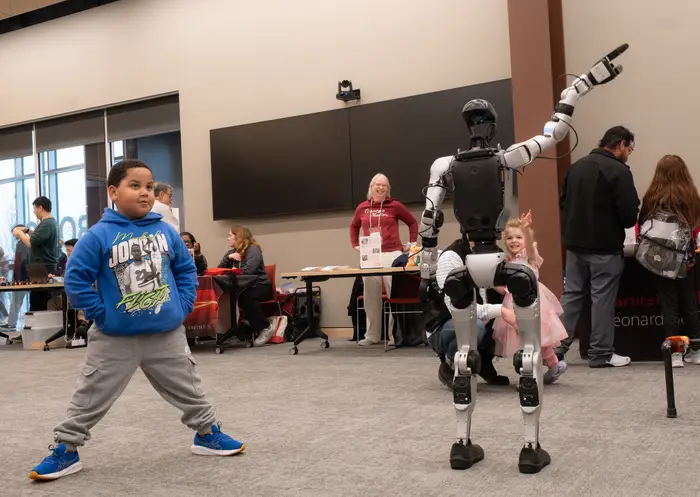
“He’s had a surprised face on since we walked in the building, he’s been admiring everything about it,” Pitzarella said. “This is awesome that something like this is in our Hazelwood community and that they’ve given us an opportunity to come down and see it, and to see moving robots, it’s just boggling my mind right now.”
AJ Herzog, a 2023 Heinz College of Information Systems and Public Policy(opens in new window) master’s degree graduate and neighborhood planner with the City of Pittsburgh, said after working with CMU and the community for two years leading up to the opening of the building, seeing the community turn out for the open house was encouraging.
“Being able to see into the space from different angles from the outside is nice so it doesn’t feel walled off from the community, particularly as more of Hazelwood Green develops, having the spaces that feel inviting and the amount of interaction is important,” he said.
A neighborhood once shaped by industry, now reinvented
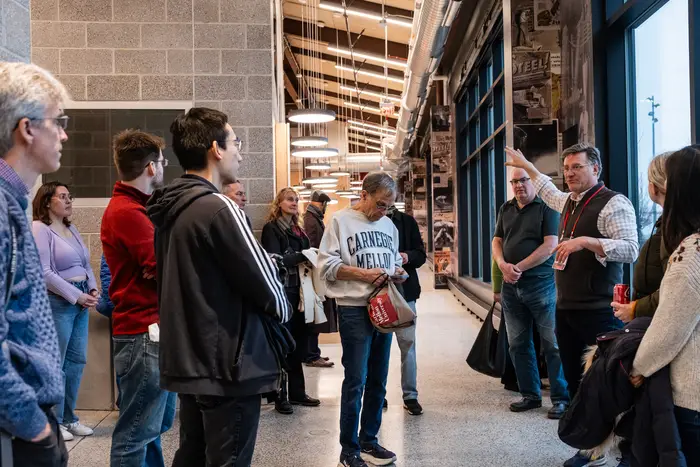
An exhibit open to the public(opens in new window) inside the RIC’s front hallway highlights the site’s history, connecting the activity inside the future-focused building to the influential people and events of the past.
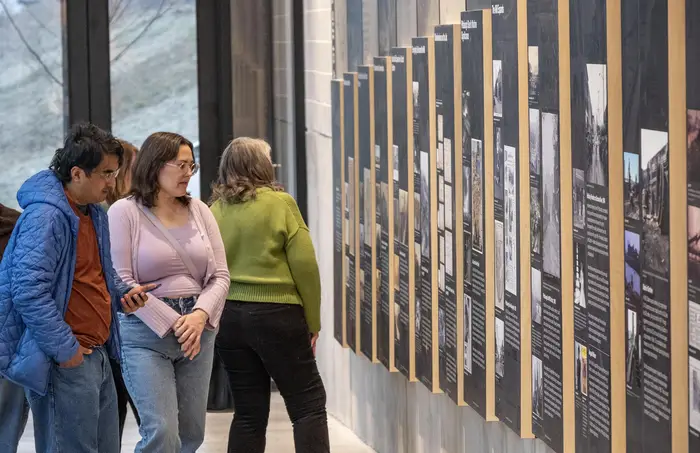
Developed by the University Libraries(opens in new window)‘ Exhibitions Team with the help of the Greater Hazelwood Historical Society and comprised of 14 panels, “Life & Livelihood: A History of the Site,” traces how river access and railroads first fueled steel production, then how the neighborhood’s identity grew around mill work and local culture. After the industry collapsed, as the exhibit illustrates, residents of the community had to endure the economic loss and environmental impact.
“CMU & Steel,” produced in consultation with regional heritage nonprofit Rivers of Steel(opens in new window), explains founder Andrew Carnegie’s connection to steel and philanthropy, including the university’s beginnings as Carnegie Technical Schools(opens in new window).
In the building’s entryway and enclosing the outdoor running room, exhibits serve as the launching point of the Robotics Project 2.0(opens in new window), which aims to build a record of robotics history at Carnegie Mellon, sharing both the technology and the human stories behind it.
After visiting the exhibit, friends Rachel Cox of Bellevue and Nirajan Rajkarnikar of Churchill reflected on what they learned, including how Pittsburgh steel mills like the one that once stood at Hazelwood Green produced 80% of the munitions used by the U.S. military during World War II.
“It’s great to see that Hazelwood is being revived with this new perspective, changing with the times,” said Rajkarnikar, a 2015 master’s degree graduate in engineering and public policy. “It’s good to see the university integrating with the community, and not just isolated on campus, but contributing to the community and the Pittsburgh region.”
Area residents are known for their resilience and dedication to their community, working together and with support from CMU to develop the Greater Hazelwood Neighborhood Plan(opens in new window), adopted as a roadmap for development in 2019 by the City of Pittsburgh. Today, the 178-acre site formerly home to the mill, now known as Hazelwood Green(opens in new window), has been reimagined with sustainability and innovation at the forefront.
The environmental effects of heavy industry are transforming into high-tech opportunities with sustainable design built in, represented by elements such as the forthcoming solar panels at the Robotics Innovation Center and existing ones at Mill 19, where they cover the entire 110,000-square-foot roof.
Community optimism has grown in recent years, according to Danielle Chaykowsky, director of programs for Center of Life.
“A lot of these kids might work down there where their grandparents worked,” she said. “It’s powerful to see the roof of the former steel mill covered in solar panels, that’s such a great sign of progress.”
A community of collaborators
Members of Carnegie Mellon’s Community‑Based Work Coalition(opens in new window) have long worked to ensure the RIC, and its neighbor Mill 19(opens in new window), are resources for young people and families nearby so they can experience groundbreaking research innovation(opens in new window) up close alongside CMU students, faculty and staff. The Coalition is a network of faculty, staff, researchers and administrators whose work directly intersects with community members across the Pittsburgh region.
“Our primary goal is to graduate students who are community‑minded leaders,” said Meggan Lloyd, assistant director of CMU’s Office of Community Engagement and Leadership Development(opens in new window), which takes part in the coalition and hosted CMU’s 2023 Pittsburgh Alternative Spring Break in Hazelwood. “We want to make sure these connections are sustained partnerships between students and community organizations.”
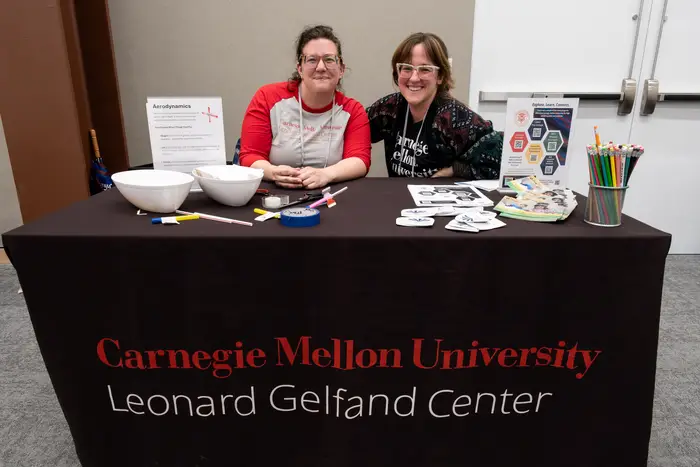
Miriam Wertheimer is the director of student instructor development and K-12 community partnerships with the Leonard Gelfand Center for Service Learning and Outreach(opens in new window), which works to create and strengthen partnerships with local schools and education providers.
“We want to ensure that everyone engaging in that work at the university is really thinking intentionally and with support and collaboration in mind,” Wertheimer said. “What we’re working toward is not isolation, but consistency while maintaining the community culture.”
For kids, robotics start with play then lead to careers
Making advanced technology feel approachable — especially for young people — is a top priority for the Carnegie Mellon Robotics Academy(opens in new window), which trains high school teachers and students and took part in the community open house.
“Our goal is always to engage with learners of all ages with computer science and STEM, using robotics as a tool,” said Vu Nguyen, co-director of the Robotics Academy, which has also participated in Hazelwood City in the Streets(opens in new window), Hazelwood’s Summer Concert Series(opens in new window) and the Community Robotics Showcase(opens in new window).
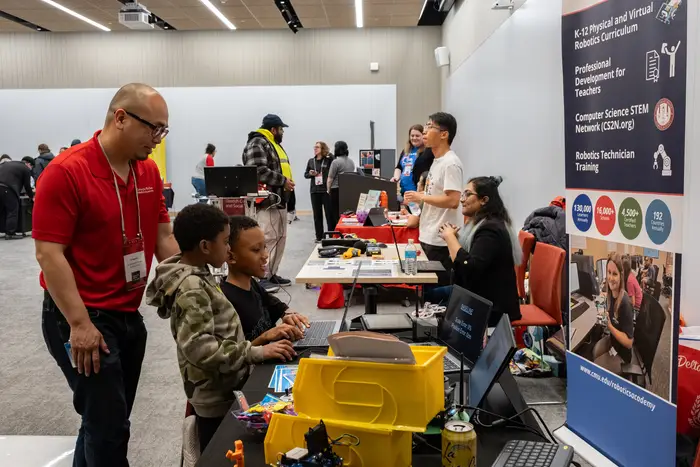
The RIC has potential to foster an ecosystem that encourages innovation through shared knowledge not only inside the building, but outside of it as well, he said.
“We want the kids in the area to see potential in their careers, and to learn the problem-solving skills you develop when working with robots,” Nguyen said. “We want the families to say that they can have a career in robotics, and if they are interested, that they can have a pathway to CMU if that’s what they want.”
Will Martin, a Ph.D. student in transition design in the College of Fine Arts(opens in new window), brought his two sons, Hazen, 7, and Roland, 5, on the tour with him.
Martin said Hazen already has an interest in robots because a neighbor works in autonomous trucking.
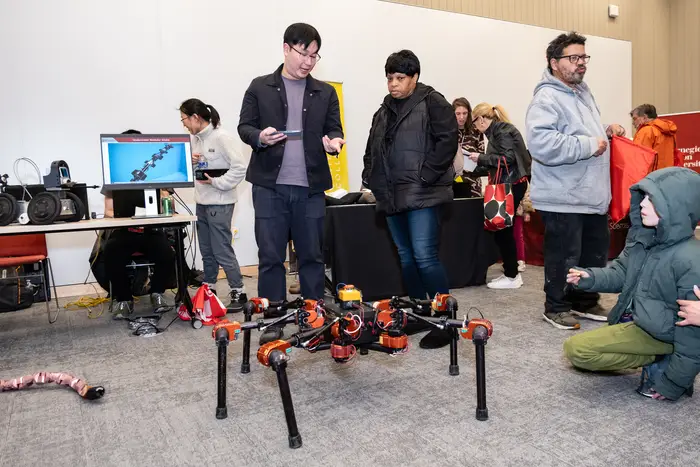
“He wanted to do his first science fair project about robots, but we didn’t quite know how to do it, so we thought we’d come here and learn about research and robots,” said Martin, whose own research connects architecture and urbanism. He has focused on the Scotch-Irish history of the region — including the Hazelwood neighborhood, once known as Scotch Bottom — and its relationship to Carnegie Mellon.
“I’ve been looking at that lineage of transdisciplinarity: how Andrew Carnegie imagined the institution, but also how it’s a part of the history and culture of western Pennsylvania and Appalachia, as a way to learn from the region, how innovation and ideas depend on place,” he said. “It’s interesting to hear how this building is meant to invite collaboration and build the architecture to facilitate certain ideas coming together.”
Summer camp makes robots accessible
Center of Life is contributing to that vision with its summer camps, serving K-8th graders in the region. Since 2023, Carnegie Mellon has hosted part of the camp on main campus, and this year, CMU’s College of Engineering(opens in new window) and School of Computer Science(opens in new window) will offer a weeklong program for 6-8th graders at the RIC. The center, which plans to break ground this fall(opens in new window) on a new three-story, 127,000-square-foot building on 5.3 acres at Hazelwood Green, has provided programs and services since 2001 to the people of Greater Hazelwood.
George Kantor, research professor and associate director of education for the Robotics Institute(opens in new window), has worked with Center of Life. This year, the summer camp will focus on middle-school students, who will spend a full week inside the RIC.
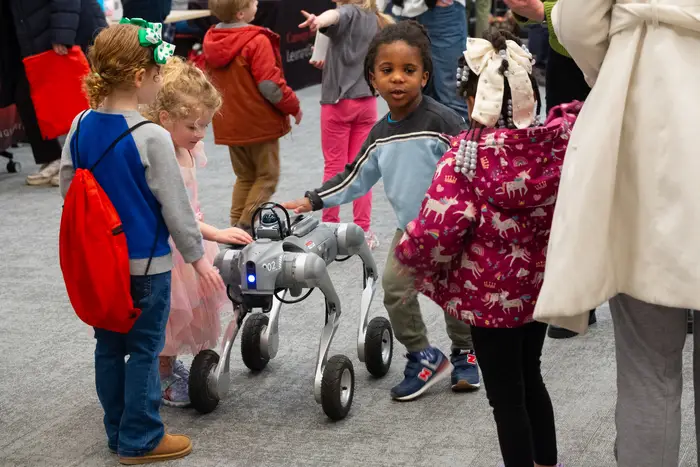
“I am very excited about being able to offer the camp locally at the RIC in the Hazelwood community,” he said. “I expect running it at the RIC to be engaging and rewarding for all parties.”
Plans include a robot-building curriculum adapted from the Girls of Steel program, which Kantor leads as director.
“They all think robots are cool across the board,” said Sarah Crawshaw, education programs manager for Center of Life.
Crawshaw added that for a close-knit neighborhood like Hazelwood, having access to resources, potential careers and opportunities to build confidence is just as vital as having access to robots.
“The kids have said, ‘I’m going to college today,’ and they’ve been really excited about that,” Crawshaw said. “To be exposed to such a wide variety of people and professions at CMU and to see these world-class facilities in our workforce development program and to feel welcome is pivotal for them and gives them a sense of ownership.”
Learning, joy and staying power
CMU recognizes that successful youth-serving partnerships are built on meaningful programs that are educational and fun.
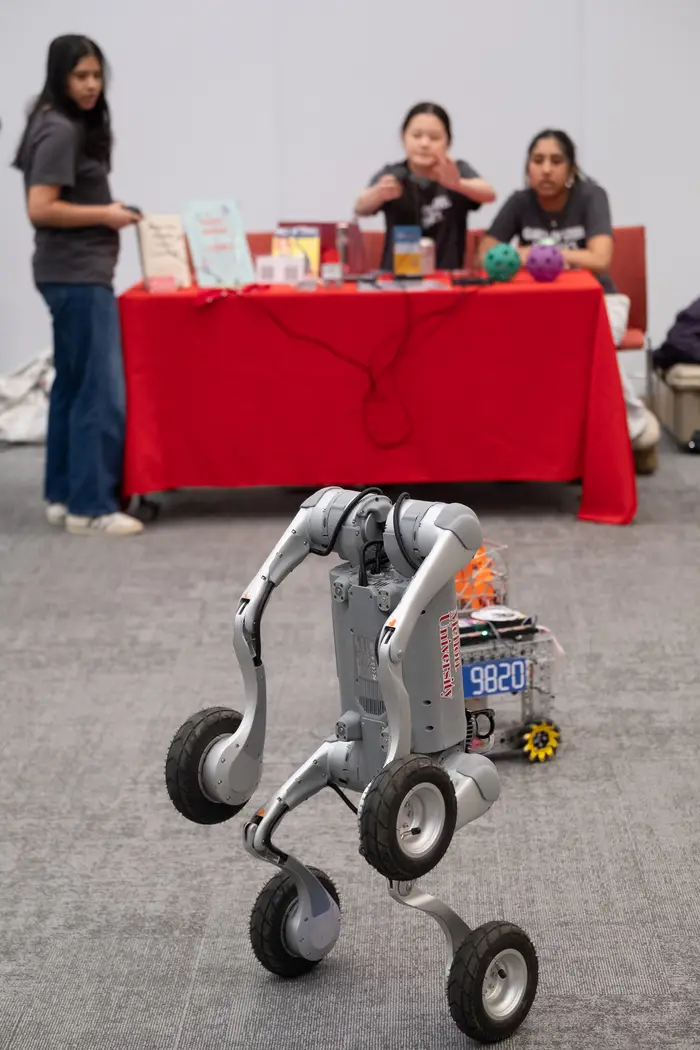
“With every event we’re a part of, we look forward to seeing kids’ faces when they play one of our collaborative-robot digital games, or when they are able to get a robot to move for the first time,” said Nguyen.
The Gelfand Center’s hands-on activities, such as making straw rockets or learning about polymers, are meant to spark similar engagement. “At the end of the day, institutions like Carnegie Mellon are places of learning, and learning is really fun,” Wertheimer said.
And for the Center of Life, the long view is already clear, envisioning a future where today’s children are tomorrow’s community leaders.
“The long‑term effects of our partnership will become more apparent as our students get older,” said Chaykowsky. “We’ve already seen benefits from the work we do and the partnerships we’ve built, especially with Carnegie Mellon, and I’m excited to see those continue to strengthen and expand.”
“Carnegie Mellon University is a private research university in Pittsburgh, Pennsylvania. The institution was originally established in 1900 by Andrew Carnegie as the Carnegie Technical School. In 1912, it became the Carnegie Institute of Technology and began granting four-year degrees.”
Please visit the firm link to site