


Pittsburgh has reinvented itself from a steel powerhouse to a hub for health care and education. But the city’s industrial past left a hidden legacy: toxic compounds like benzene and toluene in the soil. While most life can’t survive such a contamination, some microbes adapted to use the pollutants as food.
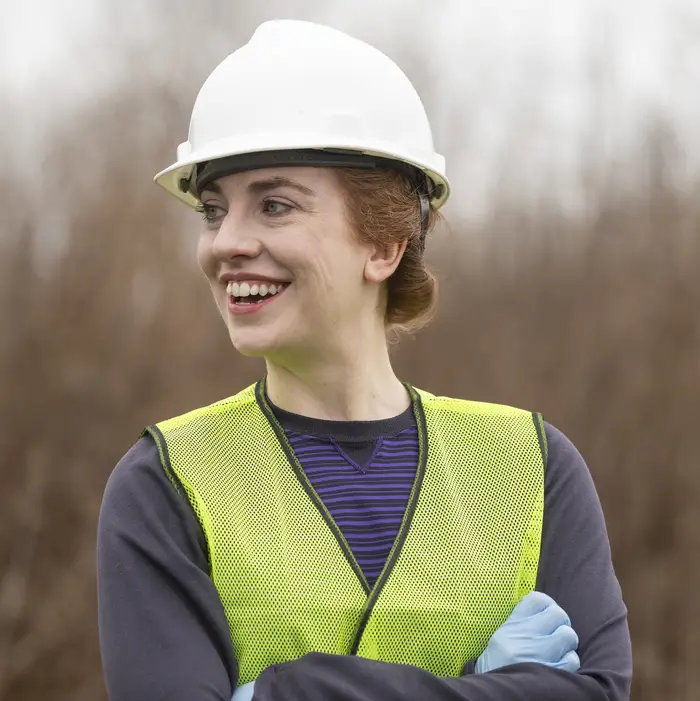
Now, scientists at Carnegie Mellon University are exploring whether these microbes can help clean up what the steel industry left behind.
“We’re taking advantage of the fact that, over generations, ecology and evolution have potentially already done a lot of the work for us in enriching microbes that might be able to assist us in doing more complete remediation,” said Catherine Armbruster(opens in new window), assistant professor of biological sciences(opens in new window) and a microbial ecologist in the Mellon College of Science(opens in new window). “And Pittsburgh is definitely the place for this project.”
With a $250,000 grant from the Richard King Mellon Foundation, Armbruster and her team are searching for answers at Hazelwood Green, a former steel coking site.
[embedded content]
Western Pennsylvania is dotted with more than 250 brownfields — former industrial sites where hazardous pollutants linger. Conventional cleanup methods often involve digging up contaminated soil and burying it elsewhere. That’s what was done at Hazelwood Green, transforming the former steel site into a safe, thriving hub. Today, it hosts research centers for CMU and the University of Pittsburgh, with more development underway. The remediation, however, took years and cost tens of millions of dollars.
Armbruster’s team is betting on a different strategy. Their project aims to harness brownfield bacteria’s innate abilities to do a less costly and more complete environmental cleanup.
But first, she must find the bacteria that break down the most common pollutants located at these sites. It’s a daunting task. Just a teaspoon of soil teems with billions of bacteria and other microorganisms.
“Science is in a place now where we have the technology to sequence entire microbial communities,” Armbruster said. “And then we can use that genomic data to identify which bacterial species are there and predict whether they have the metabolisms we care about the most.”
Digging deep
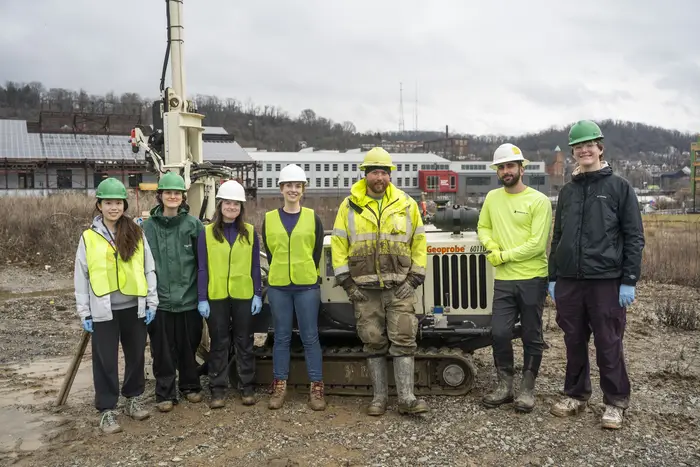
On a cold, rainy day in March, Armbruster headed to Hazelwood Green to collect soil samples. The ground was hard, but luckily she didn’t have to do any shoveling. With the funding from the Richard King Mellon Foundation, Armbruster brought in a GeoProbe, a machine designed to collect soil samples at up to 50 feet.
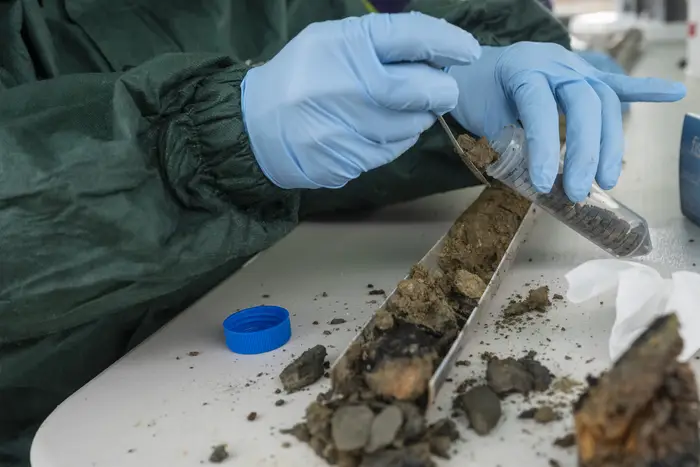
Once the soil makes it back to the lab, Armbruster has assembled an interdisciplinary team to isolate the bacteria, extract its genetic sequences, comb through the vast amounts of genomic data to identify which microbes can break down the hazardous pollutants common to brownfields and track what the break-down products become.
“I feel CMU is the right place for a project like this. The students have the interests and the aptitude to tackle these challenges,” Armbruster said.
Marcus Lopez, a senior studying biological sciences and environmental and sustainability studies(opens in new window), is leading the effort to extract the bacteria from the soil along with research scientist Mara Kessler and undergraduate Charlie Stanczak. Using traditional wet lab techniques, like spinning down the soil and liquid mixture in a centrifuge, siphoning off the liquid and adding it to petri dishes, the team will monitor for bacterial growth. Once the bacterial colonies start growing, they’ll isolate different strains and send them off for genomic analysis.
Meanwhile, Ethan Chen, a student in the M.S. in Automated Science program(opens in new window), is spearheading the effort to automate as much of the process as possible. And June Qu, a student in the M.S. in Quantitative Biology and Bioinformatics program(opens in new window), is using computational methods to comb through the vast amounts of genomic data extracted from the bacteria in the soil. Her goal is to identify which microbes carry the genetic machinery to break down chemicals like benzene, toluene, ethylbenzene and xylene. To find these needles in the haystack, she’s developing a computational tool tailored to these genes.
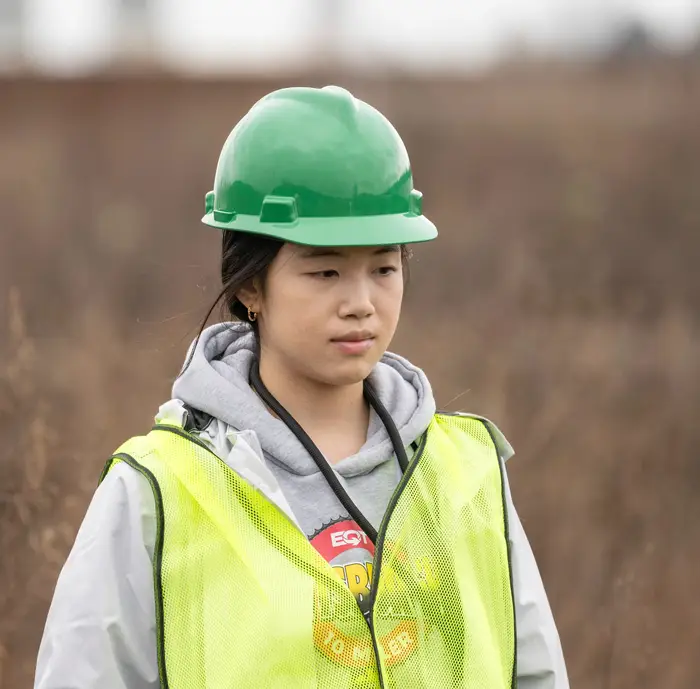
“In addition to soil samples from Hazelwood Green, I’m gathering more data from oil-contaminated sites and contaminated groundwater from different parts of the world. I’m running my tool on all this data to fine tune it a little bit more to decrease the number of false positives and increase the sensitivity of detecting these genes,” Qu said.
Once Armbruster’s team has isolated microbes from Hazelwood Green and screened them in the lab to see how well they break down pollutants, they’ll hand them off to environmental chemist Carrie McDonough(opens in new window). An associate professor in the Department of Chemistry(opens in new window), McDonough will use high-resolution chemical analysis to track what the pollutants become once they are broken down.
“We want to transform these hazardous compounds, but we want to know what we’re making during that process. For that, we absolutely needed a chemist, which is where Dr. McDonough comes in,” Armbruster said.
Preliminary results from the first group of soil samples from Hazelwood Green, some from the surface and some from deep in the ground, suggest that each site harbors a distinct microbial community, and that more contaminated samples had more bacteria that could degrade benzene, toluene, ethylbenzene, xylene and polycyclic aromatic hydrocarbons.
Education with impact

The grant is also fostering STEM learning and empowering students to tackle local environmental challenges. The project will connect local high school teachers and students with CMU’s Pre-College Program in Computational Biology(opens in new window) and the Summer Academy for Math and Science(opens in new window). Each summer, about 160 students, including five recruited from Pittsburgh-area high schools, will study the Hazelwood Green site, analyze microbial communities and gain experience in metagenomics and automated biology.
“I’m excited about this project because it’s local and culturally relevant to community stakeholders,” said Michael Young(opens in new window), associate dean for community engagement and associate professor of mathematical sciences(opens in new window). “My goal, particularly with students who might come from underserved schools or school districts, is very simple: I want them to learn new things and I want them to have a good experience. Academic and scientific rewards will be reaped later.”
If successful, this work could turn Pittsburgh’s industrial past into a model for sustainable cleanup — and inspire the next generation of scientists.
“Carnegie Mellon University is a private research university in Pittsburgh, Pennsylvania. The institution was originally established in 1900 by Andrew Carnegie as the Carnegie Technical School. In 1912, it became the Carnegie Institute of Technology and began granting four-year degrees.”
Please visit the firm link to site