


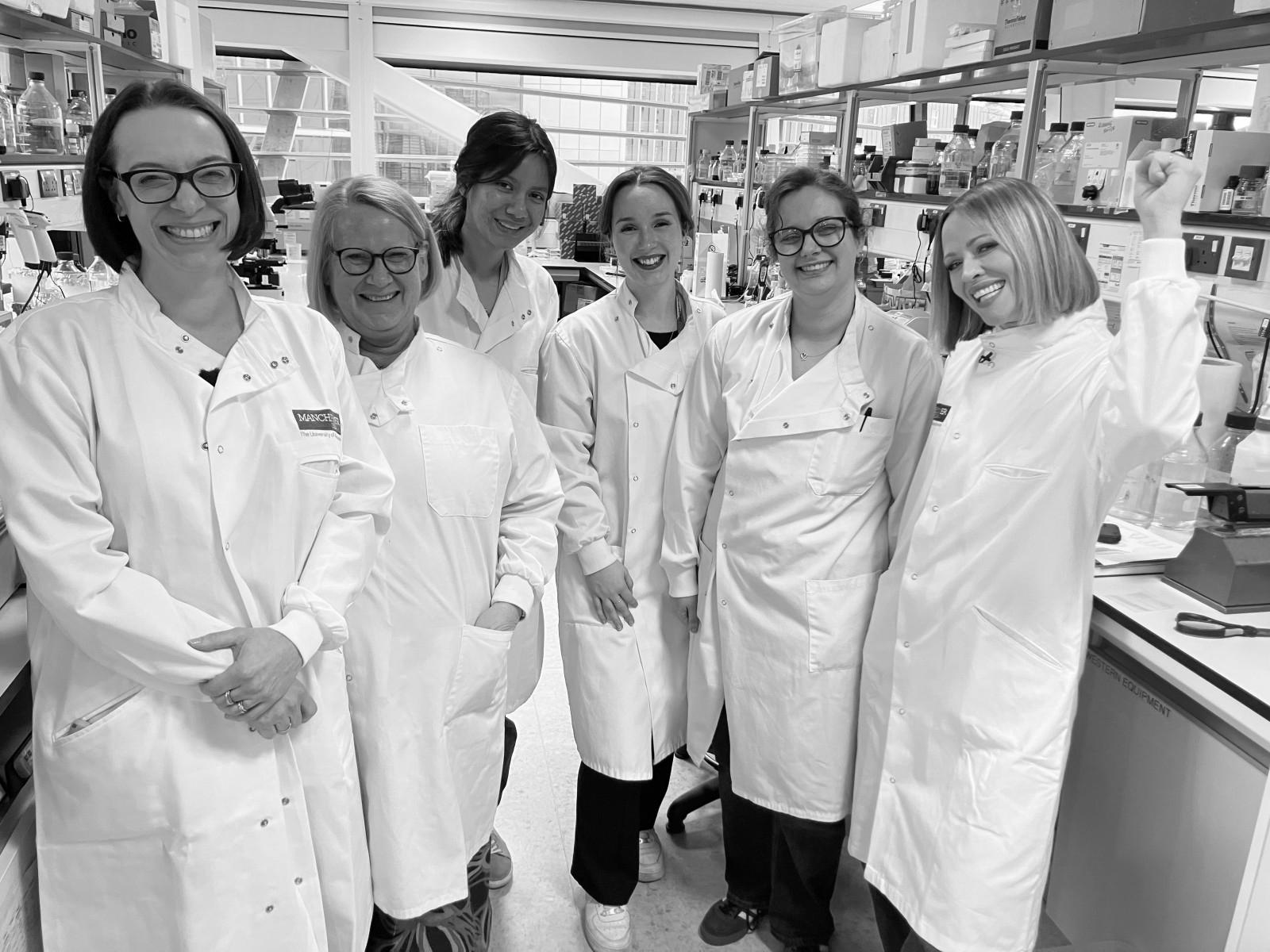
Former Girls Aloud star Kimberley Walsh came face to face with the life-changing impact of her bandmate Sarah Harding’s legacy — meeting a mum whose breast cancer was detected early thanks to research funded in Sarah’s name carried out by The University of Manchester, The Christie NHS Foundation Trust and Manchester University NHS Foundation Trust (MFT).
During an emotional visit to The Christie NHS Foundation Trust in Manchester and the Manchester Cancer Research Centre, Kimberley met with scientists and researchers and witnessed first-hand how The Christie Charity Sarah Harding Breast Cancer Appeal, set up at Sarah’s request and supported by the bandmates, is transforming lives.
At the heart of that impact is Annette Illing, a mum of three who had no symptoms, no family history of breast cancer, and no reason to suspect anything was wrong. But after taking part in a groundbreaking study to identify which women are most at risk of developing breast cancer in their 30s and backed by the Appeal, Annette received news that would change everything.
What began as a simple decision — “Why not?” — led to an early diagnosis that may ultimately have saved her life.
Annette’s dad and sister are both GPs, and the opportunity to better understand her breast cancer risk while contributing to vital research felt like a positive step. “I couldn’t really see any negatives,” she recalls. “It would either be ‘I’m fine’ and carry on as I am, or ‘I’m at increased risk’ and might need to make some lifestyle changes.”
At just 39 years old, and with no family history of breast cancer, Annette wasn’t overly concerned about having a genetic risk factor.
After researching the BCAN-RAY (Breast Cancer Risk Assessment in Young Women) study and learning it was supported by The Christie Charity Sarah Harding Breast Cancer Appeal, (The Sarah Harding Breast Cancer Appeal) Annette decided to take part. The BCAN-RAY study is also funded by Cancer Research UK with support from the Shine Bright Foundation.
It was a decision that proved life-changing as in June 2025, after Annette had been identified as being at increased risk by the BCAN-RAY study, she had her first mammogram and was diagnosed with early-stage breast cancer.
She says: “It was a huge shock as I don’t have a family history of breast cancer. It was scary to hear the word ‘cancer,’ but there was hope. I’d rather know and have choices than not know. It was caught early, meaning it could be removed, and preventive treatment was available.”
Without the BCAN-RAY study, Annette would have waited another decade for her first routine mammogram. “When the mammogram picked up my cancer, it was undetectable by any other means. If I’d waited, it would have grown and changed my prognosis. It could have been a completely different story,” she says.
Dr Sacha Howell from The University of Manchester, The Christie NHS Foundation Trust and Manchester University NHS Foundation Trust (MFT), leads the BCAN-RAY study and said: “This study was designed to identify women at increased risk of breast cancer. Annette’s experience shows exactly why this is so important. By detecting breast cancers at the very earliest stages, treatment is more straight forward and survival outcomes much better. We can also offer women approaches to prevent breast cancer to stop them developing the disease at all. Early detection may have saved Annette’s life, and we want to offer that same chance to many more women.”
Annette from Withington, Manchester, underwent two surgeries at Wythenshawe Hospital, part of Manchester University NHS Foundation Trust, followed by radiotherapy at The Christie NHS Foundation Trust, and is now on preventive hormone therapy for five years. She will also have annual mammograms for peace of mind. She says: “I feel very hopeful for the future. My cancer has been removed, and I’m in the best possible position to move forward.”
As a mum to three daughters aged 13, 11 and 8 yrs old, Annette is particularly thankful to have been part of the BCAN-RAY study. She says: “I am so grateful for this study and future studies like it, so that I know my daughters will be well looked after by the Breast Cancer Family History Risk and Prevention Clinic when the time comes.”
“The University of Manchester is a public research university in Manchester, England. The main campus is south of Manchester City Centre on Oxford Road.”
Please visit the firm link to site