


At Carnegie Mellon University students anticipate the Spring Carnival(opens in new window) and century-old annual Sweepstakes(opens in new window) race by spending months building sleek, carbon-fiber buggies to push a driver around the hills behind campus.
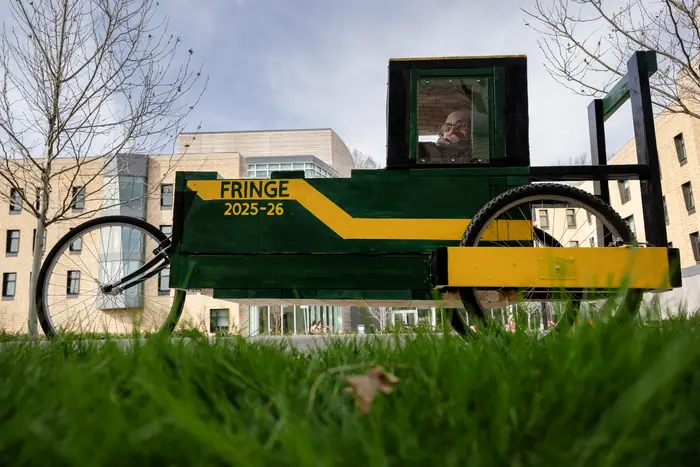
Sam Radziwon had an idea akin to long-ago races: The mechanical engineering senior built a wooden buggy, named Balsa, which will roll in an exhibition race Friday morning.
Two years ago, Radziwon served as Booth(opens in new window) chair for Fringe(opens in new window), an independent student organization founded in 1969 that participates competitively in a variety of campus traditions and co-curricular activities like Booth and Buggy. After working with lumber and sheets of plywood to build a booth, he started to consider how to build a buggy out of similar material. Last year, as a junior, he served as head mechanic for Fringe, and kept the idea of building a wooden buggy at the back of his mind. “It started as a joke: I’ll build my own buggy, it’ll fit me, I’ll make it out of wood because I understand Booth,” he said. “Fast-forward to this year, and one night I thought, let’s do it.”
How it works
Ten teams(opens in new window) will participate in the competition this year, with some fielding multiple buggies.
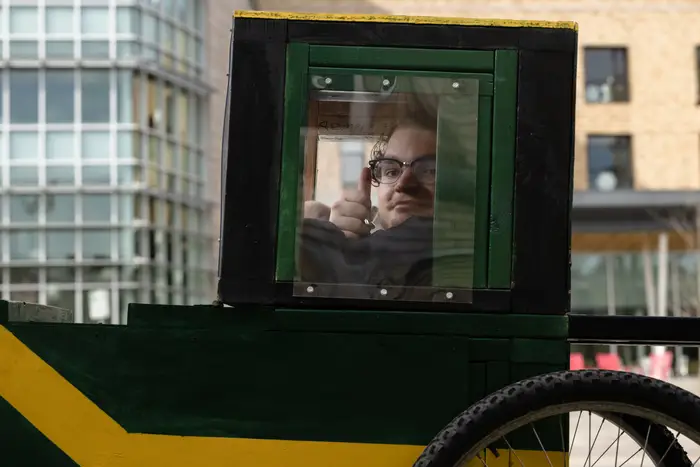
Balsa features a top-loading design for the driver to climb into, with a hatch that hinges to close and a feet-first position for the driver. To support the increased amount of weight from the wooden structure, the buggy uses a 26-inch bike tire and fork in the front, compared to the usual buggy wheels that are about six inches in diameter. Radziwon’s creation is the first feet-first design to meet race requirements since 1998.
Typical buggies have brakes that are attached to the steering, but the wooden buggy uses movable brake handles that Radziwon holds in his hands.
“This bike fork still has the handle bars on it, and down at the bottom, I am steering with my feet,” he said. “This takes a lot more turning force than any other buggy.”
Radziwon is 5 feet, 9 inches tall, compared to the typical buggy driver who is closer to just 5 feet in height.
“I have to wear a chest protector underneath my harness, which cuts out a little more room,” he said. “It’s pretty tight.”
About 12 Fringe alumni will be recruited as pushers to keep it moving along the course, where a typical buggy only takes five.
In the early history of Buggy(opens in new window) before the widespread adoption of carbon fiber, the cars were made of wood and other materials, said Elizabeth Koch, CMU’s director of Student Involvement and Traditions(opens in new window) in the Division of Student Affairs(opens in new window).
“These old, archival buggies didn’t look the way they look now, so it is an homage and it is new, all at the same time,” she said.
Balsa will take part in the race in an exhibition heat to gather data on this type of vehicle as it traverses the “back hills” of the course, Koch said.
“It won’t likely be competing against anybody else, it will be rolling on its own, in its own glory,” she said.
Fielding other peoples’ reactions
Now serving as president of Fringe, Radziwon started building the buggy in the fall, and as he told more people his plan, they reacted with surprise.
“Not horror, but something close,” he joked, adding that he has been able to prove the idea could work. “Every time I’d hit a different milestone, they’d be a little bit incredulous.”
Sam Istvan, a senior majoring in electrical and computer engineering who is serving as co-head booth chair for Fringe, helped Radziwon early on in the project, building the frame.
“People are astonished by it whenever they see it because Buggy is already confusing enough,” he said. “Then this is a wooden block with bike wheels.”
Tiegan Duncan, a junior studying mechanical engineering and chair of the Apex Buggy team, noticed Radziwon building the wooden buggy since the two groups’ shops are next to each other.
“He explained the concept to me, then I instantly decided … he had to let me help,” Duncan said.
Because of the two shops’ proximity, Duncan helped with several parts of the build, including the custom metal brake mounts and Radziwon’s steering design.
“He’s jammed in there with his arms, so we were trying to think of how he could control the steering,” Duncan said.
Taking to the course
Balsa will start at the Edward Manning Bigelow monument, just beyond halfway in the full 0.8-mile course where a typical buggy would be gaining momentum in “freeroll.” During this portion of the course, buggies can reach speeds of up to 40 mph.
“I’d be genuinely amazed if it even gets close to half that speed,” Radziwon said.
As an engineer, Radziwon did a mathematical analysis to estimate how the wooden buggy would perform, but plenty of variables on the course make it difficult to know how those numbers would translate to the trial run.
“The biggest concern most people had was how to stop this much weight moving that quickly,” he said, but using bicycle parts allows him to stop all three wheels individually at once. “It has parts designed to take this realm of force.”
The morning of the wooden buggy’s practice roll before Sweepstakes, Duncan made sure Radziwon was awake at 4 a.m., eventually calling his roommate to wake him up, and, once on the course, took part in pushing the wooden buggy.
“It looked good,” Duncan said. “He pretty much held a decent line for where the drivers usually are, given the fact that he couldn’t start where they usually start. Then he made the turn, which we had lots of confidence in.”
Koch witnessed Balsa’s practice roll, and the students’ reactions to its success.
“There’s so much joy — the students after they made it around the corner, they were jumping up and down,” Koch said. “The joy on their faces was amazing.”
On Saturday, as Duncan manages the Apex team and pushes other buggies on race day, they said they look forward to seeing the wooden buggy take the course with everyone watching.
“Apparently, we’re getting engineering degrees, but my major is Buggy. My major is putting these tiny women into carbon fiber torpedoes on wheels and throwing them headfirst down hills,” Duncan joked. “Buggy is one of the big reasons I’m happy I went to Carnegie Mellon.”
“Carnegie Mellon University is a private research university in Pittsburgh, Pennsylvania. The institution was originally established in 1900 by Andrew Carnegie as the Carnegie Technical School. In 1912, it became the Carnegie Institute of Technology and began granting four-year degrees.”
Please visit the firm link to site