Why sustainable performance requires balancing people, purpose and systems
Organisational performance can no longer be defined by financial outcomes alone. It emerges from the interaction of people, purpose and systems, shaped by constant trade-offs. High-performing organisations do not eliminate tensions, they navigate them deliberately, making clear choices to sustain long-term value, resilience and meaningful outcomes for employees, customers and stakeholders.
Reading time: 4 minutes
“Performance” is a commonplace word in business, but should we be interrogating it more?
For years, we’ve defaulted to a familiar formula: revenue growth, market share, profit, efficiency, shareholder return.
The reality is: there is no single way to define organisational performance. And increasingly, a purely financial lens is not enough. However, the growing importance of sustainability and changing workplace expectations post-COVID have led to arguments that non-financial factors such as morale, team climate, psychological safety, and the needs and expectations of stakeholders and employees other than investors should be considered in gauging organisational performance. In addition, our research and experience points to a broader truth:
Understanding performance requires a systemic lens. Performance emerges from the interaction between:
- People (capability, motivation, leadership)
- Purpose & Strategy (clarity of direction and meaning)
- Systems (structures, processes, incentives)
And importantly, individual performance is only ever as strong as the system it sits within.
Progressive businesses are increasingly recognising sustainable high-performance requires a broader perspective – one that integrates people, purpose, and process alongside profit. Organisations need to make choices about where they focus their efforts to articulate and deliver what sustainable high-performance means for them.
The bit we don’t talk about enough: performance is full of tension
Organisations are not machines-they are complex, human systems. And with that comes a set of built-in paradoxes.
We ask leaders and teams to:
- deliver short-term results and long-term value
- drive efficiency and protect wellbeing
- enable autonomy and maintain control
- create stability and lead constant change
These tensions aren’t going away. They are the job.
The shift in thinking is this: high-performing organisations don’t try to eliminate these tensions, they navigate them deliberately. They are deliberate in deciding what they are prioritising (and what they are deprioritising) as ‘performance’ and assimilate this across teams.
In practice, this shows up in very real trade-offs.
A retailer might choose to slow expansion to stabilise store operations and improve frontline capability, recognising that execution, not footprint, is the current constraint on performance.
A manufacturing business may prioritise safety and operational discipline over hitting aggressive production targets, knowing that incidents and rework ultimately erode both performance and trust.
Making these strategic bets requires a level of honesty and interrogation that many organisations avoid.
Performance isn’t a formula. It’s a set of choices
The biggest trap is treating performance as linear:
more output + more efficiency = better performance
In reality, performance is multi-dimensional and dynamic. It requires constant judgement and curiosity about:
- what to prioritise
- what to trade off
- what to redesign
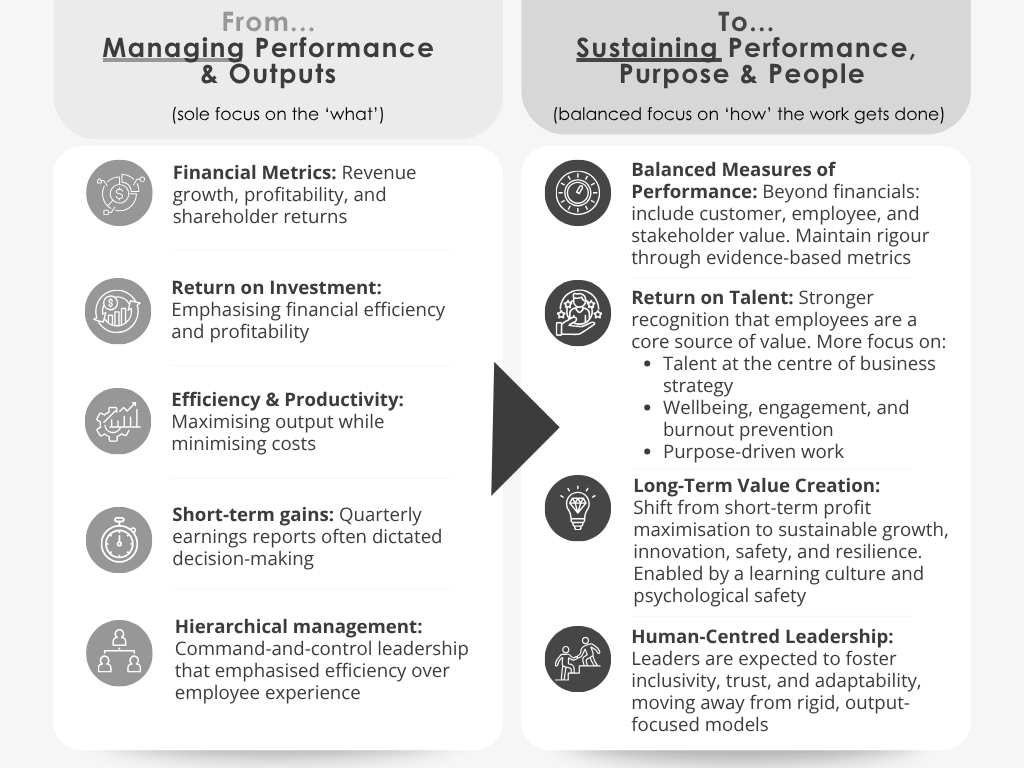
We’re seeing a clear shift from:
- managing performance (outputs, short-term metrics)
to - sustaining performance (people, purpose, long-term value)
That means broadening the lens:
- looking beyond financials to customer and employee outcomes
- focusing on return on talent, not just capital
- designing for resilience and adaptability, not just efficiency
So what?
Performance isn’t always a neat upward curve. It’s a complex, evolving system of people, processes, and trade-offs.
We argue that Leaders need to be more:
- intentional about how they define performance
- curious about what’s really driving (or blocking) it
- honest about the tensions in their system
That means asking:
- Which tensions should we lean into?
- Which need to be redesigned?
- And which are just getting in the way?
On this subject, we’ve enjoyed reading:
Get in touch
If this resonates with you or your organisation, please reach out to explore how we can help.

Principal Consultant | Organisational Psychologist
We are all about organisational health, which separates good organisations from the great. Whether our clients are at the top of their game (and want to remain there) or are in ‘turnaround’ mode, we all need to work on our organisational health.
Whatever the situation, be it a strategic conundrum, a market opportunity, or an operational gripe, we combine the art and science of organisational health to help our clients improve and excel.
Please visit the firm link to site