

Pittsburgh once powered America’s industrial economy, and it is now galvanizing the era of artificial intelligence. This week, Carnegie Mellon University — the birthplace of AI(opens in new window) — and the AI Strike Team hosted a first-string lineup of global visionaries to highlight the city’s power at the intersection of sport and innovation during NFL draft week(opens in new window).
“Powering the Future of Sport: A Draft Week Showcase,(opens in new window)” was a sports-themed day of engaging discussions, live robotics demonstrations and industry innovations on AI’s extraordinary potential to transform the future of sports. Hosted at CMU’s Robotics Innovation Center(opens in new window) (RIC) at Hazelwood Green, Carnegie Mellon University President Farnam Jahanian said the site reflects the evolution of the Steel City and its vitality.
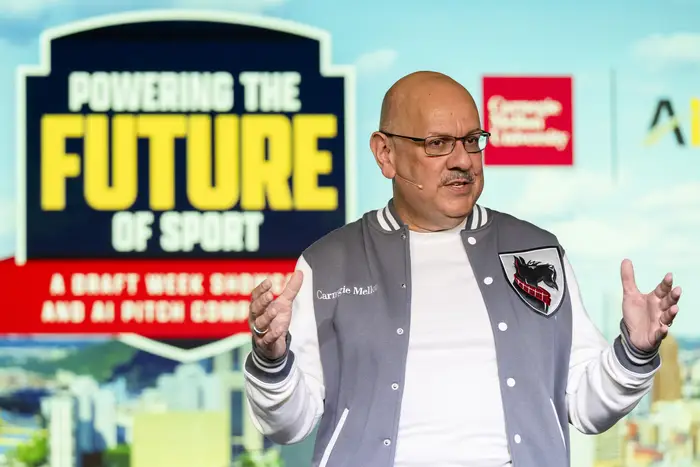
“Sports have always been one of Pittsburgh’s great unifiers,” Jahanian said. “After all, this is a town where your Sunday best means wearing black and gold. And you can see that same spirit across this region—in the way people, ideas and technologies are coming together to build a truly exciting future.
Reinforcing Pittsburgh as a global AI and robotics hub
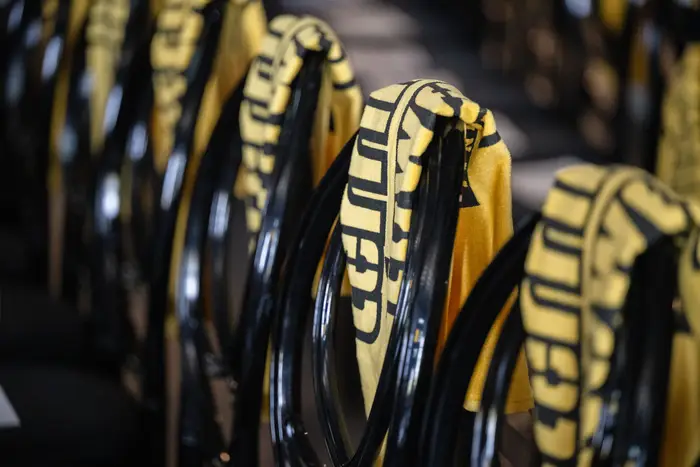
Hundreds looked on from chairs draped with Terrible Towels as Pennsylvania Gov. Josh Shapiro took the stage at the Showcase and talked about making the region and the state more competitive for investment and development. He underscored CMU’s role in driving that change.
“The center of the AI universe, I believe, is not just in Silicon Valley but it’s here in western Pennsylvania,” Shapiro said. “In part because of the great work that the Strike Team is doing here, the amazing brains that you are nourishing and developing at CMU — you are the incubator for AI growth across this country, and across the globe. Big things are happening again in Pennsylvania.”
Joanna Doven, CEO of the AI Strike Team and CMU alumna, said as the Pittsburgh region serves as a beacon for AI innovation, all types of industries, including sports, need to be included in the discussion.
“I see AI as being a great equalizer in that all sectors need to talk together more,” she said.
Jahanian highlighted the importance of bringing together AI, information technology, deep tech and scientific discovery from the innovation economy with traditional strengths of the industrial economy to ensure Pittsburgh, Pennsylvania and the country can compete globally.
“This is a region where making things still matters, and where robotics, AI and emerging technologies are expanding what people can do,” Jahanian said. “This is also an ecosystem where both public and private partners are working side by side to turn ideas into real world impact and a training ground where the next generation can see a pathway into the future.”
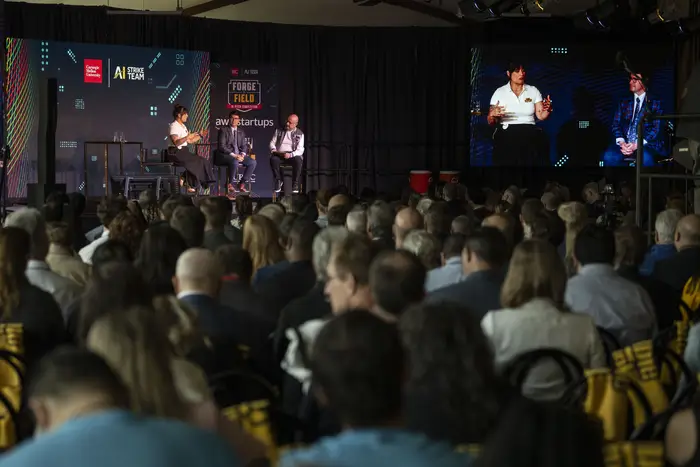
Allegheny County Executive Sara Innamorato touted the city’s robotics and AI ecosystem, institutions such as CMU, major employers located here and the entrepreneurial spirit and partnerships across sectors.
“When you come to Pittsburgh, you will be so surprised, you will not want to leave,” Innamorato said.
Pittsburgh Mayor Corey O’Connor told the audience it’s all about telling Pittsburgh’s story.
“Right now we have a lot of talent that’s all over the city with great universities, but also on the business side,” O’Connor said. “We do a good job of selling ourselves, we just have to have the link to get you here and then the city and our residents do all the work after that.”
Highlighting physical AI and sports
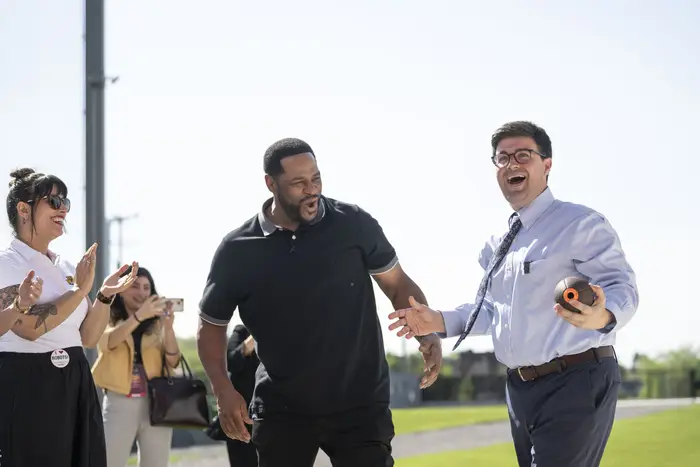
President Jahnanian led a tour of more than a dozen demonstrations of interactive robotics from CMU researchers, affiliated companies and collaborators. During that tour, which included robots that climbed rocks, charted attendees’ baseball swings and tossed footballs, O’Connor dove to catch a pass thrown by a humanoid robot.
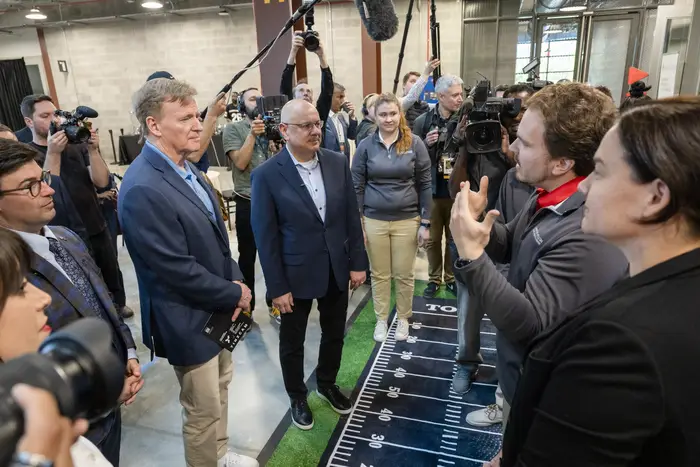
NFL Commissioner Roger Goodell joined the tour, along with Steelers legends Jerome Bettis and Will Allen, who is also a partner and co-founder at Magarac Venture Partners. As they walked from one demo to the next, investors, AI founders, CEOs and civic and sports leaders saw first-hand how AI and other technologies are transforming the way people experience sports.
As the event shifted from demonstrations to panel discussions, Chip Ganassi, CEO of Ganassi Racing, reiterated that sports will continue to evolve with technology.
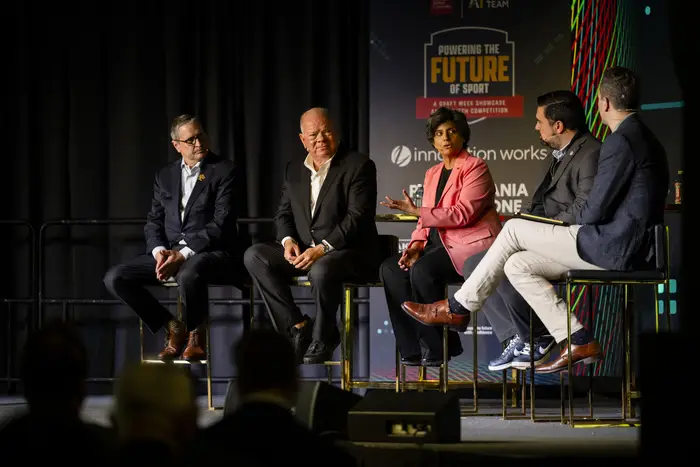
“The human element will never leave, but AI 20 years from now will be through and through,” he said during a huddle of heavy-hitting sports-industry executives hosted by Baker Machado, co-host of the “Front Office Sports Today” podcast.
Physical AI serves as “data amplified,” explained David Morehouse, executive vice president for strategy with the Pittsburgh Steelers. “It doesn’t replace gut instinct, but it takes data, amplifies it, processes it and delivers it.”
Fellow panelist Priya Narasimhan, a CMU professor of Electrical and Computer Engineering and the CEO and founder of YinzCam, talked about how AI makes it possible to harness the data collected in real-time to automate workflows and improve the sports fan experience, including increased personalization into the future.
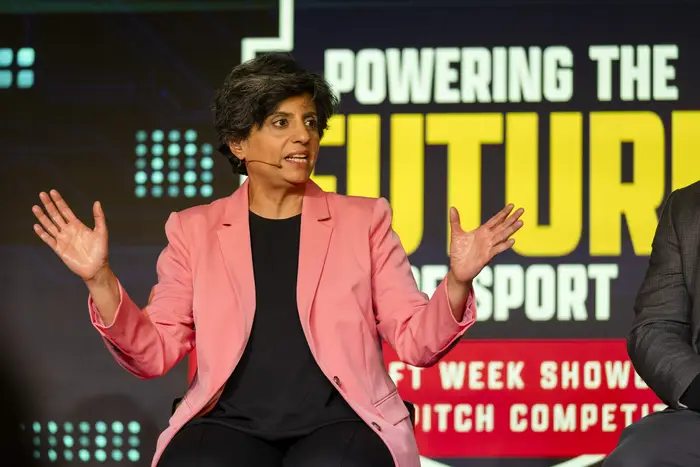
“Everyone will expect that their data will benefit them in real time,” she said.
Josh Helmrich, senior director of media strategy, business development and Next Gen Stats with the NFL, said combining data and human insights using AI allows for faster results.
“AI makes the outputs better, but you still need to be able to communicate those outputs and make them actionable,” he said, adding that players will be smarter about how they play in the next few years. “I think that is what’s still a huge opportunity.”
Investing in the future
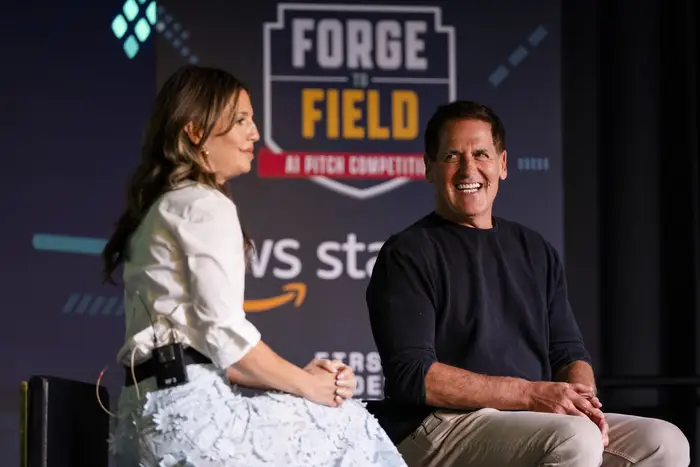
The day’s conversations expanded beyond technology as Doven sat down with entrepreneur and Pittsburgh native Mark Cuban to focus on how the city became known for AI innovation and how it can leverage its economic resources to attract future investments.
“You just want the smartest people that you can find to come in and invent new ways to leverage the technology to give yourself a competitive advantage, knowing that every other team is probably considering the same thing,” Cuban said. “When you have the resources here, it gets a lot easier. And you know, Pittsburgh is such a great sports town that I think you’re going to get the best of both worlds, where the fans appreciate it, but the people you hire will be all in to make it happen.”
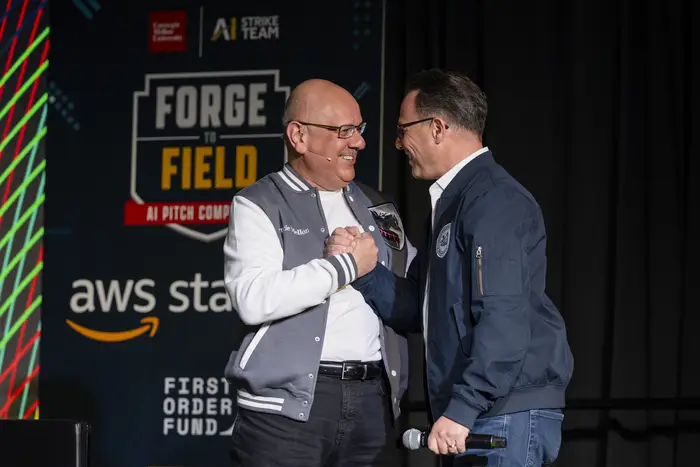
The “Forge to Field AI Pitch Competition” served as the grand finale, identifying the biggest breakthroughs at the intersection of sport and artificial intelligence. The “Shark Tank”-style competition featured six finalists and a piece of the $1.825 million prize pool.
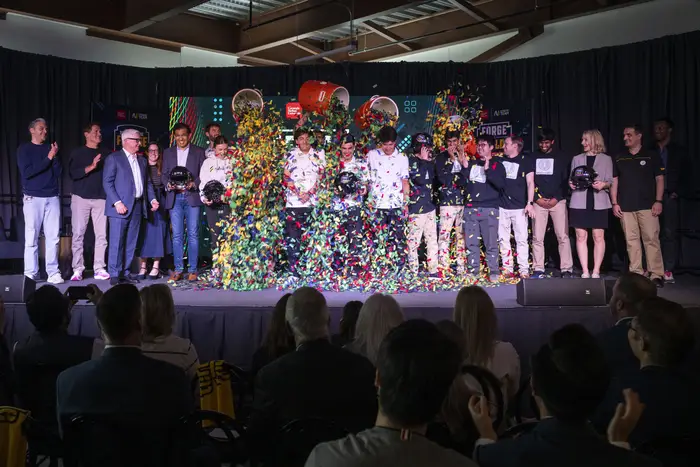
“Today’s event highlighted the uniqueness of Pittsburgh and the breadth of our skills,” said Jeanne Cunicelli, president of UPMC Enterprises and executive vice president with UPMC. “It was fantastic to see the enthusiasm of the future generation of inventors pushing our region forward. While Draft Week showcases the future of sport, the pitch competition demonstrated that innovating for athletes benefits everyone, including our patients.”
Jahanian ended the day echoing Cunicelli’s optimism with an eye on the future.
“Pittsburgh’s story is still being written,” he said. “And we’re excited to see what comes next.”
“Carnegie Mellon University is a private research university in Pittsburgh, Pennsylvania. The institution was originally established in 1900 by Andrew Carnegie as the Carnegie Technical School. In 1912, it became the Carnegie Institute of Technology and began granting four-year degrees.”
Please visit the firm link to site