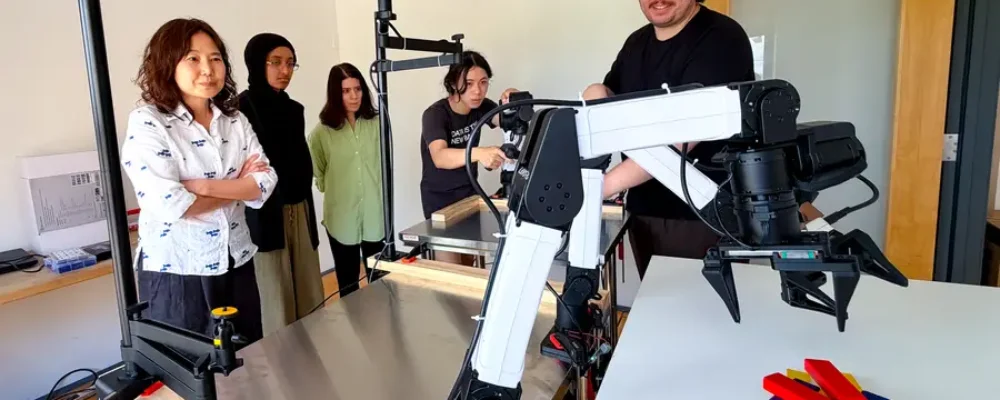


Carnegie Mellon University(opens in new window) took the spotlight in the sports tech world Wednesday as leaders in athletics, investment and artificial intelligence gathered at CMU’s Robotics Innovation Center(opens in new window) for a first‑of‑its‑kind event “Powering the Future of Sport: A Draft Week Showcase.(opens in new window)”
Panels, live robotics demonstrations and expert discussions on how emerging technologies are reshaping the sports industry set the stage for the afternoon’s “Forge to Field AI Pitch Competition,(opens in new window)” where six startups from across the country presented market‑ready sports innovations.
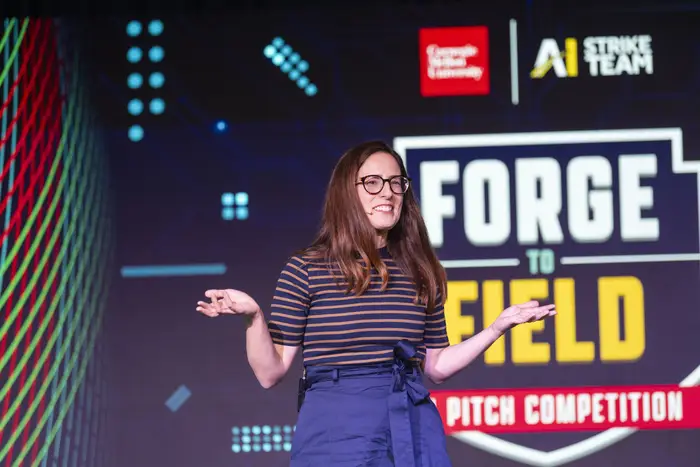
”Carnegie Mellon and Pittsburgh have long been a hot bed of innovation. Our research is at the leading edge of economy-building applications, including in AI, autonomy and robotics, and so it’s natural that we’re at the center of the intersection of sports and tech during draft week with the world watching,” said Meredith Meyer Grelli(opens in new window), managing director and interim executive director of CMU’s Swartz Center for Entrepreneurship.
“The investments announced today — including additional impromptu commitments from Mark Cuban, Ed Stack, First Order Fund and UPMC Enterprises beyond the initial $1.75 million prize pool — underscore the unique power of this moment and the incredible innovative spirit that the ‘Forge to Field AI Pitch Competition’ captured,” she said.
Fueling the next generation of sports tech innovation
The Swartz Center led a review process that narrowed the applicant pool to 30 semifinalists. Those teams then underwent several additional rounds of evaluation by judges and sponsoring organizations selecting the finalists.
Finalists faced off in a “Shark Tank”–style format for awards from a $1.75 million prize pool, which included up to $1 million in Amazon Web Services (AWS) Startups Activate Credits. For early stage AI companies, those investments function as critical fuel — covering the intensive computing costs required to train, test and deploy models and often giving young teams months, in some cases up to a full year, to advance their technology.
“Our commitment to startups is longstanding and a key tenet of how we serve the tech entrepreneurship ecosystem,” said Deap Ubhi, director and global head of technology for startups at AWS. “We have deep and abiding faith at AWS that startups are the life blood and really act as the inspiration for other tech and business leaders.”
Here are the teams that rose to the top
The startups showcased a wide range of emerging sports tech innovations, with each delivering a 3-minute rapid‑fire pitch and fielding a short Q&A before the high-profile judges panel announced investment awards from the AI Forge Prize pool.
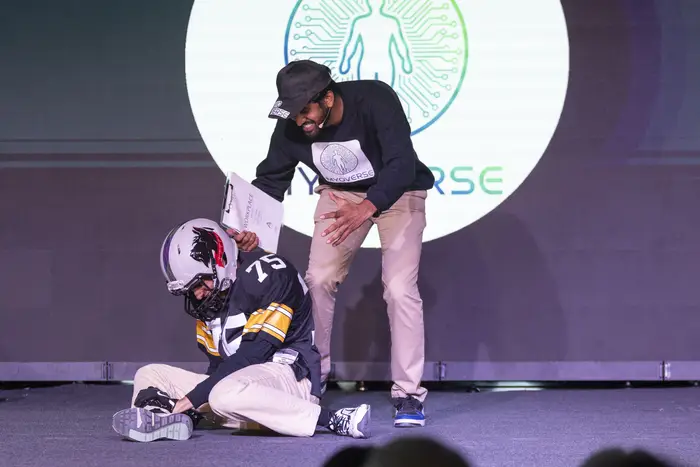
MyoVerse was offered a potential investment of $75,000 from UPMC Enterprises, $125,000 from First Order Fund and $200,000 in AWS Startups Activate Credits for its wearable neuromuscular sensing and AI analytics platform, which turns muscle activity into real‑time biomarkers for performance, rehabilitation and clinical decision-making.
“Now is one of the most exciting times in the history of sports,” co-founder Jonathan Shulgach said. “Teams are investing in data and technology more than ever to keep athlete performance and development at their best.”
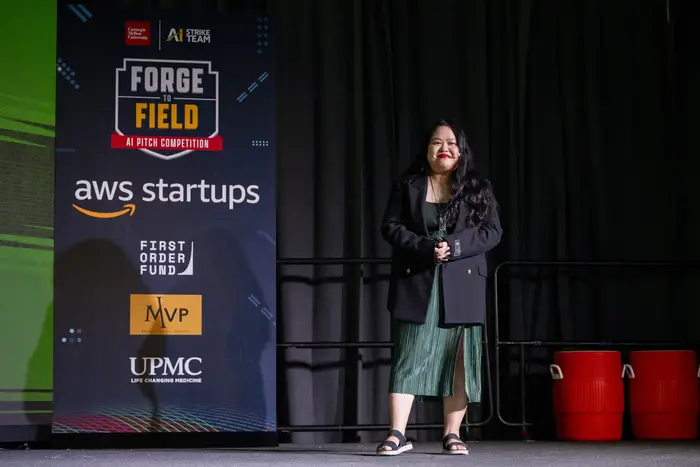
Peachy Day was offered a potential $125,000 investment from UPMC Enterprises, $50,000 in AWS Startups Activate Credits and a commitment by UPMC Enterprises for use of their virtual de-identified health care data testing environment. Its migraine‑prevention app uses predictive health tracking, coaching and neurologist‑led care to reduce pain and speed access to treatment for people living with migraine or post‑injury headaches.
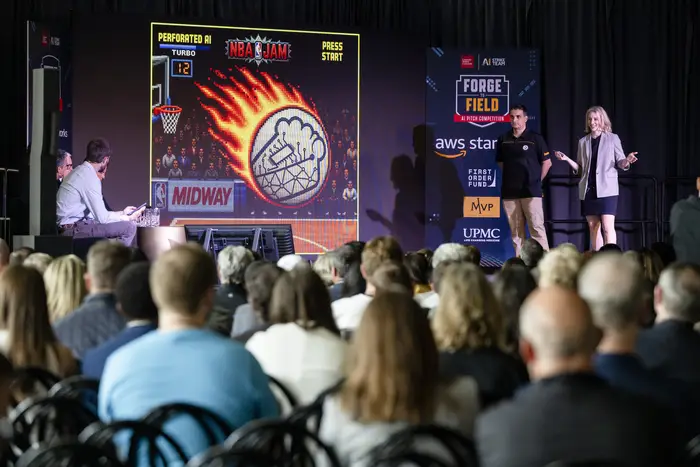
Perforated AI was offered a potential investment of $125,000 from Magarac Venture Partners, commitments from Mark Cuban and UPMC Enterprises, plus an additional $50,000 in AWS Startups Activate Credits. The company applies a neuroscience breakthrough to live sports by turning real‑time player data into immediate injury‑risk signals, helping teams intervene before minor issues become major injuries.
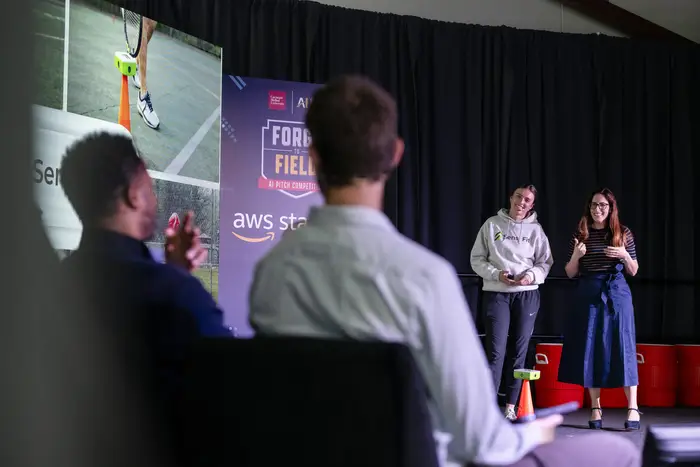
Izzy Hunter fired up the audience when she marched onstage hoisting an orange construction cone, a new tradition started by Pittsburgh Pirates fans, before introducing her startup, Sensi Fit.
Sensi Fit was offered a potential investment of $125,000 from Magarac Venture Partners, plus a potential investment of $125,000 from UPMC Enterprises Enterprises. Ed Stack, executive chairman and chief merchant, DICK’S Sporting Goods; Foot Locker, also committed access to a testing environment. Sensi Fit offers an all‑in‑one sports performance system that captures key data and delivers instant, actionable feedback for coaches, athletes and parents across any sport and at any level.
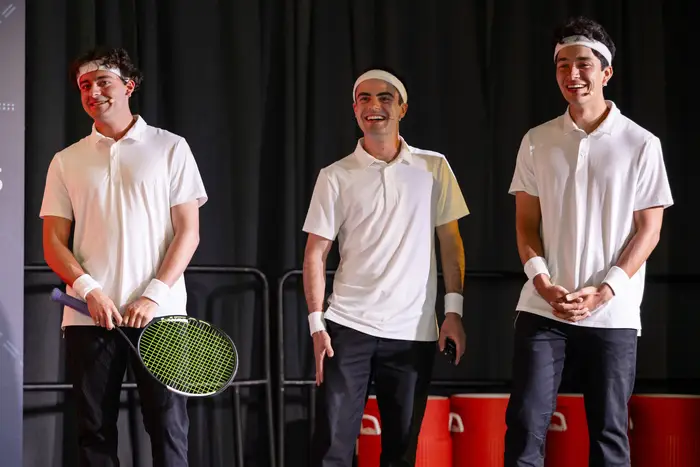
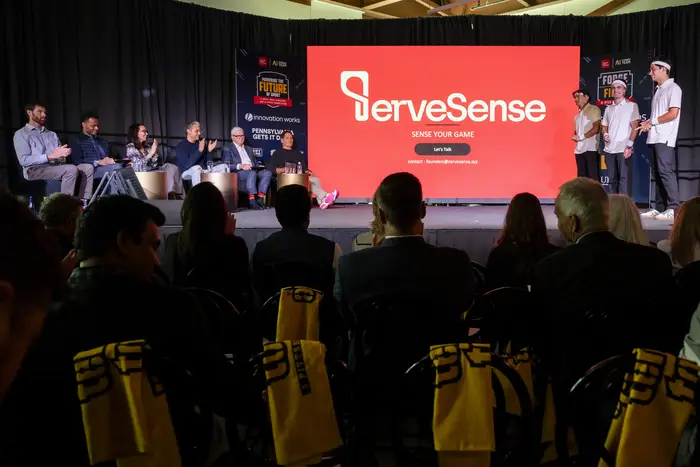
The co-founders of ServeSense donned headbands and wielded tennis rackets as they pitched the potential of their startup in measuring improvement for people who play racket sports.
“We measure every swing you take,” co-founder David Hershenson said. “People blink, but our sensors don’t. We translate measurements into action. Our app will track users’ improvement week over week. For the first time, improvement is measurable, not just something you hope is happening.”
Troy Demmer, co-founder and president of Gecko Robotics and co-founder and general partner of First Order Fund, turned to the audience and asked them to raise their hand if they play racket sports and who among them wanted to get better.
“All right, we got 100 customers right here!” Demmer told the finalists.
ServeSense was offered a potential investment of $125,000 from First Order Fund, plus commitments from Mark Cuban and Ed Stack. The company builds hardware‑software tools for racket‑sport athletes, beginning with a swing‑tracking sensor paired with an AI coaching engine that delivers individualized feedback.
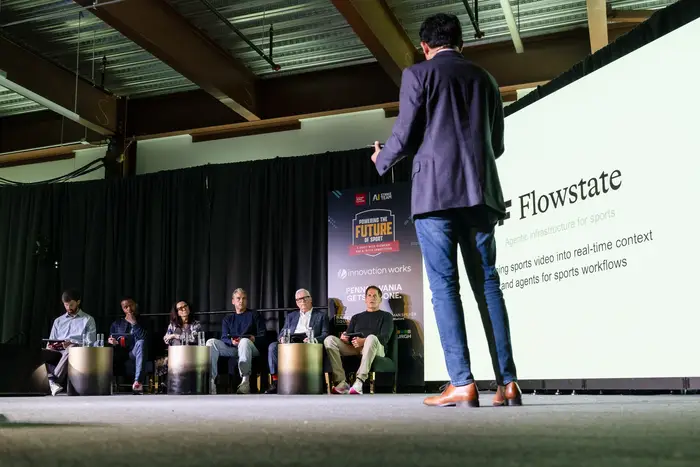
Sahil Shah drew upon his experience as a student‑athlete and his training in computer vision at CMU to create Flowstate. The year he became captain of his college team, based in a remote town in India, there was no coach. He wasn’t just expected to perform on the court, but also to step into the roles of coach, manager and operator.
“That experience stayed with me,” Shah said. “In sports, the people closest to the action are often overloaded, and when that happens, performance suffers. At CMU, I studied computer vision and started applying it to hard, real‑world autonomy problems. Sports and computer vision were always the two worlds I wanted to bring together.”
Flowstate received a $300,000 investment of AWS Startups Activate Credits for creating agentic infrastructure for sports through AI Watchers that analyze multi‑camera video and generate structured context for highlights, coaching analysis, sponsorship measurement and sportsbook content.
Three startups that did not present at the event — Deleon, Oryn AI Inc. and Pierogi Therapeutics — will also receive potential AWS Startups Activate Credits investments. Deleon will receive a potential $200,000 investment and Oryn and Pierogi will each receive a potential $100,000 investment.
Inspired by football tradition, coolers showered the finalists with confetti after the prize packages were announced.
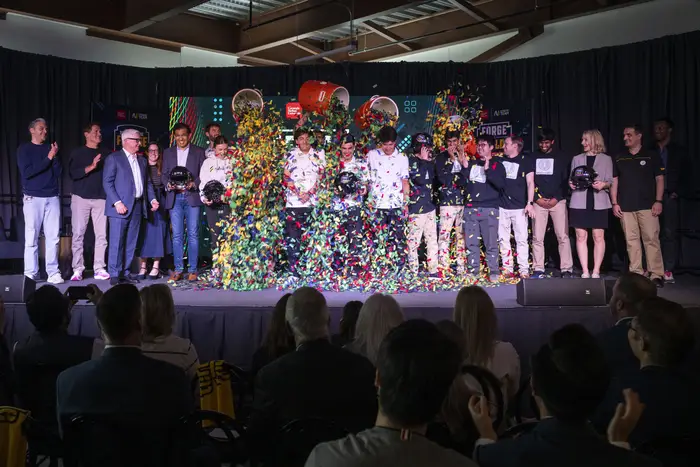
“We are so excited to support these emerging tech founders at the intersection of AI and sport,” Ubhi said. “We run into so many founders who can trace their roots to Carnegie Mellon. Coming from the West Coast, it was such an eye-opening experience for me to see the robust ecosystem supporting tech and innovation represented here in Pittsburgh.“
“Carnegie Mellon University is a private research university in Pittsburgh, Pennsylvania. The institution was originally established in 1900 by Andrew Carnegie as the Carnegie Technical School. In 1912, it became the Carnegie Institute of Technology and began granting four-year degrees.”
Please visit the firm link to site