


Transcript
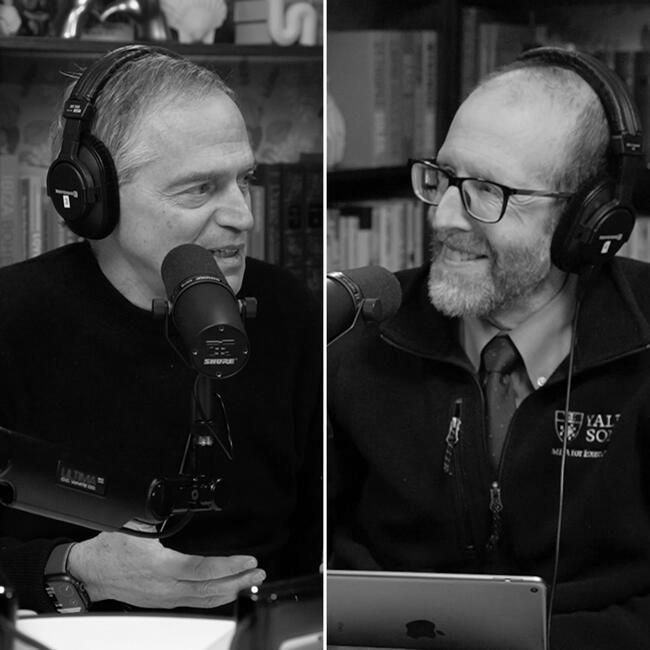
Harlan Krumholz: Welcome to Health & Veritas. I’m Harlan Krumholz.
Howard Forman: And I’m Howie Forman. We’re physicians and professors at Yale University. We’re trying to get closer to the truth about health and healthcare. Ordinarily, we have a guest. Once a month, we go into the studio, and once a year, we get to host our graduating podcast assistant. Today it’s Tobias Liu. So, welcome to the podcast.
Tobias Liu: Thank you. It’s great to be here.
Howard Forman: And it really is so much fun to have you here. And it’s both an end of an era and the beginning of an era, and we’ll get to that in just a couple of minutes. But I just thought this is such a great opportunity for our listeners to hear about just what you’ve done at Yale, and then we can talk a little about the podcast. So, I looked at your résumé yesterday, and I realized that you were a…
Harlan Krumholz: You realized he’s extraordinary.
Howard Forman: He’s a varsity swimmer. He’s a violinist. He has, while at Yale, worked in the HAVEN Free Clinic, he’s been a dual major in economics and molecular cellular and developmental biology. I mean…
Harlan Krumholz: He’s a master at making me feel inadequate.
Howard Forman: I know, we were talking about this yesterday. So, Harlan and I happened to go for a walk yesterday. We were talking about when Harlan was a student here, how easy it is to feel inadequate. I of course said I did not have to…
Harlan Krumholz: Because there’s so many talented people.
Howard Forman: Right.
Harlan Krumholz: Extraordinarily talented.
Howard Forman: I luckily did not have that opportunity because I did not go to Yale. But tell us about what are the most exciting activities you’ve had at Yale. Let’s put aside the podcast. Obviously, that’s number one.
Tobias Liu: Yeah. Like Howie mentioned, I play the violin. I’m very involved in music on campus. I think my biggest role music-related is I’m the president of the Yale Symphony Orchestra, which is a group I’ve really had the privilege to be a part of for the past four years. And I think to me, music making, especially in this time and age, is so important because it really captures that sort of human spontaneity that I think we all are craving a little more of, with all of the tech and AI in the world today. So, definitely that. I also work in a neuroscience lab on aging and genetics interactions and Alzheimer’s. So, that’s been really fun as well.
Howard Forman: And you’ve also worked with Joe Ross and published a paper with him.
Tobias Liu: Correct.
Howard Forman: And I hear through the rumor mill that you’ve taken a job next year as a gap experience before medical school.
Tobias Liu: I will be very excited and privileged to be working with Dr. Krumholz next year.
Harlan Krumholz: Compared to the experiences you had, I don’t know…. Let me ask you this, Tobias, because it is so impressive what you’ve done. Just tell me a little bit about your time management skills, because when I look at someone who does so many things so well, I just wonder, how do you fit it all into a day?
Tobias Liu: That’s a great question. Sometimes I don’t, but I think it really starts with me just really enjoying everything I do. I think it’s Bulldog Days right now, so I’ve been talking to a lot of pre-frash that are trying to decide how to do everything at Yale. And I think for me, there is a time for a lot of us at Yale where we blow past our limits and we do too much and take on too much. And that was definitely me sophomore year, maybe junior year a little bit. But I think figuring out where those limits are and really knowing that the things I do now are all things I really love to do and I’m passionate about, I think makes any kind of time management really enjoyable.
Howard Forman: Let me ask you this question, which may be very controversial, but Harlan’s asked me it. Has Claude helped you at all?
Tobias Liu: Definitely. I think one of the struggles right now as a student is, I guess, figuring out when to use AI and when to not. I think for me personally, I try to stay away from it in classes that involve reading and writing because I enjoy using those parts of my brainstem, but it definitely helps a lot if I’m doing administrative tasks or trying to manage people helping me write an email or organize task lists or schedules.
Howard Forman: That’s great. I mean, I’m blown away by the uses now, and I realize more and more that it’s just going to be part of our lives in the same way a calculator helped us do math. You can’t avoid it.
Harlan Krumholz: And what do you see for your future now? You’ve talked to me about it, but just as sharing with our listeners, what’s your hope as you go on now, as you graduate and so forth?
Tobias Liu: I’m planning on applying for medical school at this coming cycle. So, after working with Dr. Krumholz next year, I will hopefully be attending med school. I think my main motivation for becoming a doctor, I think beyond my interests in healthcare, which were really shaped by Dr. Forman and my time on the podcast, I think goes back to my interests in music. I think the idea that in music, it’s really all about how do you communicate with the person in front of you and shaping experience in a singular room. And I think to me, that’s why despite I think my interests might lie more on the system-level thinking, I think I want to be in the room and in those patient interactions.
Howard Forman: That’s awesome. I mean, it’s really nice to hear. And there are a lot of amazingly talented musicians that go into medicine. And I think even Yale now, I think just yesterday I got the email that the Yale Medical Symphony Orchestra has their scheduled conference coming up in the next week or so. And just a lot of talented people that come from a background of music, math, and science that go into medicine.
Harlan Krumholz: So, you’d be interested that one of the projects that we’re working on is to try to understand patient trajectories. Often what we’ve done is understand people sort of cross-sectionally. This is a person with hypertension, heart failure, blah, blah, blah, and to describe them as if it’s sort of a static condition that people have and then look forward, what’s their prognosis, what’s going to happen, how do we help them? But we haven’t incorporated to a great extent their history over time. And what I’ve been expressing that is everyone’s got a song. And all we’ve been saying is what are the notes in the song? But we haven’t been able to express, is there a crescendo? Is there a decrescendo?
I mean, what is the pattern that we can see in people’s lives through healthcare utilization, through their experience with health? And so, with the advanced computing power, we’re able to actually try to put together each person’s song and to try to understand what’s the next stanza, what’s the next piece of it.
Howard Forman: It’s very cool.
Harlan Krumholz: So, maybe that you’ll be able to help us see those patterns.
Howard Forman: It’s amazing.
Harlan Krumholz: Yeah.
Howard Forman: This is off the cuff, but I want to hear from you, what would our listeners not know about in preparation for the podcast that you find that you just do regularly? Like what is your process for preparing for the podcast and what might be something they’d like to hear?
Tobias Liu: I feel like I always look forward to doing prep documents for the podcast. I usually start the week before, so I’ll Google the guests, try to get a sense of who they are. And if I’m walking to class, I’ll listen to a podcast on them. Maybe if I’m brushing my teeth, I’ll read an article that they wrote. And I think usually by the end of the week, I’m trying to mentally put into a bucket what their profile is like. So, if it’s a scientist, sometimes they have so many different specific research interests. So, trying to bucket everything into like, for example, with Dr. Iwasaki, here’s her vaccines work, here’s her mucosal services work, etc.
And I don’t know, I think for me, it’s just so much fun getting to dig deeper into a person. You kind of fall into these little rabbit holes of just chasing down information and trying to learn more about these incredible guests.
Howard Forman: It is a lot of fun to read the dossier, as I call it, because you guys do find things that are just, as Harlan would say, gold. I mean, just really great snippets that I would not have found. So, it’s amazing work that you all do.
Harlan Krumholz: I hope you picked up on what he said, though. He said while he’s brushing his teeth, he’s reading something about that. Now I know the secret to the productivity.
Howard Forman: That’s right. Parallel processing. That’s right.
Harlan Krumholz: That’s great.
Howard Forman: So, we both wanted to be able to give you this small token of our gratitude, which is a clock, and I’m just going to read it or maybe I’ll let you read it and you could reverse the names as Harlan would prefer.
Tobias Liu: Thank you so much. “To Tobias Liu”—myself—“with gratitude for your incredible service, Yale Health & Veritas Podcast, 2024 to 2026, Howie and Harlan”—or “Harlan and Howie,” right.
Harlan Krumholz: Howie and I were quibbling about that.
Tobias Liu: “April 22nd, 2026.”
Harlan Krumholz: Howie should go first.
Tobias Liu: Thank you so much. Thank you so much.
Howard Forman: It’s been so great having you and we are grateful that we will not miss you because you’ll be around for the next year, but we are grateful for your service. You’ve made a huge difference, not the least of which is you launched our Instagram account, but so many other things.
Tobias Liu: It’s just been such a privilege and joy to be able to be on the podcast the past two years. I think the two of you have been my closest mentors at Yale and have really shaped how I view my career in both, I guess, my daily human interactions as well.
Howard Forman: We will always be here.
Harlan Krumholz: Thank you, Tobias.
Howard Forman: Thanks very much.
Harlan Krumholz: You find the best people, Howie. Oh my God, that was…
Howard Forman: That was gold.
Harlan Krumholz: That was gold, baby. I can’t recreate that. That was a terrific interview. He’s a great kid and…
Howard Forman: We’re very lucky to have him. You are so lucky to have him next year.
Harlan Krumholz: I am so lucky. I’m so lucky. And next year’s going to be looking up for me.
Howard Forman: That’s for sure.
Harlan Krumholz: Yeah.
Howard Forman: Change the trajectory.
Harlan Krumholz: All right, Howie, what’s on your mind this week?
Howard Forman: Yeah.
Harlan Krumholz: Because we’ll be going back and forth. This is our in studio, and it’s great to see you.
Howard Forman: Yeah. No, I know. And I love doing this and I want to hear what you think about this. This was a fun segment for me to create. So, one of the things I find genuinely humbling about the history of medicine is that anti-vaccine activism is not new. It’s not a product of social media. It’s not cable news, not any modern pathology. It’s been with us almost as long as vaccines have. And I want to tell you about someone who puts a very sharp point on that. Alfred Russel Wallace. If that name rings a bell, it should. I didn’t know him. This was a man who independently of Charles Darwin conceived the theory of evolution by natural selection.
He was a peer of Darwin’s, nationally revered, a fellow of the Royal Society holder of the Copley Medal, one of the greatest scientific minds of the 19th century. And he wrote not one but two books arguing that vaccines were dangerous and ineffective. And by “vaccines,” he mostly means smallpox. He marshaled statistics, he made logical arguments, and he wrapped it all in the language of personal liberty, that the state had no right to compel vaccination, that individual autonomy trumped any obligation to the community. Sound familiar? Now, here’s what makes this so sobering.
In the roughly 70 years between Wallace’s writings and the launch of the WHO’s intensified eradication campaign in 1967, hundreds of millions of people died from smallpox. We actually talked about this on a recent episode. The eradication of smallpox is one of the most breathtaking achievements in the history of public health. And in the 40-plus years since eradication was declared in 1980, the death toll from smallpox has been exactly zero. Wallace was wrong—demonstrably, catastrophically wrong, not because he was foolish but because he was anchoring to observation and logic without the rigor of controlled data. And that’s the lesson I think we need to keep in mind in an era of so much misinformation.
Wallace observed things. He was a brilliant observer, but observation without systematic data will lead even the greatest minds astray. We see this echoed today when parents observe their child receive a vaccine and then observe the emergence of autism. That feels like evidence. It looks like a pattern, but the data from millions of children across dozens of countries tells a different story entirely. Healthy skepticism about novel treatments and technologies—absolutely essential, but it has to be anchored to science. Wallace should be a warning to all of us. Brilliant people can be wrong, and the consequences can be measured in human lives.
Harlan Krumholz: Yeah. It’s a good story, Howie, and a cautionary tale, really. I think it makes sense to me. There’s something counterintuitive about injecting something in your body, which is getting your own immune system activated as a way it means to protect yourself against something in the future. So, it sort of makes sense to me that humans have had trouble sort of, “Let me infect you with cowpox so that you’re protected from smallpox.” It doesn’t surprise me that it takes some time.
What does amaze me is that people are willing to embrace things with almost no evidence as like the peptide thing or based on 14 people and all this stuff, and yet something that’s got a real preponderance of evidence showing benefit hits headwinds. And that does surprise me. But I think that we just have to keep making sure people are making informed choices.
Howard Forman: It’s hard for me to tell sometimes on social media how many of the truly bright people—and I mean “bright” because they’ve accomplished things, they’ve graduated from graduate school and all that—are taking an anti-vaccine stance because they’re actually grifting, like they’re conning people, or they truly believe it. I’m certain that some of them truly, truly, truly believe it. And it’s despairing for me to see it. And even in Kennedy, I mean, the way he sort of plays loose around vaccination troubles me because he comes from a very, very well-educated family. He himself has had a great education. He is clearly anchored to this. I believe he believes this.
Harlan Krumholz: But I mean, it might behoove us to sort of deconstruct a little bit the issue about vaccines. I mean, the word “vaccines,” okay, that talks about a lot of different vaccines. There’s some vaccines that are really best buys, meaning incredible value.
Howard Forman: Yup.
Harlan Krumholz: We are highly advocating for them.
Howard Forman: Yes.
Harlan Krumholz: There are others that are a little more discretionary.
Howard Forman: Hundred percent!
Harlan Krumholz: And people can choose for themselves, and they’re not disadvantaging themselves terribly. It’s just a matter of…
Howard Forman: I agree. Oh, I totally agree.
Harlan Krumholz: And so, I think we really need to be talking about this. I mean, this measles thing still really bothers me, and especially since it’s affecting kids, kids who are being deprived, the opportunity to be protected.
Howard Forman: And we’re literally watching, real-time, the unraveling of so much progress.
Harlan Krumholz: And we’re unraveling progress. So, I think it would help us not just say anti-vax or not, but where are we really putting pressure to say, “This is really strong benefit. This is benefit, but—.” You know, there’s some spectrum where people can decide. But yeah, I think we’re in this moment too where people have platforms that with very little money, it doesn’t take much money to get a big platform.
Howard Forman: That’s right.
Harlan Krumholz: And misinformation and balance. That’s right. And we’ve got to continue to say, this is where science sits. That doesn’t mean the science won’t evolve. Again, science is “progressive and self-correcting.” Francis Collins taught me that, that phrase, and I love it. And so, we’re not saying we know everything, but we’re saying this is what we know today. Today. And we’re trying to make best decisions based on that.
Howard Forman: Totally agree.
Harlan Krumholz: All right. Let me get to something, Howie, that came out this week. It’s not exactly healthcare, but I think it’s deeply connected to it, and that’s trust, trust in higher education. So, of course at Yale, we’re very aware that there was a report that came out this week, but it was also reported in the national news that takes really a hard, honest look at why public confidence in colleges and universities has been declining. And what’s interesting about this report is it was actually commissioned by the university.
So, this wasn’t a bunch of professors who were sort of going rogue and coming out with a report or a group that had one view or the other. It was actually the university asking a group to get together. And it doesn’t just make the point outward. It really looks at our own institution and it’s a very reflective look and it asks in a very direct way what role universities themselves have played in the erosion of trust about universities. Now, you and I have been part of conversations about this long time. Actually, there was a dinner at Mory’s we attended—
Howard Forman: That’s right.
Harlan Krumholz: …to start this conversation with many esteemed professors at Yale who were asking this question. Some of those professors were on this committee and it was… and you and I weren’t on this committee.
Howard Forman: That’s correct.
Harlan Krumholz: But we’re very familiar with this debate. And I think it focuses on a deceptively simple question. What are universities for? And the argument it makes is that a lot of the loss in trust is rooted in a loss of clarity about the purpose of universities. And at its core, the report reminds us that universities exist to do something quite specific: to create, preserve, and share knowledge. That’s the mission. And when we first got together with this group, that was what they kept coming back to. Is the mission of the university to heal the world, to have a certain political orientation, to feel like there’s a certain way everything should be, or is it to create, preserve, and share information?
This report connects that loss of clarity to a set of very concrete concerns that many people have that extends beyond that. So, saying this is the purpose. And then they say the cost of higher education has become too high and progressively higher every year. The admission process feels opaque and favors certain groups. There’s a question about whether campuses truly support open inquiry, and there are questions about whether academic standards are as meaningful as they once were, talking about the grade inflation. And what’s important is that these are not isolated, but they’re symptoms of something deeper. They reflect this growing gap between what universities are doing and how they are being perceived.
And that brings us back to trust. And one of the most powerful lines in the report is that “trust is earned by doing what you say you’re going to do—and doing it well.” And that idea may seem kind of simple, but it’s also about the communication of us in the university and academia with the public about what it is that we think our mission is—to be transparent about the decisions that are made, to be willing to examine where we fall short, and to make these observations obvious to the public and to make reforms that particularly address issues about cost, fairness of the admission policy, the ability for people to have open inquiry on campus, and so forth.
And I thought what was really interesting about this report also was that our president embraced it.
Howard Forman: Of the university, yep.
Harlan Krumholz: Of Yale University. So, this was a report from Yale University reported nationally, but it was one that was tough, tough on universities, tough but honest, and I think frank, and asked about, are we clear about our purpose? Are we living up to it? Are we making it visible in ways people can understand and trust? We are proud of the accomplishments. And when we walk around the campus, we look at the students, we look at how they’re thriving.
Howard Forman: That’s right.
Harlan Krumholz: We look at people like Tobias, we’re so proud, but we are in a moment, and the president of the university essentially charged a group of people who were going to be clear-eyed and tough. And then she embraced the report and said, “Yes, we’ve got to address these things.” And not to placate the feds or not to, this isn’t about the administration, but it’s about us. It’s about us. And I think many of us on campus read this and said, “Yeah, this is right. We need to grow. We need to improve. We need to do better.”
Howard Forman: I thought overall most of the report I agreed with, I was actually shocked by some people that I know that took umbrage with it, that thought it was horrible or that it was…
Harlan Krumholz: And what was their main concern with it?
Howard Forman: Well, for some people, I think it’s different issues for different people. The free speech issue, I think, is an issue for some people. They think that universities should actually have a moral compass per se, that they should have, take specific positions. I think it’s those issues. I think for some people, it’s this argument that the campus is too liberal and that that’s a bad argument altogether, that it’s liberal because it’s well educated. They want to make the argument that it’s liberal because it’s well educated. It’s liberal because it’s anchored in science, not that it is liberal and that’s biasing people.
Harlan Krumholz: Well, and I think when you and I had some issues around in these discussions, it was because we actually didn’t see liberal or conservative. We saw that there are some things that are just intrinsically right. People on the other side would say, “Well, that’s value-laden.” And we said, “Yeah, but there’s certainly some extremes where the university would be remiss not to stand up for something.” And freedom. Democracy. I don’t know, you know.
Howard Forman: No, and I think by having a strong anchor to free speech, we are speaking to freedom and democracy. And look, the Woodward Report, which is now 52 years old, I think, which is the Free Speech Report for Yale, is still a seminal paper about what our feelings are about free speech. However, over the last couple of decades, there have been numerous incidents that have occurred that clearly are in violation of the spirit, if not the substance of the Woodward Report. And I think people have a very hard time with issues around free speech. They believe in free speech as long as it’s them being allowed to speak. They don’t believe in free speech when someone says something that they disagree with.
And that is perhaps the one thing that we could do much better on this campus with, and that is making certain our students hear the full panoply of arguments around anything and arguments, not provocative statements for the sense of performance, really giving people the idea that there are arguments. And I try to do this in my class. I’m proud of my voting record as a Democrat. I’m proud of the, I mean, but at the same time, I don’t get up there and tell people the Republicans want to do this because they’re idiots. I very often will say, “There is a different perspective from a conservative viewpoint. Here are the arguments.” And people sometimes look at me like I’m evil for even giving voice to it, but we absolutely must give voice…
Harlan Krumholz: You have to open up the lines of communication.
Howard Forman: And it is true on this campus that most students either lean to the left or are afraid to speak from a right-leaning standpoint in open rooms.
Harlan Krumholz: I think the report said the faculty was 36:1 Democrat to Republican or something like that.
Howard Forman: But I found that was one of the only deceptive things in the report because if you live in a blue city and a blue state and you have to register to vote, you’re registering as a Democrat if you want to have any difference in a primary. So, I get a little annoyed with that one.
Harlan Krumholz: Yeah. And I don’t like the valence actually on political parties or actually liberal/conservative. It’s just there are things that we can do that can open up lines of communication, like I said, and cost and fairness within admission policy, all these sort of things that we need to do. But anyway, I thought people listening might want to take a look at this because it really…. Often these reports are snoozers, this one’s not…
Howard Forman: It’s not, and it’s going to keep reverberating.
Harlan Krumholz: It’s not a snoozer at all. Okay, go. What’s your next thing?
Howard Forman: So, you brought up peptides. I want to talk about peptides because this craze comes up almost every day right now in the news among friends, among colleagues. And simply put, a peptide is just a short chain of amino acids, building blocks of proteins. Your body makes them constantly. Insulin, oxytocin, glucagon are common peptides that percolate through our body and are important for our function. These are not exotic molecules. They’re fundamental to human physiology. Now, the wellness industry has latched onto the idea that if you inject additional peptides, you can turbocharge healing, build muscle, reverse aging.
Harlan Krumholz: I want it, baby.
Howard Forman: I know. I know. When I was reading this, I was thinking, yeah. And some of this is not entirely made up. There are peptides with real, FDA-approved uses. Semaglutide, we’ve talked about so many times in this podcast, the active ingredients of Ozempic and Wegovy. It’s a peptide. Tesamorelin, which I had not heard of before, but is apparently approved for HIV patients with fat distribution problems. The FDA has approved roughly 60 to 80 peptide drugs over the last century. These are the real deal. But then there’s the gray zone, and this is where most of the craze lives. BPC-157, which stands for “Body Protection Compound 157,” has been all over social media as a…
Harlan Krumholz: Who named it that?
Howard Forman: I don’t know. It’s catchy. As a magic peptide for gut healing, joint repair, even brain function, TB500 gets marketed for tissue repair. CJC-1295 and ipamorelin are pitched as growth hormone boosters. Now, the animal studies on BPC-157 are actually interesting. A 2025 systematic review screened 544 papers and found promising results in muscle, tendon, and bone injury models. But of all those papers, only one involved humans, a 12-person case series with no control group, no blinding. That is the lowest rung on the ladder of clinical evidence. And let’s be honest, animal studies are hypothesis-generating, not practice-changing. Plenty of drugs that work beautifully in rats fail or worse in humans.
On the regulatory side, in September 2023, the FDA under the Biden administration moved 19 peptides into category 2, prohibiting licensed compounding pharmacies from making them, including BPC-157, TB500, CJC-1295, and ipamorelin, citing immune reaction risks, manufacturing impurities, and a near total absence of human safety data. Secretary Kennedy announced in February, notably on Joe Rogan’s podcast, that 14 of those 19 would be restored to compounding access. The FDA is convening an outside advisory panel in July to formally review this. ProPublica reported this week that critics argue the reversal is happening without meaningful new clinical evidence. This is not a settled story.
The risks are real. The manufacturing process can introduce bacteria or heavy metals into peptide drugs, and they’re sensitive to storage conditions. One independent lab found 17% of peptide samples contained detectable heavy metals, and 73% showed purity below what the label claim. When you’re sourcing from unregulated websites, often labeled “research chemicals” only to dodge FDA scrutiny, you genuinely don’t know what’s in the vial. This is worth remembering: the push to regulate compounders traces back to the 2012 fungal meningitis outbreak from contaminated compounded drugs that killed more than 60 people.
We talked about this in the podcast. That is why these rules exist. My bottom line: some peptides are real medicine—semaglutide changed the world—but the biohacking compounds people are injecting based on a podcast tip are a completely different category. The evidence isn’t there. Talk to your doctor, and if someone tells you the only reason this hasn’t been proven is because the FDA is suppressing it, that’s your cue to walk away.
Harlan Krumholz: Yeah. Well, Joe Rogan sent a text to Donald Trump, and next thing you know, he’s in the executive office, in the Oval Office, and they’re signing an executive order to push this. I saw the FDA commissioner on TV this week saying, “Yeah, we’re going to start moving forward with this.” I don’t understand how, without any new evidence—and like you said, fewer than 20 people studied—how there’s any rationale to do this, let alone all the information you’ve provided about the safety issues.
Howard Forman: And why not do the studies? It’s not like it’s going to take 20 years.
Harlan Krumholz: And people are injecting themselves with this.
Howard Forman: Oh my God, that’s right.
Harlan Krumholz: Yeah.
Howard Forman: And you know that there’s harm happening. Now, maybe the harm’s not even due to the peptide, maybe it’s impurities, but we should know things like that.
Harlan Krumholz: Yeah. Yeah. It’s extraordinary. Extraordinary. Okay. Let me turn to a study in JAMA Network Open that I think is something that hits. It’s something fundamental that we’ve talked about on this podcast, but here’s a survey about it. This is a large national survey, more than 5,700 physicians that measured several things. But one of the things that it measured that interested me was “moral distress.” This is something where we’ve talked about this before, where people feel like they’re asked to rate how much have they been doing something that they believe violates their ethics that’s against what they believe in.
And they use this thing called a moral distress thermometer, a simple 0 to 10 scale where they’re asked to rate how much moral distress they experienced in the past two weeks. This is something separate from burnout, which they also measured in this study. And then they also were looking at professional fulfillment and a wide variety of other things. But this moral distress really kind of catches my attention because it’s asking, how often are you doing something that you think is wrong, essentially? And do you know Howie that nearly 40% of physicians reported high moral distress in just the prior two weeks?
And by the way, compared with other US workers, they had four times the odds of experiencing moral distress. And not surprisingly, this is highly associated with burnout as well. About 75% of patients with high moral distress experienced burnout systems compared to 30% with low distress. Now 30% is still one in three physicians with burnout, but you get to three quarters of the physician’s burnout, those who feel like they’re doing something that conflicts with their values. And this is about knowing what you believe to be the right thing to do, but being constrained from doing it.
I had mentioned before on the podcast, there had been this New York Times article called “The Moral Crisis of American Doctors” that talked about “moral injury.” Doctors who felt the system made it difficult to care for patients in the way they were trained to do so. And there was, I think, something interesting. One physician described the emergency room as “sacred space” but said that space had been transformed by pressure for efficiency and revenue. And that this issue of moral injury was something that was repeatedly putting physicians in a position of conflict. Conflict between what the institution was telling them to do, maybe discharge people early or whatever versus what they felt they should do.
And there was something also really important about this that was quoted in the article where people said, not only are they observing this, that patients were being treated in a certain way, but they had become instruments of this system. That was really the injury. And it was borrowed from terms used in the military where at times people in the military were being asked to do things that they didn’t think were the right things, but they were being ordered to do so. But now we’re seeing that leak into medical care. And so, I mean, this bears greater scrutiny. What is it that people are being asked to do they don’t believe in? Are patients being treated in ways that are unethical? We need to surface this more.
But nearly 40% said high moral distress in the last two weeks. That’s a red flag. We got to track it down.
Howard Forman: Have you had a chance to watch The Pitt on HBO?
Harlan Krumholz: It’s on my list. I have not seen it.
Howard Forman: I’m up-to-date, so I’ve watched both seasons of it.
Harlan Krumholz: No, don’t give me…
Howard Forman: No spoilers, but every episode has examples of sort of moral injury and moral harm and the conflicts that are inherent to the practice of medicine. I think some degree of this moral harm and moral injury is unavoidable. If you put physicians in the middle of a pandemic, as we did six years ago and tell them we only have so many ventilators and you’re going to have to help us make decisions about who can benefit the most from a ventilator, who can benefit the most from another intervention because we have limited resources, you are creating moral harm for individuals, but it’s necessary as part of our practice in a constrained environment.
I think what’s harder to explain to people is what you were just describing, which is that ER doctor who wants to admit a patient because they just have a very strong feeling that something else is going on and they believe they deserve to be observed or admitted for 24 or 48 hours but feel compelled by the system and the reimbursement scheme to send the patient home and follow up as an outpatient, that too can be moral harm. And that gets to a more gray area where the lack of physician autonomy in today’s healthcare, I think, is a major contributor to moral harm.
Harlan Krumholz: Yeah. I’d like to see us get to a point where these are reportable instances. So, like we have safety issues, and if you see a safety issue, you should report it. And those are reportable. Every time a physician, healthcare provider, nurse, whoever it is, physician assistant, anyone, any healthcare professional who’s there, who feels this moral distress, feels that there’s some conflict between what they think is in the best interest of the patient and what they’re being forced or coerced or incentivized to do should report it because we should be examining these.
In some cases, the healthcare professional may be off base, that is, that they are thinking they need something that they don’t need, and so they feel in conflict. But there may be other situations and circumstances where they’re actually detecting a flaw in our system, and we ought to be able to pick those up. And so, people ought to be able, even anonymously, to say, this was a situation I was in and this system itself ought to be taking it into account.
Howard Forman: And we do. And in fairness to our personal system, we do have many anonymous mechanisms for being able to submit such queries.
Harlan Krumholz: But I don’t think we call it out as moral distress. And I think we should say we should broaden that. But I absolutely agree with you. There are ways for people to report things. We should just broaden it to include this.
Howard Forman: Yep.
Harlan Krumholz: Okay. Next, you.
Howard Forman: All right. So, this is back to what you mentioned before about the White House. You may have caught an unusual scene at the White House last Saturday. President Trump signed an executive order—
Harlan Krumholz: Yeah, that was it. Yeah. Tell me more about it.
Howard Forman: … to accelerate the review of psychedelic drugs.
Harlan Krumholz: Oh, that’s what it was. You know, I misspoke.
Howard Forman: No, no, because they’re related. They are almost the same story, including ibogaine, which is a drug that I had not heard of until a week ago when one of our listeners, one of my close friends, said to me, “You ought to read this.” And so, I read, I think, a New York Times article on it. And standing right behind Trump was Joe Rogan. Now, how did we get here? Rogan had texted to Trump about ibogaine and its potential benefits for veterans with PTSD and opioid addiction. And Trump apparently texted back almost immediately, “Sounds great. Do you want FDA approval? Let’s do it.”
Harlan Krumholz: I’m glad that he doesn’t have other things to do.
Howard Forman: And I’m glad that he is able to just use his executive authority according to the Constitution. Policy by text message, that’s a new one. But look, let’s separate the spectacle from the substance because there is substance here. Stanford medicine researchers found that ibogaine, a plant-based psychoactive compound derived from a West African shrub when combined with magnesium, and this is going to come to your expertise in a minute, to protect the heart, safely led to meaningful improvements in depression, anxiety, and functioning among veterans with traumatic brain injuries.
In their study of 30 special operations veterans, PTSD symptoms dropped by 88% within a month and 71% no longer met diagnostic criteria after a year. Those are pretty striking numbers. There’s also genuine interest in its role in opioid addiction. And given that over 80,000 Americans died of overdoses in 2024 alone, with more than five million currently addicted to opioids, the urgency’s real. That said, and this matters, ibogaine carries serious risks, including cardiac arrhythmias and has been linked to more than 30 deaths. The NIH previously stopped funding its research over cardiovascular toxicity concerns, so the enthusiasm needs to be matched by rigorous, well-designed clinical trials.
The executive order commits $50 million to states developing psychedelic treatment programs and directs the FDA to clear the way for the first-ever human trials of ibogaine in the U.S. This is a rare area of genuine bipartisan interest. Veterans groups, red states, blue states, all leaning in. Whether the science ultimately justifies the hope is exactly what those trials need to determine.
Harlan Krumholz: Yeah. And thanks for correcting me on the Rogan thing. It was about the psychedelics. But like you said, unlike—first of all, we shouldn’t just call them all peptides, as you said in your piece. There are different kinds of peptides, but the biohacking peptides right now don’t have much evidence. On the other hand, these psychedelics, there’s a growing body of evidence.
Howard Forman: Absolutely.
Harlan Krumholz: I believe within a decade we will—maybe sooner—we’re going to have a sort of greater insight into where these benefits are and how to mitigate the harms. And this seems like it will be a class that breaks through.
Howard Forman: It is. It’s amazing. I was doing a little bit of research into this. The trial that Stanford Medicine did was in Mexico. They didn’t even do it in the United States. So, it’s just on the cusp…
Harlan Krumholz: Why did they do it in Mexico?
Howard Forman: Because the regulatory authorities would allow it, I think.
Harlan Krumholz: Wow.
Howard Forman: I mean, I think that’s literally how it happens. But now what we need to do is do rigorous trials. We need to be able to do appropriate consent of patients to let them know that you have a very serious illness and there is a risk of death that we believe we’re mitigating both because of using magnesium as well as the controlled environment.
Harlan Krumholz: Now, people are using these recreationally, right?
Howard Forman: Now, not this one, but others. Yeah.
Harlan Krumholz: Others.
Howard Forman: Mushrooms. And we’ve talked about mushrooms and psilocybin separately. This is much more severe than those. Those have real risks. This is much more worrisome. This has long QT syndrome and a lot of other dysrhythmias. And you know, Harlan, long QT syndrome among other types of changes in EKGs can lead to disastrous results and bad rhythms.
Harlan Krumholz: Yeah. It’s a pattern in the ECG, and it creates a susceptibility to even fatal arrhythmias.
Howard Forman: Right.
Harlan Krumholz: I feel like I need to increase my literacy about these as the…
Howard Forman: I think you will, because it’s a lot of cardiac stuff and it’s a good topic.
Harlan Krumholz: Yep. Yep. All right. Here, let me end on a note that this week, we’ve been talking about the challenges of medicine, moral distress, all this stuff that’s going on in policy. But this week, the 2026 Breakthrough Prizes, often called “the Oscars of science,” came out. These recognize work that’s fundamentally changing what’s possible in medicine. And this year’s life sciences awards highlight something that I thought was truly remarkable. And let me give you an example. One of the prizes went to Jean Bennett, Katherine High, and Albert Maguire for work that led to the first FDA-approved gene replacement therapy. And by the way, there’s a meaningful Yale connection here, by the way.
Jean Bennett was a Yale undergrad. She graduated from Yale in ’76. And her husband, Albert Maguire, they’re married. Katherine High is a colleague, but Bennett and McGuire are married, and he was trained in house staff at Yale New Haven. So, we have some roots here for this, but this is interesting because their therapy is for rare inherited form of blindness, Leber congenital amaurosis. These are children born with a mutation in a gene called RPE65. And over time, they lose their vision. What the team did was conceptually simple, but technically extraordinarily difficult. They replaced the defective gene with a functioning one.
And we’ve talked a lot about these sort of gene therapies, but here’s one that really worked. And I really love how this unfolded, Howie, because first of all, before there were human trials, you’ve talked about animal studies before. So, in this case, they had an animal model for this. These dogs, Briards, have the same genetic defect. And these dogs are born blind and the ones that they were working with, and they couldn’t navigate even a simple obstacle course. They couldn’t see. They’d bump into things, hesitate, just sit still. So, they used these as the first proof of concept. And after the gene therapy, something extraordinary happened.
They began to see these dogs could see.
Howard Forman: Wow.
Harlan Krumholz: And they could move through space, avoid obstacles, engage in the world, that they couldn’t do before. And then something really amazing happened. The researchers adopted the dogs. And isn’t that sweet? So, it tells you something about the work. And by the way, they helped the dogs to see. But now, this work is transforming human lives. Children who are going blind have regained vision. I mean, imagine that. It’s just they can navigate independently. And I know, this ableism. It’s not that people who are blind can’t live full and complete lives, but I think it’s nice to be able to restore—
Howard Forman: People should be allowed to have as much sense as they can.
Harlan Krumholz: … vision. And it was just nice to see this. And almost everyone with this condition now has been treated and it recognized that. There was a couple of others I just want to mention quickly. They also recognize work that transformed sickle cell disease, beta thalassemia. We’ve talked about this on the program before, where now there are treatments. And then there was work on ALS and frontal temporal dementia, where scientists identified a key genetic cause, which will then be a target for future interventions. But I just thought this was feel-good stories. And there are more prizes, by the way. There’s mathematics. There’s a whole range of areas, but these are life sciences.
And these were all just great stories where people were benefited. Scientists worked hard for a long period of time, and their hard work was rewarded. And I’m sure these scientists are appreciative of the Breakthrough Award, but what the real reward is that their work actually made a difference.
Howard Forman: Those dogs can see.
Harlan Krumholz: Okay. And then those dogs can see.
Howard Forman: And live.
Harlan Krumholz: And those dogs had good homes. They had good homes
Howard Forman: Yes. That is a great story to end with.
Harlan Krumholz: That’s a good way to end. So, yeah. Anyway, nice. Great to see you, Howard.
Howard Forman: Yeah, it’s so much fun to be in the studio.
Harlan Krumholz: You’ve been listening to Health & Veritas with Harlan Krumholz and Howie Forman.
Howard Forman: So, how did we do? To give us your feedback or to keep the conversation going, email us at health.veritas@yale.edu or follow us on any of social media.
Harlan Krumholz: And give us feedback. Hey, we’re talking about this listener challenge. We put down some feedback. Let us know how you feel. Put it in the program so helps people find us. We appreciate hearing from you.
Howard Forman: Health & Veritas is produced with the Yale School of Management and the Yale School of Public Health to learn about Yale SOM’s MBA for Executives program, visit som.yale.edu/emba, and to learn about the Yale School of Public Health’s Executive Master of Public Health program, visit sph.yale.edu/emph.
Harlan Krumholz: And we always like to give a hat tip to our spectacular students. Of course, we had a special guest today, Tobias Liu. It’s wonderful to see Tobias, and you know, he’s one of our superstar students. Gloria Beck, you and I had the opportunity to listen to a fantastic—
Howard Forman: Concert.
Harlan Krumholz: … concert by Gloria last night.
Howard Forman: So, great.
Harlan Krumholz: Well, again, another multi-talented individual, and Donovan Brown, again, another amazing Yale undergrad who’s joined us and we feel so lucky to have him, our spectacular producer, and I every week get to work with the best in the business, Howie Forman.
Howard Forman: And we want to also call out Ryan in…
Harlan Krumholz: Ryan McElroy, because we’re in studio.
Howard Forman: We’re in studio. We never—
Harlan Krumholz: Thank you, Ryan.
Howard Forman: … give a credit enough to Ryan. Thank you very much.
Harlan Krumholz: So, anyways, Howie, see you next week. Talk to you soon.
Howard Forman: Thanks, Harlan. Talk to you soon.
“The Yale School of Management is the graduate business school of Yale University, a private research university in New Haven, Connecticut.”
Please visit the firm link to site