


This commentary is adapted from a post in Todd Cort’s Substack newsletter The Real Price of Risk. The views expressed are the author’s own.
Imagine that a company had a pension fund that promised $16.5 billion in future payouts but the value of that fund today sits at only $12.4 billion. Moreover, that pension fund has been drawing down the balance for over 25 years to cover the annual shortfall. Finally, imagine if the market conditions are such that the fund is reaching a point of no return—drawn down to such an extent that it will have no pathway to delivering on the promised payouts.
In the western states of the U.S., water is money and every company with operations, supply chains, or real estate assets in the Colorado River basin is carrying access to water on its books as if the original compact, signed in 1922, is fully solvent.
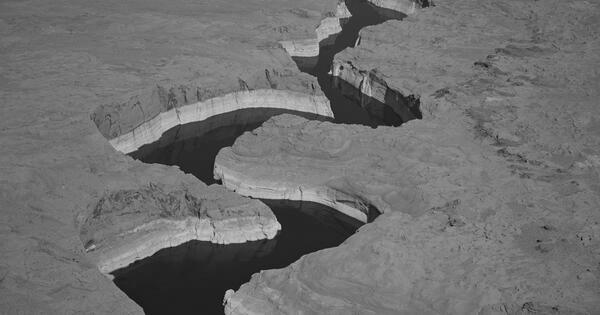
This is precisely the situation that has been created on delivery of the promised water from the Colorado River. The allocations under the Colorado River Compact to the seven states of the Basin totals 16.5 million acre feet (MAF) per year. The actual flow of the Colorado River is approximately 12.5 MAF based on the average flows from 2000 through 2023. This is an annual shortfall of 4 MAF for the last two and a half decades. The gap has been made up by drawing down reservoirs in the basin (Lake Mead and Lake Powell) to the point that these reservoirs are now approximately at one-third of their 2000 levels. All of this is in the face of increasingly tightened supply because of climate change, which is predicted to reduce flows in the Colorado River by another 20-30%.
Unfortunately, the parallel between water and financial health does not stop at the numbers for balance and withdrawal. In the western states of the U.S., water is money and every company with operations, supply chains, or real estate assets in the Colorado River basin is carrying access to water on its books as if the original compact, signed in 1922, is fully solvent. The real impairment of the last quarter century is largely unrecognized and unreported in financial accounts.
Water risk in the U.S. West is one of the next major unpriced risks to corporate balance sheets. The coming legal, regulatory, and physical events will force repricing of assets. And these events are not unfolding over the same timescale as the river’s decline to this point. They are happening now, putting a fire under corporate controllers and financial officers to understand, quantify and report the resulting impairments in the very near future.
Some corporations are more exposed to this water liability than others. Agriculture and food supply chains are by far the most exposed, with 80% of the basin allocations going to agriculture; the Imperial Irrigation District in Southern California is the largest single water rights holder. However, large agricultural users tend to have more senior rights. Under a scenario of proportional reduction, these users will see significant reductions in water deliveries, but under a litigation scenario may be protected by more senior rights.
Semiconductor manufacturers such as Intel in Chandler, Arizona, and TSMC in Phoenix are dependent on the negotiations over state deliveries. A poor outcome for Arizona could make for an untenable result for these water-intensive industries. Even under a favorable negotiating outcome, they can expect significant reductions in water deliveries from the Colorado River.
Freeport-McMoRan operates five mines in Arizona and supplies critical minerals to clean energy development and defense. The company has already filed comments with the United States Bureau of Reclamation warning of operational disruptions in the face of water delivery curtailments. Data centers in Phoenix and across the Front Range are largely dependent on water for cooling and that use is expected to grow exponentially in the face of larger computing draw from AI. Real estate and development in growing urban areas such as Phoenix, Denver, and Las Vegas is contingent on water certainty that may no longer exist.
Regardless of the sector, the risks of water loss are consistently underpriced and unaccounted for on corporate balance sheets. Some examples of where these gaps are likely to occur:
- Water rights are carried on the books as permanent assets with no conditionality discount for junior priority exposure.
- Projected operating costs have been modeled at current water prices, not at post-2026 tiered or market prices.
- Supply-chain water risk has not been assessed or disclosed even as investors have been demanding information on financially-material climate and environmental risks through the EU’s Corporate Sustainability Reporting Directive and other disclosure regulations.
- No standard accounting treatment has been adopted or applied for water rights impairment or contingent curtailment liability.
The Colorado River has been drawing down its reserves for 25 years to honor promises it was never physically capable of keeping. Corporate balance sheets across the American West have been bystanders to that process, neither accounting for the depletion nor disclosing the exposure. That changes in 2026, not because companies have suddenly decided to get ahead of the problem, but because the federal government, the courts, and the market are now forcing the reckoning. A water-rights curtailment is not an abstraction in a risk factor disclosure; it is an operational shutdown, a stranded asset, a supply-chain rupture. Companies that map their water rights seniority now, stress-test their operating costs against post-2026 market pricing, and trace the water dependencies in their supply chains will be better positioned than those that wait for a federal curtailment order to discover that the pension fund was insolvent all along.
Subscribe to Todd Cort’s The Real Price of Risk.
“The Yale School of Management is the graduate business school of Yale University, a private research university in New Haven, Connecticut.”
Please visit the firm link to site