Knowledge on the world stage
[embedded content]
At the 2026 World Economic Forum, CMU President Farnam Jahanian and several other members of the university community facilitated discussions on the ties between industry and academia across a number of panels.

During an opening roundtable discussion titled “Open science for global challenges,” Jahanian discussed the importance of interdisciplinary education, AI-accelerated scientific discovery and the future of work with an emphasis on upskilling and reskilling to prepare for the changes being driven by AI and advanced technologies.
“It’s not just about educating the next generation of scientists and engineers,” Jahanian said. “It’s really about developing the population such that we all can benefit from it and can leverage that in our day to day work — whether it’s in scientific discovery, or in any sector of the economy.”
Erica Fuchs(opens in new window), director of the Critical Technology Initiative and a Kavčić-Moura Professor in the Department of Engineering and Public Policy(opens in new window) facilitated a panel related to her expertise in technology policy, manufacturing, and the dynamics of international industry. She previously led the National Network for Critical Technology Assessment(opens in new window), which brought together leading scholars from 13 Tier I research institutes. The network focused on deep engagement with government and private sector leaders to inform national decisions on technology investments and policy.
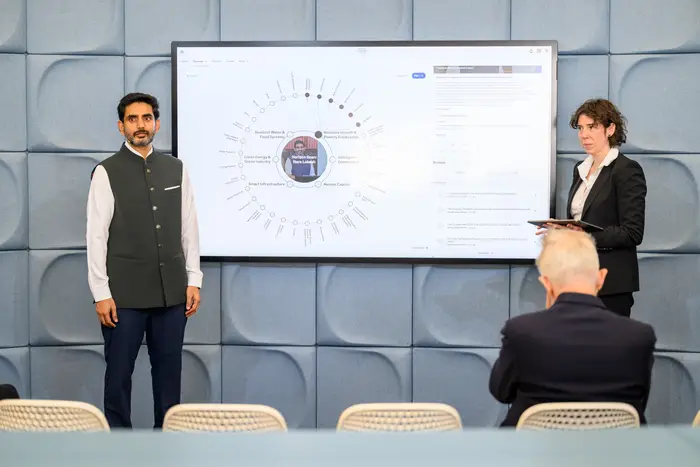
Fuchs also attended panels covering topics such as intelligent infrastructure, workforce development, industrial policy, and the future of research, with special attention to the international implications of each.
“In this polarized moment nationally and internationally, it is essential to bring together the widest possible variety of viewpoints and stakeholders together with changemakers, to identify paths forward for the betterment of all people globally,” she said.
As the U.S. reevaluates domestic industry in the face of new technologies, Fuchs said the shifting geopolitical landscape offers those in higher education the chance to step in as standard-bearers for dialogue and partnership.
“There is also tremendous potential for academics between nations to develop a common empirical understanding of the world to inform trade and diplomatic negotiations, policies, and defense alliances within and between nations,” she said.
While offering world-class expertise to industry and policy leaders is one of the biggest benefits of engaging in worldwide discussions, the university’s global reach also has the advantage of helping other academic professionals communicate the needs of higher education as a whole.

“Academia has historically played an essential role in providing vision for the way the world works, technical possibilities for the future, causal empirical evidence to understand the relationship between actions and outcomes, and as a neutral third party,” Fuchs said, “whether for data, pre-competitive research, science and technology standards-development, and even science diplomacy between nations.”
“Carnegie Mellon University is a private research university in Pittsburgh, Pennsylvania. The institution was originally established in 1900 by Andrew Carnegie as the Carnegie Technical School. In 1912, it became the Carnegie Institute of Technology and began granting four-year degrees.”
Please visit the firm link to site