

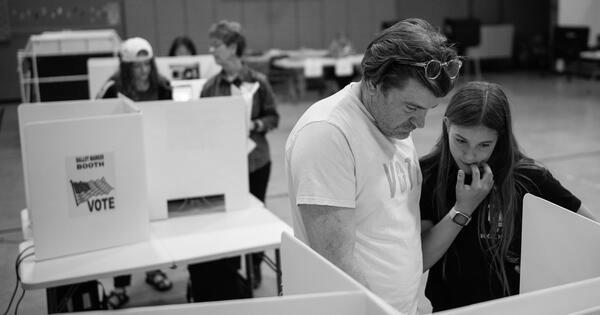
Americans are frustrated by their increasingly polarized government. Their trust in government is at an all-time low, with just 4% saying that the political system is working extremely or very well. And yet political scientists have demonstrated that voters routinely elect politicians whose views are more ideologically extreme than their own.
The seemingly incompatible match between moderate public opinion and politicians’ extremism can be accounted for by rational individual behaviors as voters try to translate their opinions into the political sphere.
If they are so unhappy, why do voters on both sides of the aisle keep electing candidates who don’t reflect their preferences? One possibility is that the party activists who turn out for primary contests hold more extreme views than median party members. Another is that voters today care more about party than policy, and are attracted to the candidate with the most intense partisan identity.
To Yale SOM’s Minjae Kim and his co-authors Daniel DellaPosta and Liam W. Essig of Penn State University, these explanations aren’t entirely satisfying. They also say that those rationales are not based on as firm empirical evidence as people might think—for example, a recent Yale study shows that voters do care about policy, above and beyond their partisanship. So in a new study, the three researchers propose a different explanation: voters choose more extreme candidates as a way to cope with uncertainty about the politician’s future behavior.
Kim, DellaPosta, and Essig suggest that when a voter whose own views are broadly aligned with a party is unsure how a candidate will respond to a future policy issue, or when the candidate’s stance on an important issue is not yet known, the voter may choose a more extreme candidate based on the assumption that such a candidate will be more likely to consistently uphold the party line.
“This seemingly incompatible match between moderate public opinion and politicians’ extremism can be accounted for by these very rational individual behaviors as voters try to translate their opinions into the political sphere,” says Kim, an assistant professor of organizational behavior who studies how social actors coordinate their behaviors.
Kim gives the example of a Democratic candidate who pledges to abolish police departments, a stance that is more popular with the party’s left-wing minority than its centrist majority. Even if an average Democratic voter doesn’t personally share that policy goal, “they are inferring that the more extreme Democratic candidate would, in the future, or in an as-yet-unknown case, represent the Democratic voters better, because this candidate is so ‘Democratic,’” explains Kim. “The ironic thing is that there is obviously a more representative Democratic politician out there who opposes disbanding police departments. But people might infer that the moderate Democratic politician is not going to champion Democratic issues in the future as much.” Thus, Kim and his co-authors conclude, ideologically extreme candidates win because they are unrepresentative—in a particular direction—not in spite of it.
They tested their theory by constructing a simple computational model of 10,000 voters’ behavior based on varying levels of uncertainty about 50 politicians’ stances on 20 issues. Their model, which simulates partisan primaries, shows that partisan voters converge on politicians who are far less representative and more extreme, even though more currently representative politicians are available.
Notably, voters’ “support” for extreme politicians was strongest when uncertainty was highest—when few of the politician’s views were known. “In this model, it is the uncertainty faced by reasonable voters seeking to optimize fit that leads them to support more extreme and ideologically unrepresentative candidates,” the authors write.
The scholars also tested their hypothesis empirically, with a vignette experiment involving 782 respondents, roughly equally divided into self-identified Democrats and Republicans. Respondents were shown known stances from both “moderate” and “ideologue” candidates in their respective parties, and then asked to infer their unknown position on a key party issue: Medicare for All for Democrats, and the right to refuse services to same-sex couples for Republicans. They were also asked how likely they were to vote for either politician.
The goal was to test whether respondents thought that the more extreme—and therefore less currently representative of the average voter—candidate was perceived as more representative on future issues. The researchers found that, indeed, “voters infer the more extreme candidates to have greater ideological fit overall” than the less extreme but more representative candidate. However, for these respondents, that did not necessarily translate into a greater likelihood to vote for that candidate. That could potentially be because they do not want to admit to voting for an extreme candidate, or because there are additional mechanisms behind voting behaviors.
The model’s results suggest that moderate partisan politicians—what are often called “mavericks”—may not have a bright future ahead in an increasingly partisan political environment. Voters today “essentially infer that the maverick is not going to just follow the party line, and the contemporary voter’s policy preferences usually do align well with the party line, even though they may diverge on very key issues,” Kim said.
It is possible that multiple dynamics are at work at the same time, the researchers note. But their findings do offer an important explanation for why extreme and unrepresentative politicians keep getting voted into office.
And they offer an insight into what could help generate a more representative governing body: reduction of uncertainty. Voters should demand, and moderate candidates especially should offer, as many of their policy views as they can, as a way to reassure voters about where they stand, so voters are not left to infer that information on their own. “We show that in the model, when moderate candidates reveal a lot of positions, they actually win out,” Kim says. “The less uncertainty there is, the more the representative candidates are going to win, based on our model.”
Of course, Kim adds, there will always be some uncertainty, because issues will arise that no one can predict. Few voters could have foreseen the COVID-19 pandemic, for example, and no one could have anticipated the response from President Donald Trump, who veered from championing the vaccine to questioning its effectiveness and from anti-mask to pro-mask and back again. “Uncertainty may be inherent in our system and in our politics,” he says.
“The Yale School of Management is the graduate business school of Yale University, a private research university in New Haven, Connecticut.”
Please visit the firm link to site