

CRE Enters a Selective Cycle as Growth Becomes More Targeted
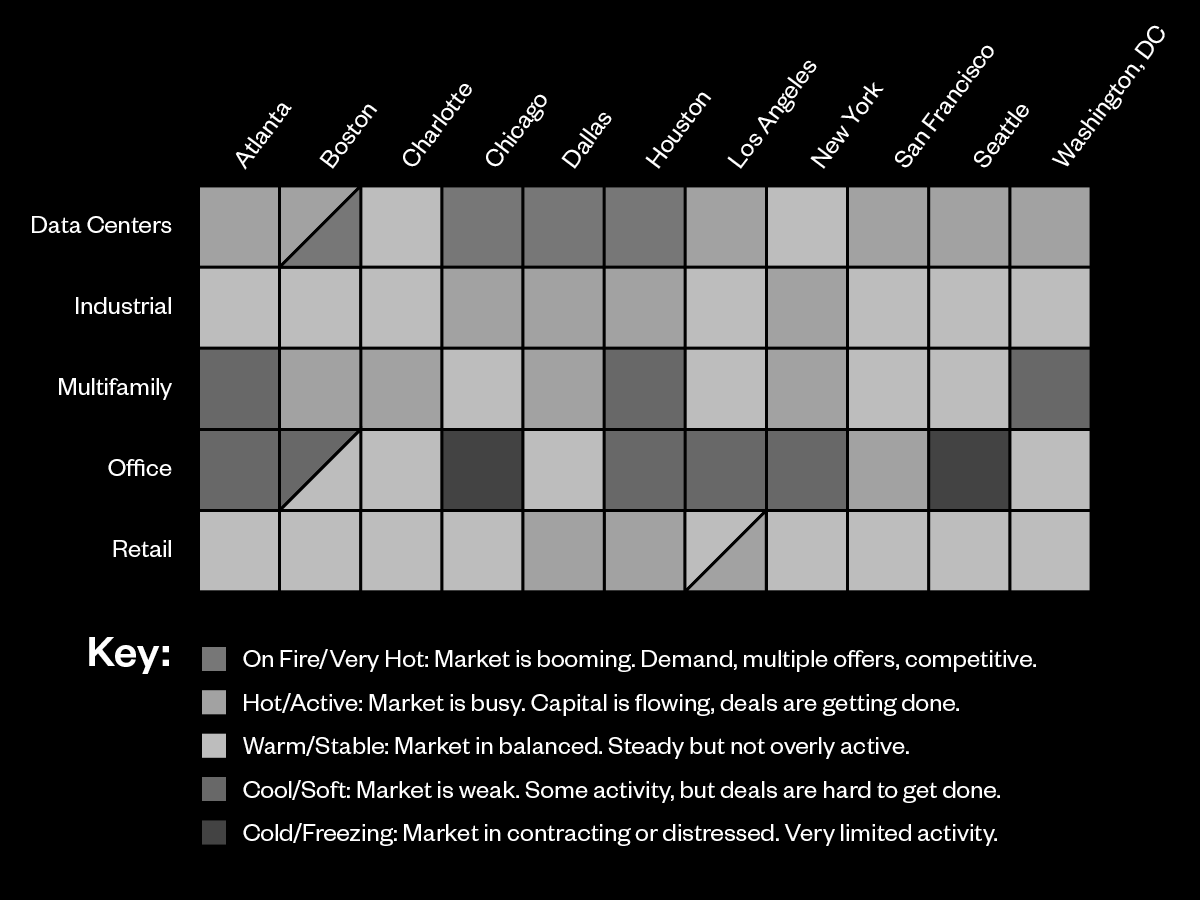
Seyfarth’s real estate team provides a bird’s-eye view of the current state of commercial real estate throughout the country—highlighting which markets and major asset types are active, slowing down, or experiencing shifts.
Seyfarth’s Take: What to Know
✔ Opportunities: Data centers remain the primary growth engine, with continued acceleration in Texas, the Midwest, and key coastal markets. Industrial has stabilized as a consistent, reliable performer across most regions. Multifamily is becoming more market selective, while retail has stabilized broadly, with pockets of strength in high-growth metros and well-located corridors.
✔ Challenges: Market divergence is becoming more pronounced. Office fundamentals remain uneven, with certain markets still experiencing elevated vacancy and valuation pressure. Multifamily softness persists in some Sun Belt markets, where supply remains high. At the same time, cost pressures, interest rates, development costs, infrastructure limitations, and regulatory constraints are reinforcing a more disciplined and cautious investment approach.
✔ Market Trend: The current CRE landscape is a highly differentiated, market-by-market environment. Capital and leasing activity are concentrating in high-performing asset classes and submarkets rather than lifting all sectors uniformly. Data centers remain the dominant driver of demand and infrastructure investment, while broader market conditions show stabilization with persistent region and sector variability. As a result, success increasingly depends on precise asset selection, local market fundamentals, and alignment with long-term demand drivers.
Regional Rundown
“The Atlanta market remains stable quarter over quarter, with no significant shifts across asset classes. Data center development continues to lead activity. Industrial and logistics are seeing improving vacancy rates amid limited new supply, while retail holds steady. Multifamily fundamentals are improving but still pressured by elevated vacancies from the large number of recently completed projects. The office sector remains in recovery, with leasing concentrated in newer and recently renovated properties offering strong amenity packages.” Kwame Benjamin, Partner
“Multifamily housing continues to lead the way in the Boston real estate market. However, despite a solid local economy, an increasing number of developers and investors are starting to exercise caution due to rising costs, stubborn interest rates, and a looming statewide rent control referendum in November.” Catherine Burns, Partner and Eric Greenberg, Partner
“The Charlotte market continues to chug along at a steady pace in virtually all asset classes.” Eric Sidman, Partner
“The Chicago commercial real estate landscape has remained stable, with data centers and industrial leading in demand, multifamily and retail holding relatively steady, and the office sector still underperforming.” Michael Merar, Partner and Tobi Pinsky, Partner
“Recent industry reports indicate that Dallas has emerged as the leading global market for data center development.” Amy Simpson, Partner
“Data center development in Houston and across Texas remains highly active, driving significant projected power demand growth, with most large ERCOT interconnection requests tied to data centers. Industrial continues to perform well, with strong development and leasing activity, while retail is gaining momentum. In contrast, multifamily is considered overbuilt in Houston, and the office sector continues to face challenges.” Peter Oxman, Partner
“In Los Angeles, the data center market remains strong, with high demand and limited supply. Multifamily demand is steady, though rents are largely flat. Industrial vacancies are elevated, but leasing is improving. The office sector remains weak but is beginning to stabilize, with some submarkets outperforming. Retail fundamentals are solid, though performance varies by asset type and location.” Tim Farahnik, Partner and Stacy Paek, Partner
“The New York commercial real estate market has seen little change since spring, with multifamily continuing to lead in terms of activity; industrial, data centers, and retail holding steady; and the office sector still facing comparatively weaker conditions.” Miles Borden, Partner and Cynthia Mitchell, Partner
“In San Francisco, market conditions remain largely unchanged from April, with continued improvement across several asset classes, including office, supported by ongoing AI-driven growth, a more pro-business environment, and increasing return-to-office momentum. There is also growing market buzz around potential AI-related capital markets activity, reflecting sustained investor interest in the sector.” Robin Freeman, Partner
“In Seattle, data center activity remains robust, the industrial market has entered a more stable phase, and multifamily fundamentals are gradually improving. Office continues to face elevated vacancy driven by hybrid work, while retail is showing signs of recovery, supported by improving foot traffic and selective leasing activity.” Jami Balint, Partner
“After lagging behind other asset classes for the past few years, the office sector in Washington, DC is beginning to show signs of life. Tenant concessions are down, and workers are returning to the office at nearly pre-pandemic levels. Trophy class office continues to attract the most tenant interest, while Class B office struggles.” James O’Brien, Partner
“With approximately 900 lawyers across 17 offices, Seyfarth Shaw LLP provides advisory, litigation, and transactional legal services to clients worldwide.”
Please visit the firm link to site