

As more solar power is added to the energy grid in Western Pennsylvania and across the world, researchers at Carnegie Mellon University are thinking about what comes next: how to maintain those solar panels.
The technical term for when dust, pollen or other particles in the air inevitably settle on top of solar panels is called ‘soiling’ and it can significantly reduce how much light a panel can absorb. That can be a problem in the arid, sunny regions where solar farms are often located such as the American Southwest, India and the Sahel region of Northern Africa.
Bringing technology from outer space to Earth
Right now, most solar panels are cleaned with water by hand or robotic equipment, which requires a lot of time and resources. But one CMU alumnus believes there’s a way to do it at a fraction of the cost.

“Soiling is a really big problem, and companies spend lots of money to clean their solar panels,” said Michael Provenzano(opens in new window), a graduate of the Tepper School of Business(opens in new window) and a member of CMU’s Swartz Center for Entrepreneurship(opens in new window)’s VentureBridge program(opens in new window), which supports CMU-alumni founded companies.
“Solar farms — which could be hundreds of acres and millions of solar panels — cost millions of dollars to clean every year,” Provenzano said. “Because of that, they don’t clean very often and dust sits on the panels, and that’s causing them to lose revenue. Depends on different regions, but some of them see up to 60% losses and revenue just from dust.”
Provenzano’s Pittsburgh-based company, Clear Solar(opens in new window), has licensed panel-cleaning technology from NASA with the goal of using it on Earth. The technology, called an electrodynamic dust shield, is vital in NASA’s missions on the Moon and Mars, where it has already successfully demonstrated dust removal from important surfaces. If solar panels and other infrastructure aren’t cleaned, dust collects on them and spacecraft may stop functioning. NASA researchers saw this situation play out in 2024 when dust settled(opens in new window) on the Opportunity rover’s solar panels and diminished its power supply.
“The dust shield cleans 97% of dust off of the glass panels,” said Provenzano, who learned about the technology when he was working at aerospace company Astrobotic. “It makes a lot of sense to use it in space when you don’t have people that can walk over and clean something off easily. We saw that and thought, ‘Hey, we can use that in other applications.’”
Because dust is also a problem for solar panels on Earth, Provenzano wants to build on NASA’s technology and deploy it on a much larger scale.
Zapping solar panels clean
The dust shield is created through a multistep process: First, thin lines of conductive material are added to the glass top of the solar panel and are covered with a clear protective film. Then, an electrical current is channeled through the conductive traces, charging everything on the surface of the panel. When the polarity of the electrical current is quickly flipped, the charged dust particles are repelled and pushed off the surface of the panel.
“It’s cool, you can actually see the dust particles bouncing off of the panel,” Provenzano said.
There is a risk that the dust could settle back on the panel, he said, but there are ways to address that, too.
“The panel is usually tilted so gravity and wind are on our side,” Provenzano said. “But the good part about our system is that we can clean every single day. We can clean multiple times a day. So if that does happen, we can just redirect the current to push it downward off the panel, not in the direction of other solar panels.”
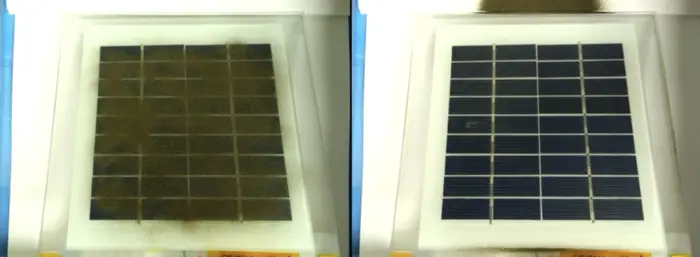
The impact of this split-second cleaning zap could be big. While there are installation costs and the technology does lower the energy transmittance of the panels by about 1%, Provenzano believes dust shields will ultimately save solar operators money. It would cost roughly $0.14 to clean one megawatt of capacity, or approximately 2,000 solar panels.
“The net gain from using the system is still highly positive,” Provenzano said. “Operators might lose a tiny bit in power production, but they’re gaining a lot because they’re not as dirty as often. One solar farm in the Western U.S. can stretch for hundreds of acres and have millions of solar panels that cost millions of dollars to clean.”
Clear Solar has 13 pilot projects around the world and in the U.S., including Pittsburgh, and will begin field tests in July.
Making solar technology more reliable and longer lasting

CMU assistant research professor Stewart Isaacs(opens in new window) is using wind to take on soiled solar panels. In his work at Carnegie Mellon University in Africa(opens in new window), Isaacs is focused on improving and maintaining solar power in places that don’t have access to the electrical grid. Because solar is one of the only options in these locations, the stakes of making sure the panels work reliably is high.
“In some of the dirtiest locations, dust can actually reduce power output by more than half,” said Isaacs, part of the College of Engineering(opens in new window). “My research looks at how we account for these floating particulates to estimate the performance of our solar panels.”
To that end, Isaacs uses computational models to analyze solar panel performance at different levels of soiling.
“A better understanding of the data allows us to know exactly how often we need to clean them and whether there are other methods that we can explore that might allow us to clean them strategically,” he said.
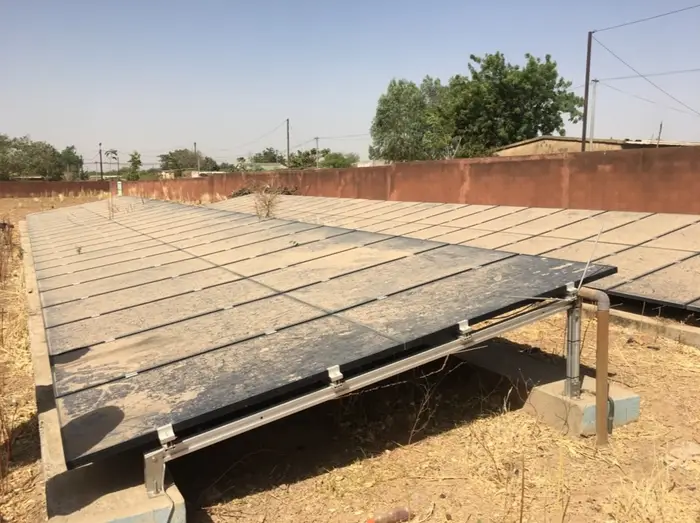
Isaacs is also thinking about how physical changes to the shape of a solar panel could impact its cleanliness.
“We know that wind plays a key role in kicking the dust off the panels,” Isaacs said. “We’re trying to understand how the aerodynamics of the wind interact with the dust and be intentional about the way we design our solar panels to enhance that wind and keep the panels cleaner. I want to kind of tease all that out to make sure that we’re getting the best possible solution.”
Solar maintenance for the future
As the solar industry expands and matures, researchers and experts are beginning to look ahead and think about the costs of aging technology.

Companies investing in large-scale solar stand to benefit from clean panels, according to Alan Scheller-Wolf(opens in new window), Richard M. Cyert Professor of Operations Management at the Tepper School of Business, who studies renewable energy supply chains.
“These are very expensive machines that you want to have very high utilization on, so you can derive value from them,” Scheller-Wolf said. “If they become less efficient, you start to lose money.”
To maximize the value of a solar panel, Scheller-Wolf said that upkeep and maintenance is a key factor for investors from the beginning.
“I view cleaning as part of the holistic investment decision solar farms are thinking about,” he said. “Because the product is so valuable, if I clean it and it makes it more effective, then I’m getting extra value out of the panels.”
But he said the benefits go beyond the financial health of solar farms.
“The most efficient thing you can do to make something more sustainable is just use it longer,” he said. “You want to use your phone, your shoes or your solar panels longer. That’s better for all of us. And if the maintenance of solar increases the useful lifetime of the project, it increases the sustainability of the project, too, because you don’t have to replace them as often. That’s incredibly important.”
“Carnegie Mellon University is a private research university in Pittsburgh, Pennsylvania. The institution was originally established in 1900 by Andrew Carnegie as the Carnegie Technical School. In 1912, it became the Carnegie Institute of Technology and began granting four-year degrees.”
Please visit the firm link to site