


Transcript
Harlan Krumholz: Welcome to Health & Veritas. I’m Harlan Krumholz.
Howard Forman: And I’m Howie Forman. We’re physicians and professors at Yale University, and we’re trying to get closer to the truth about health and healthcare. Our guest today is Professor Bhramar Mukherjee, but first, we like to check in on current or hot topics in health and healthcare. What do you have today, Harlan?
Harlan Krumholz: Yeah, a new study came out that’s getting some attention, and I think it’s worth talking about. It’s out maybe 10 days now by the time this drops. The headline’s something like, “The updated COVID vaccine is associated with a 37% lower risk of major cardiovascular events.” Thirty-seven percent, that sounds big. But when a study on a hot-button topic produces a big-sounding number, I think the right response is not to cheer or dismiss it but to slow down and ask what kind of evidence is it and how strong is it?
So let me summarize it for you for a minute. The study looked at more than a million veterans in the VA system. Everyone in the study received a flu vaccine. Now, this was by intent because they wanted to look at people who were not completely anti-vaccination. So they said, “Well, let’s look at people who got flu vaccine.” They at least got a vaccine. And then the comparison was between those who got the flu vaccine alone or people that got it plus the updated COVID vaccine on the same day. Then they followed people for eight months and looked for COVID-associated major cardiovascular events, meaning cardiovascular death, heart attack, stroke, or hospitalization for heart failure.
Now, this is a serious study by a serious group. They’ve got a great reputation. They’ve published quite a lot and are very strong. They used a method called target trial emulation. That means they tried to structure an observational study. That means these people weren’t randomized. This is just looking out at people who happened to opt for getting the COVID vaccine versus those who didn’t among those who got flu vaccine as a baseline. And yet they tried to structure it like a randomized trial. So they defined who was eligible, defined the treatment, the comparison and they used some fancy statistics to weight them so that in the end they had the resemblance of being in a group that was equal in terms of their characteristics.
Now, I want to be clear. I value this method. It’s clever. Observational studies can sometimes provide strong evidence about causation, whether, for example, does the vaccine cause a beneficial effect? Target trial emulation has an important place. I don’t really reject this because it’s observational studies. Some people do. Some people are only going to trust randomized trials. I actually think that we can use observational studies in this way, but it’s most persuasive when the treatment choice is close to arbitrary. So for example, imagine two blood pressure medications, a diuretic or a calcium channel blocker. The guidelines endorse both. They say you can use either. They don’t favor one over the other. We’re not sure if one is better than the other. And truly, out in practice, you don’t tend to give one to one kind of patient and the other to another kind of patient. Patients aren’t opting. It just depends what the doctor writes a prescription for.
In that case, that might be a pretty good case for doing this, but vaccination’s different. Choosing to get an updated COVID vaccine is not a coin flip, it’s tied to beliefs, trust, access, risk perception, prior experiences, and to a lot of other preventive behaviors and engagements and geographies. So patients who get the COVID vaccine probably differ and studies show they differ from people who don’t get them in ways that are really hard to measure.
Now the investigators knew this, and so they had a lot of information. They had information about their diagnoses. They had some lab results. They had their medications. They had a lot of information, but they didn’t have detailed chart review. They didn’t abstract this. This stuff wasn’t going through the kind of careful adjudication that occurs within randomized trials. So let me just give you three headlines on this just to get to the end here and to make points about this.
First, the headline number, this 37%, this is what we call a relative reduction. The absolute differences were very small. So you can talk about a large relative reduction, but then you can ask, does it really make a difference? The actual difference was about two fewer events per 10,000 people over eight months. That’s not nothing, but it’s pretty small. And when you get to that small an effect, then things like bias, the things that can creep into the study that can influence it that aren’t about the thing you’re trying to study, can importantly influence.
And that’s the second point. Second, this wasn’t randomized. Vaccine choice is especially vulnerable to bias. The officers adjusted, like I said, for age, diagnoses, prior vaccine, labs, but adjustment is only as good as what’s measured. A diagnostic code can tell us that someone has heart disease, but did they have severe heart disease? When did it start? They didn’t have any of that information. So they couldn’t really look more deeply into exactly what did people have, what were their diagnoses and so forth. No one interviewed these patients, for example.
Third, the design was clever, that is, that they restricted it to people who all got flu vaccine. But that meant the population was pretty special. I mean, if you looked in this population, two thirds of them, for example, got SHINGRIX, the varicella vaccine, of course, 100% got flu vaccine. So when you looked at it, it was sort of a healthy group. That may represent why the cardiovascular events were relatively low.
So where do I land on this? I salute the study. It’s careful, thoughtful, useful. It’s consistent with the idea that the COVID vaccination may reduce some COVID-related cardiovascular complications, but for me, it doesn’t move my confidence very much. I do not consider it strong evidence of a meaningful cardiovascular benefit. Now, that shouldn’t deter people who want to get vaccinated from getting vaccinated. It shouldn’t actually give a lot of confidence to people who are. It’s just saying we’re still not sure about this. There are reasons people might want to protect themselves with the belief that this is going to do that. There are other people who may decide that it’s not enough evidence and they’re waiting for more. And I think we’re right now at the point of a lot of uncertainty about this. A thoughtful observational study can add information, but it doesn’t always settle the question. Having a big study doesn’t always provide you the answer. Being big by itself isn’t enough.
Howard Forman: Given this, is there a need for us to be doing large-scale randomized trials funded perhaps by the NIH to get answers to it because it sounds like there’s no other way.
Harlan Krumholz: I think it’s essential. And I say that because first of all, we’re dealing with a public who wants the information, who’s uncertain about this. But the most important thing to me is that the virus has changed so dramatically. It’s a very different virus than it was on day one of the pandemic. When people were in lines getting into ICUs in New York City, when we had to open up new areas and we didn’t have enough ventilators for all the people who needed it, it was a lower respiratory disease. It’s now become more of an upper respiratory disease and it can be catastrophic just like flu can be catastrophic, but the question is, do these vaccines, which are, just like flu, sort of configured far in advance, are made available, are they actually providing benefit? Who are they providing it to? And what’s the size of that benefit?
And I think the only way we’re going to learn about that is to actually randomize people. And so I don’t know a better way to do that, and we ought to be incorporating that into our national approach and policy. We may still be a couple years behind because we need to make a decision today, but at least, what happened last year? Is there evidence that it really helped? And I think we’re not sure. And again, I think this big deal about this 37%, again, I’m trying to take all the politics out of it, I’m just talking about the science, what you have to do is look at what’s the real size of the benefit, not just what the percent reduction is.
Howard Forman: The size was bigger for the over-75 group, right? I mean—
Harlan Krumholz: That’s right. I think it got up to like 25 per 10,000, right?
Howard Forman: Right.
Harlan Krumholz: It was bigger, but it still, it wasn’t a dominant effect.
Howard Forman: Right, right, right. Got it. That’s great, Harlan.
Harlan Krumholz: Yeah, thanks, Howie. And okay, I’m real excited about this interview coming up. Let’s move to it.
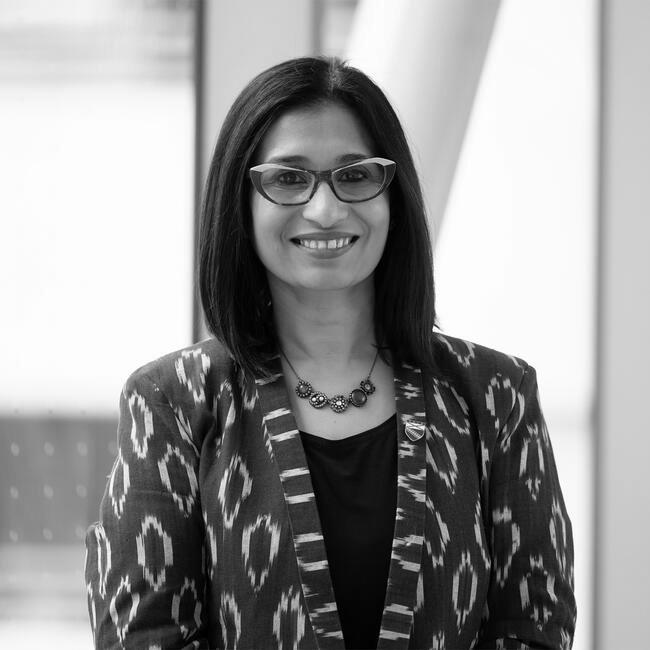
Howard Forman: Dr. Bhramar Mukherjee is Senior Associate Dean of Public Health, Data Science, and Data Equity and the Anna M. R. Lauder Professor of Biostatistics at the Yale School of Public Health. Her research focuses on developing statistical methods to make large-scale health data more useful for understanding public health problems, including data from medical records, genetics, and environmental factors. Her work has applications in cancer, cardiovascular disease, COVID-19, environmental health, and beyond.
Before joining Yale in 2024, Dr. Mukherjee spent nearly two decades at the University of Michigan, where she served as chair of the Department of Biostatistics and developed programs that we will talk about that she has brought to Yale. She earned her bachelor’s degree in statistics from Presidency College in Kolkata, a master’s degree from the Indian Statistical Institute and both a master’s and PhD in statistics from Purdue University.
So first, I want to welcome you to the podcast, and I want to start off by just asking you to give us a little bit of a definition of what data equity means. We talk a lot about health equity on the podcast. We’ve definitely talked about the uses of big data on the podcast, but what is “data equity”?
Bhramar Mukherjee: First of all, thank you. The two H’s and two heroes of my academic career and my move to Yale. So thank you for inviting me. So data equity, in a sense that it mirrors the definition of health equity. Altruistically, it means that everyone, regardless of their background, circumstances, beliefs, or ideology, should benefit equally from data innovation, data science knowledge, data science resources. And in a world which is very driven by data and decisions being driven by data, this is critical. But then how do you actually give a mathematical structure to this altruistic notion? So in a recent paper in JAMA Health Forum, we actually talk about 10 fundamental pillars of data equity, which combines concepts from computer science as well as public health, blending issues such as fairness, transparency, accountability, ethics from computer science literature, privacy, confidentiality blended with public health notions of selection bias, representativeness, generalizability, causality, quantifying uncertainty. It needs to be blended as we think about this as an ethos and audit our work through every step of the data processing cycle.
Howard Forman: Can I just ask one quick follow-up? On the day that we’re recording this, and we’re recording this a few days before we’re going to release this, you have a paper just recently out in the Journal of the Medical Informatics Association, I believe. And it’s way over my head to really understand the technical details, and I mean that sincerely. I mean, sometimes we say it in a cheeky way, but this is a sophisticated paper about this. But to my understanding, it raised a question that I might not have appreciated in the past, and that is that even when you want to achieve representation across multiple institutions when you’re doing a clinical trial, it’s easier said than done because different populations may reside in Michigan and New Haven and Atlanta that aren’t necessarily individually representative but collectively they could be. Can you just explain a little more about why that’s so important and why that is a challenge that math and statistics can answer?
Bhramar Mukherjee: Yes, this is a great question. And unfortunately, this has been one of my obsessions, how to actually bring multiple sites of data where the recruitment mechanism has been quite different. For example, I work with Michigan Genomics Initiative, where patients were largely recruited in a very operative setting as they’re waiting for surgery. And then I have Biobank of Michigan Genomics Initiative combined with the UK Biobank, which is a population-based study, and the age range is from 40 onwards, and then I blend it with NIH, all of us, which has consciously and intentionally oversampled certain population, and Yale New Haven Health System, what do we have in mind? If we are trying to generalize our inference, do we have a target population in mind and how do we get to that target population?
So statistics and epidemiology has tools to think about this issue of representativeness. And there could be statistical tasks where we really do not care about representativeness in your sample, you can still retrieve your target parameter, but in most cases you probably do want your sample to look representative.
So in this new paper that you’re talking about, it’s a fantastic collaboration between Yale School of Medicine and Yale School of Public Health, the biomedical data science department and the biostatistics department along with people from Penn and Michigan where we have multi-site data with different kinds of enrichment, different kinds of study population. And we’re trying to understand that in the process of making the data more representative, if we share a lot of information across sites, are we making certain population more vulnerable? What can we share in a privacy-preserving way because data is not supposed to be shared across sites. And so how can we do that in a sequential learning platform? So that was a very interesting pragmatic question, but also a great mathematical challenge.
Harlan Krumholz: Let me take a little different tactic. Howie, we were so lucky when Megan Ranney became dean of the School of Public Health, and you judge a dean in a lot of different ways. How does she develop a vision? How does she strengthen a community? Fundraising is critically important. But—I shouldn’t say “but.” “And.” And I think one of the most important things is: can she attract talent? And there’s no greater indication of the impact that Megan has had than her recruitment of Bhramar. I mean, this was like we were able to get the very best player in the entire world to come to Yale. Someone who had been at Michigan, had deep roots, but it enabled to inspire her that actually this might be it.
So it’s like, what I love being here is that the surprise of being able to say like, “You got to be kidding me, we were able to recruit her to here?” And now let me tell you why, why, Howie, this is an amazing recruitment. It’s because she of course is one of the most brilliant statisticians in the world and so that goes without question, but she also is known far and wide as a remarkable mentor to find someone who’s achieved that level and be so committed to her students and the people around her, and to do so with humility is remarkable. And then to go into these tough areas about like equity or areas that are really, they’re hot-button, they’re challenging, they’re technically challenging, but also socially challenging. So you’ve got to be a leader. You can already hear what she is able to bring on that.
So I just wanted to say that out loud because I was so thrilled that you joined us, that you were willing to take this jump at this point in your career and we’re so lucky to have you on campus. I want for listeners just to take a step back and start at the very beginning because people hear this, but what is a statistician? We hear about statistics all the time. There are even people on TV who bounce around statistics. Everyone says you need a statistician to work with you on your … what in the heck is a statistician, exactly?
Bhramar Mukherjee: All right. So let us get back to the root word of statistics. What is the etymology of the word statistics, do you know?
Harlan Krumholz: Oh my gosh, what is the etymology of the word statistics? I don’t know that.
Bhramar Mukherjee: Yeah, so you are not the only one. I’m a professional statistician for 30 years. I did not know that until an English professor at Yale entered my classroom and asked the students this question. Professor John D. Peters was lecturing in my ethics and equity and artificial intelligence and data science course, and he asked this foundational question, and it actually comes from the word statistic, and it refers to the state, numbers released by the state, was the first origin. And it was really illuminating for me because at the heart of it is numbers about the health of a state or of public.
And so a statistician looks at data, looks at patterns and synthesizes in terms of from data to information and knowledge. They take a problem, for example, an environmental health scientist may knock on my door and see that, well, in this community there has been this high levels of PFAS and we are seeing some incidents of these diseases, is this beyond chance? How do you take that question and translate it into the grammar and language of mathematics and statistics combined with data to answer, is this beyond chance? Should we do any policy intervention? So I’d say that statistician is really a translator between real-world problem and the grammar and language of mathematics. So to me, poetry and proof actually go together.
Harlan Krumholz: So two quick follow-ups on this. People who hear about statistics often hear this other word, inference, that statisticians are making inferences from uncertainty. Can you just elaborate a little bit more on why is the word inference so important and what does it mean exactly for people listening who aren’t familiar exactly with that?
Bhramar Mukherjee: This is also a great question because uncertainty is at the heart of our job. If we always could evaluate everybody in the world or in the population that we are interested in, statisticians will not have their job. So because we have limited resources, we can often only sample certain population and certain members of the population and every time we sample, we are going to get a different mean or a different rate. So how do we think about these samples coming together to describe the population? So obviously we are not certain, and that’s where the notion of uncertainty is so important because this is not a single number. Every time you do this, you get a distribution. And how do I quantify that uncertainty with the current sample? Because in real life you get to do it only once. How do you talk about that distribution? How do you talk about inference from S to P, from sample to population, from a statistic to parameter? That’s where mathematics modeling assumptions come in to get from the sample to the population.
Harlan Krumholz: What your estimate is of what the real answer is, if you could measure everyone. So one final follow-up here before I hand it back to Howie is, so do you consider statisticians to be a subset of data scientists? Are data scientists a separate group than statisticians? People are hearing this word a lot now, “data science.” And even in your course, people talk about data science, artificial intelligence. Can you help sort of disentangle this for people who are listening about how do these all intermingle? How does a statistician get involved with these new tools that are coming out?
Bhramar Mukherjee: Yeah, so this is very interesting. So statistics is also quite a newer subject, I would say. Compared to mathematics and physics, if we measure the history of a discipline by the time when the first exclusive book on that topic was written, first exclusive book in statistics was written about 1901. And so it is a relatively young discipline, but around like 2000, we started talking about data science. And in my mind, I think about data science as a weighted combination of statistics and computer science. If I think about a formula in my mind, it’s W x statistic[s] and (1 – W) x computer science where the weights are chosen in a data-adaptive way.
In certain problems, you may need more computer science optimization tools and in some problems you may need more probability and more mathematics, more layers of uncertainty. Data science gives us both. So lots of data science programs you’ll see with classical layers of probability and statistics have incorporated machine learning, optimization, large database harmonization. In a sense, I think it has been really liberating because visualization, data harmonization, putting together databases have become a part of data science and obviously theoretical statistics can often operate in abstraction, but data science always has data at the heart of it.
Howard Forman: I want to go back to something Harlan said about you being such an incredible mentor and a developer of talent and talk a little about the program that you brought to Yale, which is the Big Data Summer Immersion program at Yale. This is a program that you built and developed at Michigan; you’ve now brought it to Yale. It’s been here for I think two full years now and you’re in the middle of it right now. And so first of all, I want to thank you for even doing the podcast in the middle of this intensive six-week stretch, but what are your hopes and aspirations with a program like this where you’re bringing in undergraduates who obviously have an interest because they’re going to spend six weeks here in this area, but what do you hope, what type of talent are you trying to develop for the future?
Bhramar Mukherjee: Yeah. So this has been, I think that Harlan was very kind to say things that I don’t deserve, but this is one thing that I feel that is a real genuine contribution that I have made to the field. It’s not because of me. Around 2015, actually timed when my own daughter started college, I saw a lot of young people in my living room who are very good at math, very good at science, but could not really see the connection between health and math and health and computer science. And so I felt like we need to tell these students that you can use your codes and your coding abilities, your mathematical abilities, to solve very important problems in public health and biomedicine.
So I basically went to my dean at the time at University of Michigan and got some seed money because I’m very good at whining and then started the program with absolutely no resources. I even brewed the coffee for the students in the morning because there was only 1.5 FTE given to me to support the program, but that 30 students actually trusted us, we could not give them any stipend and that was an amazing experience for all of us after those four weeks. And then we got funding and thanks to the NIH for having an amazing opportunity called Summer Institute in Biostatistics. It’s an R25. There are 10 such programs in the nation, and we try to bring students on campus. But at Michigan, what we did, NIH funding supports about 20 slots, but we had very generous contributors and donors which helped us to expand the program.
Let me give you some numbers. Why I think that, what, 357 students trained in Michigan and about 60 trained in Yale in the last two years, more than 60% have gone to grad school. Some of our students from last year have started programs in Harvard and Brown and Columbia. Every department that I go to and I give a talk, somebody raises a hand, “Dr. Mukherjee, can you recognize me? I’m BDSY 2017, 2018.” This time, when I went to Michigan, one of my former students is a faculty member in the Department of Statistics at University of Michigan, and he shared with me that he chose Michigan because he has such fond memories of Ann Arbor when he came from India as a summer program student at BDSY. What more could you want? People who never thought about biostatistics as their career are leaders in biostatistics and statistics and solving important problems. The ripple effect of that across generations is priceless and is going to outlive all of us.
Howard Forman: Not to mention that you’re making our own nation more competitive, you’re building the intellectual capital that we do need to invest in, and do, and you yourself are doing that, so it’s so great.
Bhramar Mukherjee: Ninety percent of our students are from the U.S. and from small colleges, from R1 universities and liberal arts colleges and small universities, it’s really what they contribute to each other, the peer learning and finding people who think in a similar way as you, is just incredible.
Harlan Krumholz: I want to go into a little different direction. Since we have you here, we need a consult. So earlier in the program we were talking about observational studies in target trial emulation in the segment that I have. And one of the questions that we were asking this target trial emulation, as you know, of course, you’re an expert, but for listeners to remind you of the discussion we were having is that this is a method to be able to make causal inference to say, whether not A is better than B, for example. And I wonder what your thoughts are about the leveraging of observational data using these things and when can observational data support strong causal inference?
I think one of the problems is people think, “Okay, if you use this, it’s okay.” But to me, it depends, it depends how you’re using it and in what situation and what kind of methods. There’s all sorts of gradations of the quality of the work that’s done. But since you’re a world expert on this, what are your current thoughts about the use of real-world data for making these when you don’t have randomized trials?
Bhramar Mukherjee: Yeah. So first of all, I’m not an expert on target trial emulation. I’m just beginning to learn it through my students and postdocs. This is a different language of taking the classical causal inference and making it more design-focused and understandable. But some of the basic principles, when you can actually talk about something causally from observational databases is a very interesting question, right? Because nothing is free. So you actually make lots of assumptions in order to say that this will work and those assumptions are often not verifiable based on your current data.
So it really depends, as you said, on the quality of data, the question that we are answering and the kind of, Do you have a single study? Do you have replication? Do you have validation? Do you have scientific belief that this question is grounded in? I also think that to me, the causal inference framework helps me to actually explicitly lay out my assumptions with observational data, that what assumptions am I making so that I can say that this linear regression estimate or this risk difference estimate is causally defensible? Many times people just put forward those estimates without making the assumptions implicit and the causal inference framework almost is a forced check on me that at least tell me what assumptions am I making in order for this estimate to be causally defensible or have any kind of causal interpretation, otherwise everything is swept under the rug.
Harlan Krumholz: And this is where I think sometimes the public hears a very large study and substitutes the idea of size for quality. Okay, here’s a study of a million people. And so they think, “Wow, if you studied that many people, it must be a power study,” but that’s not always true.
Bhramar Mukherjee: Yeah. This is where I want to make a very important comment because this is something that everyone should know about the big data paradox or the curse of big data. What happens is that when you have one million people to estimate a parameter, obviously your variance is very, very, very tiny. But then think about when you’re doing inference, your variance is one part of it. If you have bias, bias becomes a much more dominating term than variance because you already have controlled that. And so even a tiny amount of bias is going to be much more amplified in the context of that very tiny variance and you are going to get a lot of spurious association significance because your bias is not really tackled properly.
So in observational data, this is really, really important that this inflated sample size is giving you an over-promised sense of precision, but you are probably becoming precisely wrong. You really need to be careful about selection bias, information bias, confounding bias. And if you don’t adjust for the confluence of all of them and do not do proper sensitivity analysis, you cannot commit and you cannot promise that significance 10 to power −60 that you’re seeing, which is just an artifact of the large sample size. And speaking—
Harlan Krumholz: Just to say for people listening, just define variance for them, because many people won’t be familiar with that.
Bhramar Mukherjee: Yeah, we were talking about every time you actually draw a random sample, you get a new estimate and how variable are they? It’s a measure of accuracy. How much chance randomness do you see in an estimate?
Harlan Krumholz: And when you have such large samples, then your estimate is very precise that you have a very narrow amount of uncertainty about the estimate, but it can be highly influenced by other factors.
Bhramar Mukherjee: It’s off because the bias. Yeah, so we have to control for bias and think about… you know, in classical statistics we just went off to sample size because we are greedy for power and reducing the variance and make them so precise. But now in modern observational data, we need to retool our thinking and think about bias very, very carefully. And this is something I want the audience to pay attention to.
Howard Forman: As we get to the end, I want to give you an opportunity to speak a little about your native India. You are very proud as being an immigrant scholar and someone who has gained so much from being able to come to this country. You’ve also gone back to India many times and gone to educate both the institutions you came from as well as many others. I imagine you are an absolute celebrity in this space when you go back there, at least from the social media posts, it seems that way and deservedly so. But I wonder if you could speak a little about what it is like at a time right now when so much pushback is occurring about immigrant scholars about what that status has meant to you and how it has informed your work.
Bhramar Mukherjee: Yeah, this is going to be very difficult for me to respond to without being emotional given that how difficult it is becoming to have a journey like me. I came to this country in 1996, and it would be 30 years in this country and I can truly say that I did not know anybody. I was just roaming around the streets of West Lafayette, Indiana, and I would not be here if my professors did not see something in me. Universities in the United States have been such a home for people like me, students like me.
But the talking about celebrity, my father is actually a real celebrity. He’s an actor and director, and his face is recognized by everybody in Bengal.
Howard Forman: Oh, wow.
Bhramar Mukherjee: And so I cannot have any claim of celebrity in my family. So he has acted in movies by Satyajit Ray and like, he’s really very well known. And at the age of 86, he’s still doing theater workshops and producing. He just produced a stellar version of Waiting for Godot’s adaptation and it’s a super hit in Bengali state. So I have no claims from going … I basically sit silently and do my math, I’m the black sheep of the family, so I have no hope of being a celebrity. And I think people know me because of my COVID-19 work in India, but I definitely feel very strongly about contributing to health data science in India.
And as much as I have reservations and grappling with the impact of AI, when I actually see that in villages in India, you can take an eye image and predict and screen people for different diseases, including predicting anemia in pregnant women and that is a non-invasive screening tool in a resource-constrained setting. The potential of AI, where it can go, and really I’m taking my sabbatical and I’m going to be in India. India has a very realistic national AI plan, which is not mimicking what the West is doing and really focusing on frugal AI, sovereign AI. I hope to learn, I hope to contribute and that will always be a part of who I am.
Harlan Krumholz: That’s amazing. I think just for final point, you’ve now been at two amazing schools of public health and two amazing institutions. I wonder if you could just reflect for a few minutes. I mean, I feel that the School of Public Health here is very special. Well, I wonder if you can just reflect on what are your impressions in the time that you’ve been here? What’s your sense of what really distinguishes the School of Public Health here?
Bhramar Mukherjee: Yeah. So first of all, as you mentioned that we have a fantastic leader, Dean Megan Ranney. So when people tell me, when people look at U.S. News ranking and so on and they said that, “Oh, we are in the top school of public health.” My friends in Hopkins and Harvard, “We have the best school of public health.” I always say, “But we have the best dean.” That really makes a difference, the visionary leadership, where we are going. And Michigan is an amazing institution. I will never be … public university and I’ve always been in a public institution, this is my first time in a private institution.
And so I see a lot of differences, but I do see that the innovation at Yale and also the integration with central campus, as I said, English, philosophy, sociology, that happens at Yale in a much more organic way. Michigan School of Public Health is very big. So we’d never have to go outside to seek collaboration; that’s good and bad in the same way. So I feel that this is really two different but two outstanding schools of public health.
But the Yale School of Public Health, my excitement has been because we are on a sharp gradient, where I feel like Michigan has been a top school that has been sort of like an upper part of the asymptotic plateau. Where we are on a gradient. We are creating new plans, strategic visions, we are creating a new mace, new building, and that excitement, but relying on a hundred years of history, it’s not really nascent and the collaboration of the school of medicine and this collaboration with the school of management, this has been really fascinating for me and I feel that personally I needed a change, but I’m so grateful that I could experience two brilliant schools of public health.
Harlan Krumholz: Yeah, I think it’s amazing to think a hundred years of history, but only a few years of independence, and that independence really was a spark of creativity for what the future will be like with a great leader, great faculty. I think the sky’s the limit for this school.
Bhramar Mukherjee: Thank you so much.
Howard Forman: I do think that your work and Megan Ranney’s leadership and so many others are what makes our trajectory so steep right now. So thank you so much for what you have done—
Harlan Krumholz: Thank you.
Howard Forman: … what you continue to do, what you will do.
Bhramar Mukherjee: Thank you so much for the invitation.
Howard Forman: Truly grateful she’s here.
Harlan Krumholz: A true star, a true star at Yale. How lucky we are to have her here.
Howard Forman: Yes.
Harlan Krumholz: So Howie, what’s on your mind this week?
Howard Forman: Yeah, so I got a story that sounds technical, but it really isn’t. On June 1st, the Centers for Medicare and Medicaid Services released the rule governing the new Medicaid work requirements from last year’s reconciliation law. That’s the One Big Beautiful Bill Act. Buried in nearly 400 pages is a quiet change to what is called “medical frailty.” It’s the medical frailty exemption. The carve out is meant to protect people who are too sick to work from being thrown off of Medicaid. Congress wrote that exemption to cover serious conditions, cancer, disabling mental illness, substance use disorder. States expected a diagnosis in the medical record would do the job. The new rule says no. You also have to prove that the condition “significantly impairs,” that’s the specific language, your ability to work.
A second test Congress never put in the statute. That distinction matters more than it sounds. Someone has to make that impairment call, and states will tell you they don’t have clinicians trained to do it. Scholars, particularly constitutional scholars, argue the rule contravenes the law itself and litigation is coming. But here’s the trap. States must comply by January 2027 and the rule took effect immediately with comments collected after the fact. No state betting on a court will risk that deadline. The harm lands before a judge can rule and we’ve run this experiment before. Arkansas tried work requirements in 2018. Eighteen thousand people lost coverage in four months, not because they refused to work but because of paperwork. Ninety-five percent already met the requirement or qualified for an exemption. Employment didn’t budge. So why care if you’re not on Medicaid? Because people who lose coverage don’t vanish. They show up sicker in emergency rooms with bills nobody pays. We all carry that cost. This is a policy that fails its own stated goal and asks everyone to fund the failure.
Harlan Krumholz: Howie, this is such a great topic. I’m so glad that you took it on. It’s the same people who say “get government out of our lives” has now put government into the lives of so many people. And this friction, these adjudications, this kind of judgment I think is not in any of our best interest. And maybe it makes for a soundbite, but when it gets implemented, actually we end up having to spend more money, more people suffer. It’s not helpful in that way. And so what we need to do is focus on improving the economy, make the life staples more affordable to people and ensure that people have access to healthcare when they need it. And the more barriers we put in front of people, the worse we are going to be off as a country to have a sicker population.
So people need help. We need to be able to provide it. I think this was highly unfortunate. I really love the way you put in context why this doesn’t work. I mean, even if you believe in it, the question is operationally, it’s very difficult to do. And so we can have arguments with people on the political spectrum about the beliefs that they have, but the point is it just, it’s hard to do.
Howard Forman: It’s millions of people, I mean, it’s millions of people. And it’s not millions of people who are wealthy and taking advantage of Medicaid. We’re talking about a specific population that is already poor, they already have chronic disease and now we’re putting one more hurdle in there to try to stop them from getting access to this.
Harlan Krumholz: I think it’s just … You see all of this focus on got to get these people to work. They’re just taking advantage of the system. But there’s still little appetite to close all the loopholes in the tax for those who have means. It’s not symmetric in terms of where that focus is. And it also disparages a lot of people. Suggests that it’s a mentality that diminishes these individuals. I think it’s a shame. It’s a shame.
Howard Forman: It is.
Harlan Krumholz: Thank you, Howie. Really great segment. You’ve been listening to Health & Veritas with Harlan Krumholz and Howie Forman.
Howard Forman: So how did we do? To give us your feedback or to keep the conversation going, email us at health.veritas@yale.edu or follow us on any of social media.
Harlan Krumholz: And feedback is always welcome. We love to hear from you. It also helps people find us. So that’s an open invitation to anyone who’s listening.
Howard Forman: Health & Veritas is produced with the Yale School of Management and the Yale School of Public Health. To learn about Yale SOM’s MBA for Executives program, visit som.yale.edu/emba, and to learn about the Yale School of Public Health’s Executive Master of Public Health program, visit sph.yale.edu/emph.
Harlan Krumholz: And a hat tip to our superstar undergrads; Donovan Brown’s here with us today. You guys have no idea what a great job they do behind the scenes prepping us for these.
Howard Forman: That’s for sure.
Harlan Krumholz: Gloria Beck is also working with us, our fabulous producer, Miranda Shafer. And of course I get to work with the best in the business, Howie Forman.
Howard Forman: Thanks, Harlan. You are the best in the business as well.
Harlan Krumholz: Not at all. Thanks, Howie.
Howard Forman: Thanks, Harlan.
Harlan Krumholz: Talk to you soon.
Howard Forman: Talk to you soon.
“The Yale School of Management is the graduate business school of Yale University, a private research university in New Haven, Connecticut.”
Please visit the firm link to site