
Dr Chris Blount at the UK Space Agency said: “The Long Baseline Multistatic Radar (LMBR) project has been a fantastic example of innovation and collaboration by incredible UK and international talent, and an exemplar case of the capability multiplication through collaboration the International Bilateral Fund (IBF) seeks to achieve. The LBMR team have taken the thorny challenge of real time on-demand monitoring of space objects on geostationary orbit, and through proactive partnering and an innovative application of existing world class UK assets, have been able to demonstrate a state of the art, dual use by design, capability. This has been achieved without the extensive investment, time, and effort a dedicated facility would have otherwise needed, and even surpasses the capability such a facility would yield. This is exactly the innovation and engineering excellence UKSA and the IBF seeks to promote, and is a key step towards a capability to make the UK and our international partners safer and better able to respond to the challenges of a congested and contested space.”
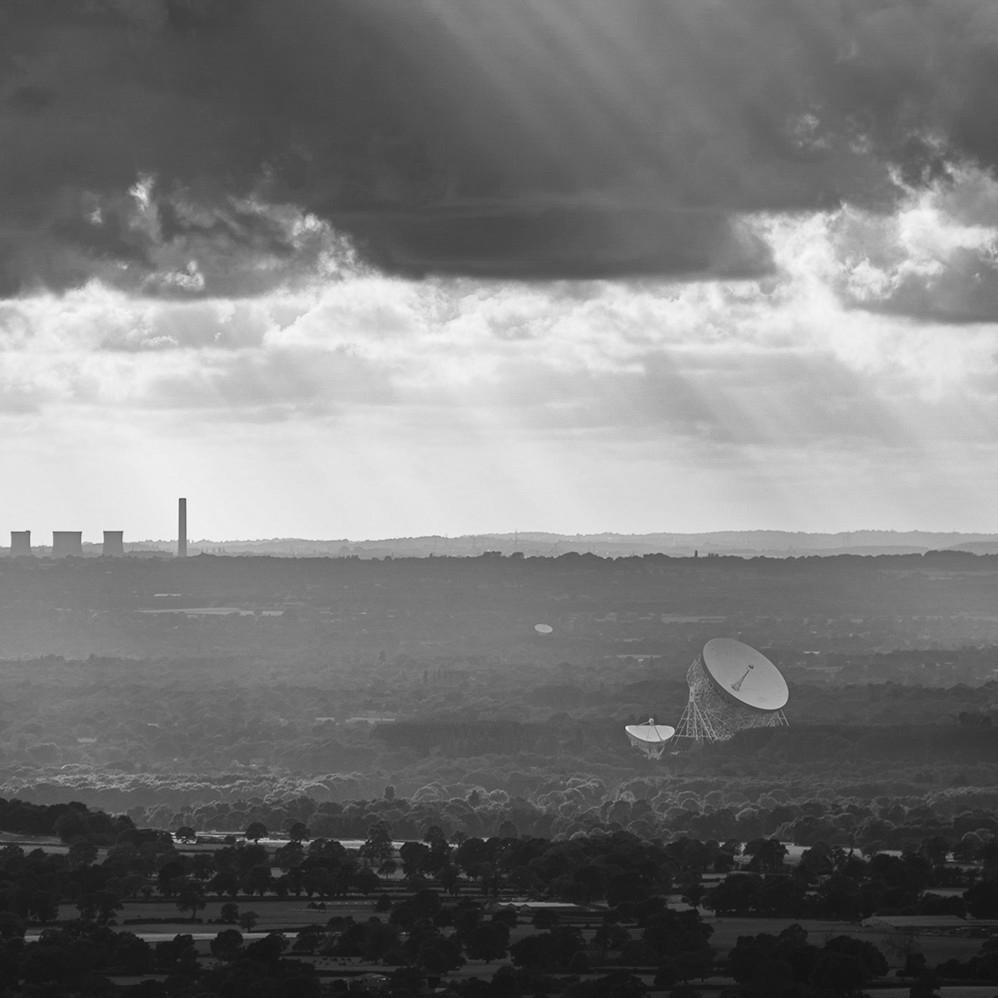
Professor Simon Garrington, a radio astronomer at the Jodrell Bank Observatory, University of Manchester, UK, said: “The 76-m Lovell Telescope at Jodrell Bank makes a superb radar receiver for this type of work. We are very keen to realise its full potential in contributing to monitoring objects in orbit, protecting UK assets in space, and making space safer. Our e-MERLIN array is also being used in this work and is a unique UK capability for high precision measurements of objects in orbit”.
Professor Gaven Smith, CB FREng – University of Manchester and former CTO, GCHQ, UK said: “This is a compelling example of how research facilities and skills can be applied to the challenge of protecting important UK assets in space against a range of natural (eg space debris) and potentially hostile threats. The need for these capabilities is becoming increasing urgent, and this application of radio telescopes shows how powerful capabilities can be developed rapidly and cost-effectively within the UK, by leveraging our research base.”
Prof Marco Martorella, LBMR project leader, Chair in RF and Space Sensing at the University of Birmingham, UK, said: “The successful demonstration of the Long Baseline Multistatic Radar marks an important step towards an operational Space Domain Awareness capability. Beyond its immediate operational potential, LBMR provides a unique platform to advance radar technologies, validate new sensing concepts, and train the next generation of RF and radar engineers. Building and retaining this expertise is essential to developing the capabilities needed to detect, track and identify space objects, helping to protect critical space infrastructure and ensure the safe and sustainable use of space for the future.”
Chris Saunders, a senior mission concepts engineer at UK-headquartered space company, Goonhilly, said: “This project has been a fantastic demonstration of multi-national collaboration across academia and industry, demonstrating the value of leveraging existing satellite communications infrastructure to protect our critical assets in space. Goonhilly looks forward to building upon the successful LBMR concept, as it continues to develop day/night, all-weather, RF-based Space Domain Awareness capabilities.”
Mr. Gregory Hogan, Chair of NATO SET ‘LBMR for Space Domain Awareness’ Research Group, MIT Lincoln Laboratory, US, said: “This multi-nation live demonstration highlights the advanced capability that can be achieved through Allied partnership. By augmenting US radars with partner nation radiotelescopes significant increases were achieved in sensitivity for detecting and characterizing satellites at Geosynchronous distances, greatly enhancing the SDA mission.
Ken Smart, Space Domain Awareness Lead at CSIRO, Australia, said: “The success of the Long Baseline Multistatic Radar demonstration relied on bringing together complementary capabilities from across the United Kingdom, United States and Australia. CSIRO’s contribution of the Mopra radio telescope and expertise in radio astronomy and signal processing extended the geographic reach of the network and provided an independent receiving capability from the Southern Hemisphere. Together, the partners demonstrated how existing scientific and communications infrastructure can be combined to deliver a powerful new approach to Space Domain Awareness, while strengthening international collaboration on the technologies needed to help ensure the safe, secure and sustainable use of space.”
Phoebe Ryder, PhD Student at University of Manchester, UK: “For me as a young scientist, it has been really valuable to join an international team which brings together experts in space radar, satellite communications and radio astronomy. This project has been a great opportunity to combine curiosity-driven research with real world needs to produce a demonstration of a useful and novel capability. Working with the UK Space Agency, and other stakeholders, has given me invaluable insight into the applications of this research, and hopefully some opportunities for a future career in this really interesting and important area.”
Dr. Jason Guicheteau, Chair of NATO Sensing Technology (SET) Scientific Technical Committee, US, said: “The successful live demonstration of the LBMR is a testament to the power of allied collaboration, showcasing the transition of foundational science into a tangible, operational capability originating out of NATO Science and Technology Organization (STO) research task groups.”
“The University of Manchester is a public research university in Manchester, England. The main campus is south of Manchester City Centre on Oxford Road.”
Please visit the firm link to site