

Researchers from Carnegie Mellon University will develop a new artificial intelligence framework to better identify critical minerals in the ground, increasing America’s access to these valuable materials and reducing the cost and time for exploration and extraction.
The CMU research team will work with Sandia National Laboratories, Colorado School of Mines and the Pittsburgh Supercomputing Center(opens in new window) to use AI to identify geologic and biological clues that could indicate the presence of minerals essential for advanced manufacturing in technology, aerospace, energy and defense. The project, known as GEM-AI, was awarded funding by the U.S. Department of Energy as part of the Genesis Mission.
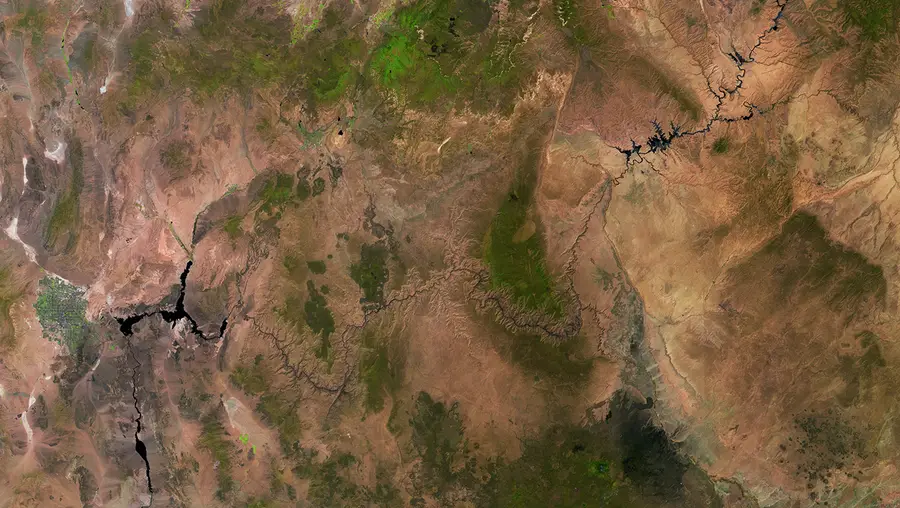
GEM-AI, led by Artur Dubrawski(opens in new window), the Alumni Research Professor of Computer Science in the Robotics Institute(opens in new window) at CMU’s School of Computer Science(opens in new window), will bring together expertise in AI, geology, microbiology and remote sensing to create an agentic AI system capable of integrating diverse scientific data while reasoning about the quality and reliability of the information it receives. The AI framework will scour existing satellite and aerial photography, sensor imagery, geologic sampling data and metagenomic analysis for markers that indicate where critical minerals could be located. Previous research has shown that the presence of geologic or biologic materials near the surface — or even floating in dust particles above the surface — can indicate the presence of valuable deposits below.

“AI allows us to harness diverse data to know where to look for critical minerals, reducing the time, resources and cost to explore in our own country while increasing the chances of identifying valuable deposits. It will enable us to explore in new places and with new methods,” Dubrawski said. “Our goal is very patriotic. We want to empower the United States to be as strong as possible when it comes to mineral independence. It is critical for our industries, our national security and the continued prosperity of our nation. This project will not only support commercial and strategic aspects of mineral exploration but chart the future for scientific research in this field.”
The Genesis Mission is a historic national initiative led by the U.S. Department of Energy, which is building the world’s most powerful integrated science discovery platform. By uniting government, industry, academia, and philanthropy, it is accelerating breakthroughs in energy, scientific discovery, and national security through a new platform that combines AI, supercomputing, quantum systems, and advanced scientific instruments.
GEM-AI received funding through the Phase I RFA awards. The goal of the Phase I RFA awards is to identify promising pathways toward transformative scientific capabilities and establish a foundation for future investment and scale. Project teams will design and demonstrate research workflows that integrate AI with scientific investigation, while rigorously evaluating whether those approaches can accelerate discovery, improve predictive capabilities, enhance experimentation, or generate new scientific insights.
Dubrawski and CMU co-PIs Chi-En Teh(opens in new window), a project scientist within the Auton Lab(opens in new window) at Carnegie Mellon’s Robotics Institute, and Paola Buitrago(opens in new window), director of artificial intelligence and big data at the Pittsburgh Supercomputing Center, will lead the development of the AI systems. Researchers at Colorado School of Mines, led by Thomas Monecke, professor, geology and geological engineering, and Ben Frieman, research assistant professor, geology and geological engineering will contribute expertise in geology and mineral exploration. Researchers at Sandia National Laboratories, led by Umakant Mishra, a computational soil scientist, and Guangping Xu, a geochemist, will contribute expertise in environmental genomics and metagenomic analysis and critical mineral characterization. The Pittsburgh Supercomputing Center, which is a joint effort of Carnegie Mellon University and the University of Pittsburgh, will provide advanced computing infrastructure to support large-scale model development and deployment.
GEM-AI demonstrates Carnegie Mellon’s ability to transform foundational AI research into applied tools ready for the field. The project builds on an existing partnership between CMU’s Auton Lab, which Dubrawski leads, and Colorado School of Mines to use AI to analyze aerial and satellite photography and sensor data to aid in mineral exploration and discovery.
The Genesis Mission expands that project to include Sandia National Laboratories(opens in new window)‘ expertise in environmental genomics and metagenomic analysis, including the investigation of whether soil microbial communities can serve as indicators of mineral deposits. For example, when deposits of sulfide-bearing minerals weather, they can release metal and sulfur compounds, creating environments that may favor metal-tolerant and sulfur-metabolizing microorganisms.
Phase I will focus on the Pacific Northwest and the Arizona copper belt as pilot regions. It will use data already collected by the DOE and other government agencies and research institutions. GEM-AI will be designed to incorporate additional data sources and models, enabling it to scale and adapt to scientific advancements. Its framework could be used by the broader DOE research community.
GEM-AI fits squarely into the mission of the Auton Lab: to develop foundational AI that makes a difference. The Auton Lab has already designed AI systems to help identify victims of human trafficking, forecast the need for predictive maintenance for mission-critical equipment in the U.S. military, monitor and predict public health crises and epidemics, and detect radiological threats. GEM-AI is another extension of this work into a new field.
“As we move from one discipline to another, we figure out how to apply our technology and learn how to tackle new challenges quickly,” Dubrawski said. “We can pivot quickly. Time and time again, we develop new frameworks that make us fearless whenever we face new challenges in new domains that initially we may have no clue about.”
“Carnegie Mellon University is a private research university in Pittsburgh, Pennsylvania. The institution was originally established in 1900 by Andrew Carnegie as the Carnegie Technical School. In 1912, it became the Carnegie Institute of Technology and began granting four-year degrees.”
Please visit the firm link to site