The ball’s journey to its casing at the National Football Museum is just as fascinating as the final it was used in. After England’s 4-2 win in front of some 97,000 spectators, Helmut Haller – who had scored the opening goal – carried it back to Germany, claiming tradition entitled the first scorer to keep it. It stayed there for 30 years, until a consortium of the Mirror Group, Virgin, and Eurostar bought it for £80,000 and repatriated it ahead of Euro ’96. The initials on its surface belong to Uri Geller, who signed it for luck as a pre-tournament publicity stunt.
Today, the ball sits on permanent display in the ‘England on the World Stage’ section of the National Football Museum, alongside Hurst’s hat-trick shirt and other objects from the final. The museum marks the anniversary on Thursday 30 July with a programme of talks from its Visitor Experience team on the 1966 tournament and the final itself.
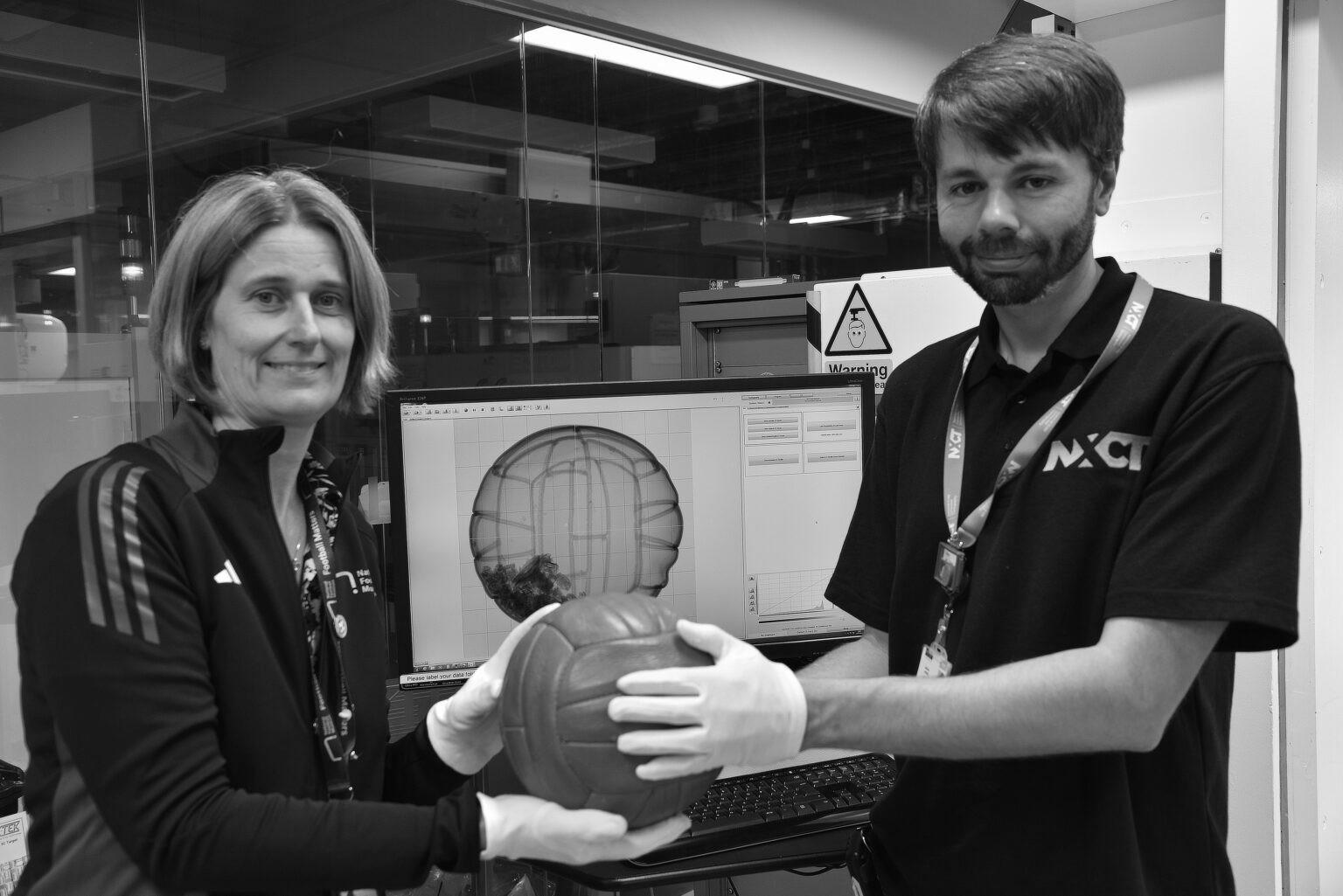
Dr Matthew Lawson, who performed the scans in the NXCT, said: “X-rays are a fantastic tool to non-destructively see inside objects, this technique has been used a lot in cultural heritage previously but never to look inside such a nationally significant football!
“Although a football is mostly air on the inside, we were able to see the makeup of the leather panels, the stitching and the perished air bladder in amazing detail thanks to X-ray computed tomography. Everyone at the NXCT in the University of Manchester would like to thank the National Football Museum for this exciting opportunity to scan such an artefact and to hold it in our own hands!”
Tim Desmond, CEO of the National Football Museum, said: “This is the most famous football in the country and, until now, nobody had ever properly looked inside it. What the scans give us is a window into how the game was made in 1966, the materials, the methods, the craft of a ball stitched by hand in a Yorkshire factory. It’s also a measure of just how far the technology has travelled to reach the Trionda of 2026.
“We’re a museum committed to educating ourselves and others, and to translating objects behind glass into stories people can get inside. As such, my thanks go to the University of Manchester for their expertise and curiosity that have created such a brilliant insight for our visitors and beyond. If you haven’t seen it already, come and witness a slice of history for yourself.”
“The University of Manchester is a public research university in Manchester, England. The main campus is south of Manchester City Centre on Oxford Road.”
Please visit the firm link to site