

Your recent work has focused on unpriced risk. Would you explain what that is?
It’s a risk that’s apparent—it’s not hidden or unrealistic, it doesn’t require a black-swan event to be relevant—but for some reason, there’s a lag in pricing it. Maybe the data needed to price it is difficult. There might be significant cost to quantifying the risk. Or the complexity of the issue might be daunting.
There is often unpriced risk associated with “wicked problems”—deeply complicated issues like climate change, healthcare, homelessness, or water scarcity that are so intertwined with social and systems issues that there is no single definition of the problem, let alone a single solution. Given the nature of wicked problems, it’s clear that pricing associated risks would be challenging.
But unpriced risks can show up anywhere. Quirks in the production and delivery of helium mean there are extreme shortages and price spikes every few years. That reality is understood within the industry and documented in scientific and trade publications. Yet the predictable risk from helium shocks is absent from financial filings.
How did you come to this work?
Speaking with hundreds of chief sustainability officers (CSOs) over the last couple of years, three things have become very clear. First, the political attacks on environmental, social, and governance (ESG) investing have forced CSOs to search for new ways to make the case for why sustainability is important. The fundamental risks haven’t changed or gone away, but the backlash to the old language has made new approaches to communicating the issues necessary.
Second, regulations, mostly in the European Union, are requiring greater disclosure of financial impacts from sustainability issues.
An effective price analysis is a window into the underlying problem and the most effective management strategy. If leaders can avoid costs from a worst-case scenario, pricing the risk makes the company money.
In response to those two pressures, CSOs have worked to bring sustainability onto the balance sheet. Rather than making qualitative arguments—“This is the right thing to do”—they are increasingly trying to deliver quantitative modeling and calculations of how much money will accrue as a result of sustainability efforts.
And third, AI is enabling that quantification. Modeling the financial impacts of sustainability risks has been very difficult, if not impossible, because the data is messy. AI’s ability to parse, organize, and track vast amounts of information allows CSOs to access that messy data and make their case in the quantitative language that chief financial officers (CFOs) understand.
What happens if we quantify unpriced risk?
An effective price analysis is a window into the underlying problem and the most effective management strategy. If leaders can avoid costs from a worst-case scenario, pricing the risk makes the company money. If it’s a situation the company can’t address alone, perhaps they spend a little bit to lobby for actions which could potentially deliver a large upside on revenue if they prevent the risk from manifesting.
Risk and opportunity are two sides of the same coin. When we’re talking about resource scarcity, there’s opportunity in solving the constraint. With energy, metals, or water, there could be a chance to introduce alternatives, develop ways to reduce need, or recycle the resource.
Pricing the risk might also clarify the dynamics of a system. Will a long-term purchase agreement lock in advantageous prices, or is it better to track the commodity price? One of the biggest money-making strategies for airlines is fuel hedging and contracts.
So why do organizations leave risk unpriced?
Beyond the very real issues around data, cost, and complexity, the pessimist in me says that for some problems, we don’t want to know the answer. I worked in the oil and gas industry. For a long time, we struggled with accounting for stranded assets—reserves where the cost of pulling them out of the ground was greater than the value of the commodity itself.
Some of those reserves had been sitting on the balance sheet for 30 years. They underpinned companies’ credit, revenue expectations, and shareholder perception. The rules allowed companies to price those assets with optimistic assumptions. There was no forcing mechanism requiring them to account for all the risks, and industry leaders definitely didn’t want to report large costs that optimism could keep off the radar.
With intractable problems or when the numbers get really bad, that’s definitely something we see, but I believe that almost all business owners and operators are dedicated to acknowledging reality, as opposed to trying to hide it through ignorance.
Is it possible for companies to put a price on the risk they face from climate change?
Often, company leaders want something simple and definite. That’s not what you’re going to get. We know, in aggregate, that planet-wide climate risks are cataclysmic. We know that all businesses are holding financial risk from climate change, but those risks will accrue differently depending on the region, sector, and business activity. So, it’s hard to answer when a company asks, “How will climate change affect us specifically, and how much could it end up costing?”
Companies ask how likely it is they will face financial repercussions; when those repercussions might occur; and if acting now will make a difference. All those answers depend on what happens within a complicated system. Will it be government policy putting a price on climate risk? Will it be a natural system collapsing? Will it be subtler things like younger workers refusing to relocate to cities where extreme heat is becoming the norm?
The data is difficult. And to get a realistic understanding, you have to bring in all the relevant factors. It’s not just what the company does; the actions or inaction of other players factor in. Things like drought, flooding, or wildfire factor in. Those factors all interact at a systems level—this is part of how we get wicked problems. You can see how, with so much uncertainty and so many contingencies, people get frustrated.
When companies come to me for advice, we go through a process to agree on the scenarios that are likely to occur. We then quantify the risk associated with each scenario. The result is a range of prices depending on which scenario comes to pass. While that’s challenging for someone who just wants one answer, it’s still a big step. And, again, it gets CSOs and CFOs speaking the same language.
Would you say more about that?
Sustainability professionals are very smart. They understand the wickedness of these systems-level challenges, but they haven’t looked at risks the way a CFO would.
Two years ago at an event hosted by Yale’s Center for Business and the Environment (CBEY) and the World Business Council for Sustainable Development, I asked CSOs to raise their hand if they knew what net present value meant. Maybe a third of the room raised their hand. When I asked, “What are the factors that go into a net present value calculation?” I lost almost all the hands. It was really surprising, because net present value is a key metric CFOs use for determining priorities.
That experience led CBEY to launch our Do the Math initiative. We’re helping CSOs learn financial modeling and pushing out tools that can create financial spreadsheets and projections, test scenarios, and support analysis around risks and accrual models. In doing that, we’ve discovered that comptrollers, risk officers, human resources directors, and operations people also struggle to quantify the risks in their domains. And some financial officers have found value in the tools, which range from basic Excel models to multi-agent AI models.
Beyond the tools, I’ve also been writing The Real Price of Risk, a Substack focused on unpriced risk case studies. My goal is to expand discussion and understanding of how to approach unpriced risks.
What becomes possible if sustainability risk is presented in a way CFOs understand?
Until recently, sustainability data was never good enough to convince CFOs that they should base decisions on it. Between the economization of sustainability and the power of AI to sift and sort the data, that is changing. I don’t know how fast it’s going to move, but my sense is that it’s going to be fast. I think we’re at a significant inflection point.
The impact could be significant. People understand the dilemmas created by wicked problems but, given the way the systems are currently set up, they don’t know how to move forward or contribute to solutions. Not everyone needs an MBA, but leaders in all roles need to learn how financial modeling works, what good data looks like, and how to model risks in a quantitative way.
What does the process of quantifying sustainability risk within a company actually look like?
Companies use two different standardized processes to determine which risks are material to their operations. An enterprise risk assessment identifies things like financial, supply chain, or labor risks. Materiality assessments will detail risks specifically associated with environmental and social issues. Those might be threats to property tied to climate; ethical failures; regulatory compliance failures; or dangers from extreme weather on workforce, operations, or supply chain.
Combining those assessments produces what we call an integrated enterprise risk assessment—out of all potential risks, here are the actual risks that are material for this specific company’s operations.
Qualitative versions of these assessments have been around for a long time. It’s why we see acknowledgments like, “We are exposed to climate risk, so we’re doing X and Y,” in companies’ 10-K filings.
Where things are really starting to change, in the last year or two, is quantification of the material risks. The change in our ability to quantify material risks has been accelerating. A few years ago, a manufacturing asset sitting in a 100-year floodplain would have a qualitative assessment of business disruption predicated on the likelihood of the flood event and government flood control infrastructure with a statement of insurance coverage to assure investors. Today, we would provide a risk-adjusted estimate of costs from repair (insured) and the revenue loss from the expected number of days of operational downtime (partially insured).
That is costly right now. You have to have the right people with the right data sitting at the right spreadsheet. If companies try to do this for every single risk in every different scenario, they’re looking at an exponential increase in costs. AI will help bring costs down dramatically, but we’re in early days.
Are enterprise risk and sustainability risk different?
For a long time, we used very different criteria to assess financial materiality and sustainability materiality.
For example?
Enterprise risk has generally used subject-matter-expert data. That is, people within the company are asked, “From this list of potential risks, what’s the probability and magnitude of each?” While for sustainability risks, external stakeholders are generally asked, “What do you think the risks are?”
If you only ask people inside the company, you only tap the knowledge that the company already has. There can be an attitude of, “We’re already taking care of those risks.” On the other hand, external stakeholders come up with lots and lots of different risks—it turns out everyone has their own pet peeve—resulting in a huge array of risks without any clarity on which are most significant.
We’ve been moving toward alignment on how to assess financial materiality and sustainability materiality over the last 10 to 15 years, but there’s still room to innovate and improve.
Climate change isn’t solely impacting the private sector. Your Substack looked at an example of unpriced risk in the public sector. Would you talk about the risks facing municipalities when climate issues impact property values?
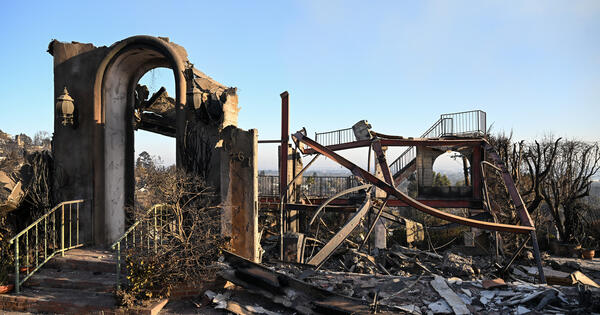
This is another wicked problem, because even as some factors are driving property values up, there is significant unpriced risk that could trigger large losses. Wildfire, flood, and drought are pushing insurance premiums up. High insurance bills create a perception of risk; that hurts people’s willingness to buy.
In parts of California, you cannot insure against wildfire anymore. Anyone looking to sell a house is essentially only able to take cash offers, because banks won’t hold a mortgage on an uninsurable property. That reduces demand, and the value goes down.
These are serious issues for individual owners. At a municipality level, they could cascade. In property-tax states, a big chunk of municipal operating budgets comes from property taxes, which are dependent on property valuation.
In a community where wildfire risk is going up and insurance policies are increasingly unaffordable, if the community tries to borrow to build wildfire resilience, bond buyers are going to say, “I’m not sure that you’ve got the revenue base to support this.” The credit rating agencies are keenly aware of these risks. Suddenly the municipality has less money to work with, even as it has more risk to address. That could turn into a nasty spiral.
We’re seeing more and more coastal and inland flooding in the Northeast. Other regions are seeing drought and water scarcity. Public sector leaders are facing difficult choices.
Do communities need to be pricing these risks?
Municipalities already have all sorts of things they must do. They have long lists of good things that they want to do. How do they know whether to prioritize climate resilience enough to get it into this year’s budget? Price. If municipalities calculate the risk-adjusted price of their choices, they can be in a position to say that climate resilience work is something they absolutely have to do right now. That isn’t to say the political choices will be easy. But leaders will at least have numbers supporting their case.
Your career has had a clear through-line of a solutions-oriented approach to environmental issues. But you’ve also crossed sectors and industries and worked in many different roles. What drew you to the work?
I grew up in a super-environmental family in the East Bay. My parents went to UC Berkeley. They’re Peace Corps graduates. My brother recently retired from a career as a lawyer with Earthjustice. His wife worked for the National Resources Defense Council. My wife is a lawyer and huge environmentalist. I’m surrounded by environmentalists. Caring about our environment has always been part of the way I think about the world. But if anything, I’m the black sheep in the family because I think that business is incredibly important in environmental issues.
I’m the sort of person who wants to solve problems. It’s my personality to think, “Let’s just figure out the most efficient way to do this.” That was reinforced by engineering’s solution-oriented culture. I got a PhD in environmental engineering. I was a research professor at the Colorado School of Mines. I led remediations at Superfund and other contaminated sites for an environmental services company.
The solutions orientation was also reinforced by the practicality of the business world. I worked in a number of consulting roles in Europe and the U.S. around sustainability reporting and ESG investing. If you just wave your hands at the problem, you’ll never see that contract re-upped.
How did you end up at Yale?
I was living in San Francisco leading sustainability services for a consulting firm. Hoping to improve the company’s brand value with an affiliation to a prestigious institution, I applied for what I thought was a part-time, remote role teaching an online sustainability class for Yale SOM.
I got the job, but it turned out to be full-time and in person. It was a big choice to leave the West Coast, but I followed my interests and my passion.
You began teaching at SOM and serving as the faculty co-director of CBEY in 2014. Has being at SOM influenced your work?
SOM’s frame of business and society resonates with me on several different levels. I’ve had one leg in industry and one leg in academia throughout my career. I think that business is a critical component of making society better. But I see business as the engine of societal betterment, not the steering wheel. When we tell business what is right through proper analysis, proper incentives, regulations, and other tools, then business is the best way to get where we want to go.
In my view, the solutions that put financial, social, and environmental factors side by side in equal partnership are the ones that deliver the most effective, sustainable outcomes. To me, that’s the epitome of business and society.
The energy at a university like this is just mind-blowing. There’s passion, excitement to explore issues, and drive to figure out new solutions. That’s true throughout the university, but for sustainability issues, I’ll particularly point to Yale SOM, the School of the Environment, and CBEY. The students I work with are phenomenal. Their energy and passion are paired with ability and a willingness to seek solutions that are effective and a little bit outside of the box.
And it fits so well with what I believe, which is that even with wicked problems, we have to figure out a way forward. The risks are real and serious. For us to succeed as a planet, we need to price this risk. For economies to succeed, they need to price this risk. For companies to succeed, they need to price this risk. Otherwise, we’re circling the drain.
“The Yale School of Management is the graduate business school of Yale University, a private research university in New Haven, Connecticut.”
Please visit the firm link to site