


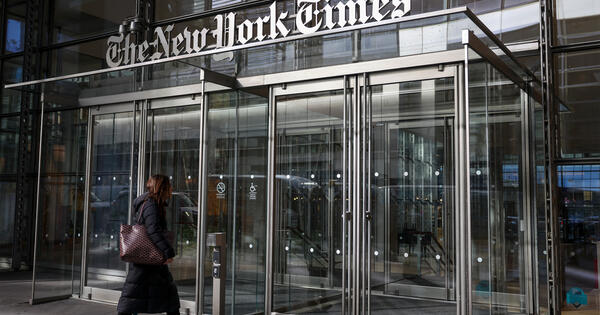
In the eight months after Hamas’s October 7, 2023, attack on Israel, the New York Times published more than 1,500 articles about the ensuing conflict. New research from Edieal Pinker, BearingPoint Professor of Operations Research and special advisor to the dean, finds that the framing of that coverage presented Israel as the driving force in the ongoing war, while Hamas largely receded from view. The result, Pinker argues, was a narrative that placed much of the responsibility for the continuation of the war on Israel.
According to the study, published this month in Studies in Conflict & Terrorism, the Times regularly reported the Palestinian death toll and told personal stories of suffering in Gaza, while giving relatively little attention to Israeli military deaths after October 7 or the effects of the ongoing war on Israeli civilians. Hamas fighters killed in combat and continuing Palestinian attacks on Israelis were also rarely mentioned.
The study grew out of Pinker’s experience of following the war through both the U.S. and Israeli press. “I was struck by the difference in the perception of the war I was receiving from the two sources,” he says, “and in particular how the human element of the Israeli experience was missing in the mainstream U.S. media.”
Pinker began by assembling a dataset of 1,559 Times news articles published between October 7, 2023, and June 7, 2024, about the conflict. He and a team of research assistants tagged articles for topics including Israeli and Palestinian casualties, Hamas fighters, Palestinian violence, Israeli hostages, and personal accounts of suffering on both sides, allowing him to measure how prominently each element of the conflict appeared in the coverage.
Among articles that directly covered events in the conflict, he found, 11% mentioned Israeli military casualties after October 7, and 12% mentioned Hamas fighter casualties. Only 21% mentioned acts of Palestinian violence, despite hundreds of armed clashes between Israeli forces and Hamas or Palestinian Islamic Jihad during the period Pinker studied. And while more than a third included personal accounts of Palestinian suffering, fewer than 4% included personal accounts of Israelis affected by the war who were not direct victims of the October 7 attack, such as those displaced by subsequent attacks or reservists whose lives were disrupted by the war.
Across the 1,559 articles, Israel was mentioned more than 27,000 times, compared with about 8,500 mentions of Hamas; in only 105 articles was Hamas mentioned at least as often as Israel. Pinker argues that this disparity reinforced a picture of Israel as the party driving events after October 7, even as Hamas continued to fight Israeli forces.
Pinker also identified 969 articles—70% of those that offered some description of the war—as consistent with what he calls the Times’ dominant narrative: the Hamas attack on October 7 followed by Israeli violence and Palestinian casualties, with little attention to subsequent Israeli casualties or to whether Hamas fighters were among the Palestinians killed. The Israeli hostages were mentioned in 42% of those articles.
“The distinction between what I call the dominant narrative and the fuller context is that it places all agency about the war in the hands of Israel and elides the role of Hamas in the continuation of the war and in the toll the war exacts from the civilian population of Gaza,” Pinker says. “This naturally leads to public opinion-driven political pressure on Israel that can have the perverse effect of strengthening the bargaining position of Hamas and prolonging the war.”
Pinker argues that the Times’ framing is especially significant because, as the U.S. newspaper with the largest number of subscribers, it helps shape how people far from the conflict understand the war and what they see as an appropriate response to it. The study also underlines the importance of editorial choices in framing complex stories, he adds. “I hope readers become more aware that ‘accuracy’ in reporting has multiple dimensions. It is not just about the facts being correct; it is also about what facts are mentioned and how frequently.”
“The Yale School of Management is the graduate business school of Yale University, a private research university in New Haven, Connecticut.”
Please visit the firm link to site