


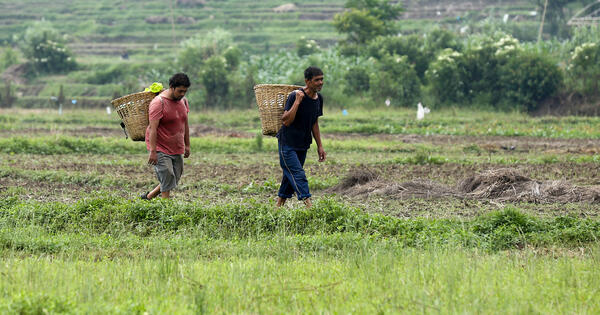
Poverty is often studied as a chronic condition that affects a person or a household uniformly day to day and season to season. But in agrarian areas across the developing world, hundreds of millions of subsistence farmers and landless families experience regular cycles of seasonal deprivation. During a lean season that occurs between planting crops and harvesting them, work grows scarce, wages decrease, and food becomes more expensive. Some families have to cut back on food, and the ramifications extend beyond the immediate hardships: Children, for example, can suffer permanent physical and cognitive setbacks as a result of malnutrition during the lean season.
In parts of Bangladesh, where Yale SOM economist Mushfiq Mobarak grew up, seasonal deprivation is such a predictable part of the year that it has a name, monga. In the 2015-2016 season, over 60% of landless households in northern Bangladesh reported sometimes reducing the number of meals or size of portions during the lean season, while 20% had to do so regularly.
“Each year the newspapers discussed the monga situation,” Mobarak says. “That’s how I originally got interested in the question—it was something happening around me in the country.”
Now an expert in scaling economic development solutions, Mobarak has spent two decades studying seasonal deprivation, examining government and NGO responses, and designing his own interventions to counter monga. After noticing that many of those affected in Bangladesh live a few hours away from cities that offer better employment prospects during the lean season, he wondered if encouraging seasonal migration could alleviate the problem. That question sparked a long-running research agenda through which Mobarak has investigated both the effectiveness of temporary migration in addressing seasonal poverty and the downstream economic and social effects this intervention can produce.
“The policy responses to seasonal poverty may be different from the responses to chronic poverty,” Mobarak says. “I wanted to understand what policies one can design to address the seasonal dimension specifically.”
In his original Bangladesh study, conducted during the 2008 rice-growing season, Mobarak and his co-researchers offered to pay the cost of travel for one member of each household to migrate to a nearby city to find work during the lean season. The results they observed were striking: Among families that sent a migrant to a city, each person consumed an average of 600 more calories per day, essentially gaining a daily meal during the lean season.
After the success of the 2008 study, Mobarak began investigating how leaders could scale this intervention responsibly and effectively. Subsequent papers explored economic spillover effects on rural wages, food prices, and employer profits, as well as noneconomic impacts of migration on health, education, and intra-household decision-making.
When attempting to replicate a similar solution for seasonally deprived areas of Nepal in 2019, Mobarak and his co-researchers Corey Vernot and Arjun Kharel realized that it wasn’t necessary to encourage migration there. Since Nepal has an open border with much-wealthier India, many Nepali workers were already migrating during the lean season. But a new puzzle emerged: Even though workers were making money away from home, lean season food insecurity was still prevalent amongst family members left behind in rural villages. Because technology to remit wages electronically across the border did not exist, most workers only brought money back home when they returned for the harvest season. Money wasn’t arriving during the lean season, when it would carry the most value for families’ food and financial security.
After a year of piloting and fieldwork, the researchers hypothesized that in the absence of technological solutions, a well-timed loan structured to match the cadence of migrants’ work travel could address this remittance friction. They issued $90 loans to rural households during the lean season, to be repaid once the migrant worker returned for the harvest. In addition to food security, the loan could also affect agricultural productivity by permitting greater pre-harvest investments in fertilizer and other agricultural inputs.
When people create these kinds of transnational households to improve the family’s life, we need to use technologies and policies to improve connectivity between different members of the family.”
The team found that the loan indeed improved food security during the lean season, especially for women, who tend to remain at home while men migrate. Among families that received the loan, investment in nitrogen fertilizer increased by 17% and weekly labor on household farms increased by 3.4-3.6 hours. Those investments during the lean season—impossible for families that lack funds or physical capacity to work their land—resulted in a 12% increase in rice harvested, a bump that can in turn help families build their resources for the next lean season.
What’s more, migrant workers saved more at the destination when their family members received a loan at home, and that extra remittance income was used to pay back the loan at harvest, when migrants returned home with the money. Economic theory can explain this behavior: The knowledge that families can now spend money at home during the lean season, when that money has the greatest value, motivates migrant workers to save more of their wages to bring home and later repay the loan. Without impacting the total amount of money migrant workers earn, therefore, the loan allows households to spend money at the place and time where it has the most utility for promoting the family’s health and prosperity.
Mobarak says that the success of the study, and the research agenda in which it is embedded, can inform technological and policy solutions. Payment platforms like M-Pesa in Kenya and bKash in Bangladesh already facilitate remittances within those countries; similar innovations could ease remittance frictions in Nepal, although they would have to account for more legal and regulatory complexities to move money across borders. In the absence of high-tech solutions, governments or NGOs can provide loans and structure them in ways that accommodate migration patterns and make money available in villages when it has most utility. Especially as climate change intensifies extreme weather, lean seasons may become more intense, inducing more households to consider seasonal migration and making efforts to support it even more crucial.
“When people create these kinds of transnational households to improve the family’s life, we need to use technologies and policies to improve connectivity between different members of the family,” Mobarak says.
“The Yale School of Management is the graduate business school of Yale University, a private research university in New Haven, Connecticut.”
Please visit the firm link to site