


Transcript
Harlan Krumholz: Welcome to Health & Veritas. I’m Harlan Krumholz.
Howard Forman: And I’m Howie Forman. We are physicians and professors at Yale University, and we’re trying to get closer to the truth about health and healthcare.
Harlan Krumholz: Today, we have the chief of cardiology, Eric Velasquez, as our guest. But first, Howie Forman, what’s on your mind this week?
Howard Forman: Yeah. God, plague, Harlan. Plague.
Harlan Krumholz: Plague, plague.
Howard Forman: I mean, it’s—
Harlan Krumholz: I knew you were going to talk about plague today.
Howard Forman: I know. I know. Possible plague in Siberia is the health topic this week. Everybody—
Harlan Krumholz: It wouldn’t have been on my bingo card to say, “What’s Health & Veritas—”
Howard Forman: I know.
Harlan Krumholz: “…going to be talking about in October 2026?”
Howard Forman: I know. And I’d rather not be talking about it, but here we are. So a 28-year-old lab technician at Russia’s Anti-Plague Institute near Irkutsk was hospitalized in late September and dead by October 2nd. The alarm has been driven less by what we know than by three things. Number one, this is Russia. Number two, the information is thin. And three, Russia’s own actions made it look worse than its official story. So first, Russia. Just as a memory, in 1979, anthrax escaped from a military lab in Sverdlovsk and killed dozens of people. Soviet officials blamed contaminated meat until 1992—13 years later. Our skepticism about Russia has been earned. Second, the information. Russia’s health agency says that the woman died of pneumonia of unknown origin, that her sample showed nothing related to her work, and that there was no lab accident. Regional media reported she broke a tube containing plague bacteria. And by the way, they now say she was vaccinated against plague. A neighboring regional leader posted that she died of plague, then edited it and added the word possibly.
Third, the actions. Nearly 200 contacts were tested and isolated. Hospitals were quarantined. More than 60 staff were isolated. The country’s chief sanitary doctor flew in from Moscow. That’s a response to a possibility you can’t rule out, and Russia still hasn’t told us how it ruled it out. So where does it stand? Pneumonic plague is the only form that spreads person to person through close respiratory contact, and it incubates fast, usually one to three days. That short fuse is why this week matters. As of this recording—this is Wednesday afternoon [Oct. 7]—Russia has told the World Health Organization that no plague has been found in her contacts, and the World Health Organization puts the risk as “low” and “very low” outside Russia.
No secondary case has been reported anywhere, though the WHO has inquired about a report. If that holds, this was one death, not an outbreak. But notice what we still don’t have: what actually killed her. The WHO has asked Russia that question directly and the initial response seems to be, “typical respiratory viral infection.” Not really satisfactory, given that she died at the age of 28 from this. Too many questions, given the seriousness of this possibility. Under the International Health Regulations, a suspected pneumonic plague case is exactly what countries are supposed to assess and report. The WHO’s member countries adopted a pandemic agreement in May 2025, but it still can’t be signed because they haven’t agreed on its core provision, how outbreak samples get shared and who gets the vaccines and treatments that come from them. And the United States has left the World Health Organization. Transparency and lab safety can’t be built during a crisis. This time, we may have gotten lucky. Let’s plan on avoiding a next time.
Harlan Krumholz: Howie, gosh, the part about this that seemed kind of chilling was, wait a minute, there’s an institute that’s working with these highly infectious agents that could potentially cause such human harm, and then, all of a sudden, someone comes down with it? It’s of course a very different circumstance than the pandemic before, but it’s still worrisome. Most people are on the airwaves like you, seeking both to reassure people but to say we need more information.
Howard Forman: Yeah.
Harlan Krumholz: I don’t know. We’re living in a world where just the news alarms us all the time, and that’s how they get eyeballs and that’s what causes concern, or is this something that we really should be paying attention to? I don’t know if you’ve seen Gladwell’s new book, which we should talk about at some point, which is about—
Howard Forman: Yeah.
Harlan Krumholz: …the epidemic of gun violence and how we don’t really pay adequate attention to it. If you look at the number of people who died from plague in the world versus the number of people who were shot last night in the United States, it’s a big disproportion. But when you look at the amount of time spent on the airwaves, that’s all we’ve been hearing about for the last 48 hours is this case, so—
Howard Forman: Yeah, I think that the added feature about this is there’s a book that came out in the last year or two where it’s a “nonfiction book,” but it’s a fictional narrative about it that basically posits the possibility of using plague as a bioterror element. And I think that’s why we get concerned, because Russia is not our ally at this point in history. They are secretive. Plague is potentially bio-weaponizable. And I think that that’s what gets people a little bit nervous, and I don’t blame them for getting nervous. It’s just in this case, it sounds like there wasn’t even a single case.
Harlan Krumholz: By the way, what was the name of this institute?
Howard Forman: This is the… I have to go back and look at it.
Harlan Krumholz: I think it was the Anti-Plague Institute.
Howard Forman: Yeah, I think that’s right. I think that’s right. I think that’s exactly, the Anti-Plague Institute near Irkutsk.
Harlan Krumholz: I don’t want to disparage any particular country or policy, but what in the hell are they doing up there in Siberia? That’s—
Howard Forman: Look, we do a lot of weird research.
Harlan Krumholz: I know. I know.
Howard Forman: China does weird research. I have to believe that the majority of what we actually see here, there, and everywhere is probably done for a good purpose, but it’s the fact that these are not our allies and that bioweapons are a real thing that gets us very scared.
Harlan Krumholz: Yeah, it does concern me.
Howard Forman: Yup.
Harlan Krumholz: Hey, thanks for reporting that and—
Howard Forman: Sure.
Harlan Krumholz: …let’s get to our guest, Eric Velasquez.
Howard Forman: Yep, this will be great.
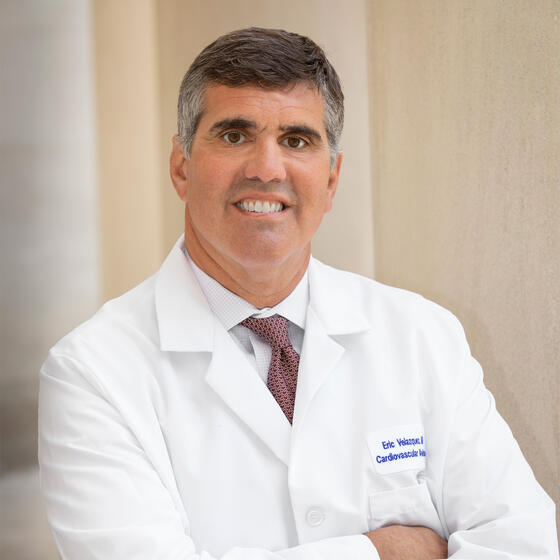
Harlan Krumholz: Howie, it’s my great pleasure today to introduce Dr. Eric Velazquez, the Robert W. Berliner Professor of Medicine at the Yale School of Medicine and, by the way, the chief of cardiovascular medicine at Yale Medicine and Yale New Haven Hospital. He also serves as a physician in chief of the Heart and Vascular Center for Yale New Haven Health, deputy director of the Clinical Trials Innovation at the Yale Center for Clinical Investigation. He’s in charge of almost everything cardiovascular. His clinical and research work, by the way, in addition to his administrative, is quite distinguished. He works on heart failure and coronary heart disease. He’s done some of the most impressive trials. He’s influenced treatment guidelines. He’s working on improving cardiovascular care for vulnerable and underserved populations. He’s a guy who got his undergrad degree from Williams, not far from here, his medical degree from Einstein, and then completed internal medicine and advanced cardiology research in echo at Duke. But now, he’s been here for, I don’t know, what is it, Eric? Almost eight years in this—
Eric Velazquez: Eight years now, yeah.
Harlan Krumholz: He’s firmly part of the Yale family. So it’s a great pleasure to have him here. Thanks so much for joining us. You run an extraordinarily large and complicated cardiovascular enterprise. I think it’d be good for listeners just to get an idea of an understanding of exactly what you’re responsible for, because it’s massive. And then, how you judge your success, given the various different things that you’re responsible for because you’re responsible for the academic mission, for the actual business of the cardiovascular section, and of course, caring for all the people who report eventually up to you. So can you just give people a sense of what is cardiovascular medicine at Yale and what’s your vision and how do you measure success?
Eric Velazquez: We have an amazing faculty with university appointments, which really span the spectrum of translational research in the cardiovascular space from—
Harlan Krumholz: By the way, just give a sense of the scope. How many clinicians, how many scientists? It’s big. This whole thing’s big, right?
Eric Velazquez: So just to give you a scope, I mean, we have 180 ladder-track faculty and research-track faculty, and we have staff and fellows that are assigned to our section/department and trainees that range another 150 or so. So we’re about 350 people large. Among those individuals, on the faculty university side, we have about 100 to 110 clinically active faculty. We have 50-plus advanced trainees in cardiovascular medicine who are part of our section. Our general core cardiology fellowship, to give you a sense, has about a thousand applicants a year, and we choose somewhere, depending on the year, between five to nine of those to join us, and we have that core general faculty training over three years. And then, we have eight or seven other subspecialty fellowships as well. They’re usually one or two years long for additional training. We have a host of individuals at different parts of their postdoctoral training who are working within our research laboratories, and then we have strong staff.
Now that does not include… that’s the people that are on the Yale University side, and yet, we are aligned with Yale New Haven Hospital and the Yale New Haven Health System. In the hospital here in New Haven, we have roughly a thousand people working in the cardiovascular space supporting this clinical mission. And in the health system at large across our five hospitals and 27 ambulatory clinics where we see cardiology patients, we have a greater extent of people at different stages supporting us, either full-time or part-time. So it’s a big operation from that perspective.
Howard Forman: Yeah. Cardiology has been just transformed in our careers. I feel like I’ve been in medicine now probably a little more than 40 years. If I go back to medical school, it’s transformed. My father’s father died of a heart attack at 63. It was his second heart attack. My father had a heart attack at 49, got angioplasty at the end of the year, got stented a few years later, benefits of Mevacor and other things, and is alive and well at 93. When I think about the field when I was a medical student and a resident, there was basically cardiology and there was this burgeoning field of interventional cardiology and maybe occasional people that might’ve called themselves EPS, or electrophysiology. It’s huge right now.
You talked about the scale of the operation, but I wonder if you could talk from your historical perspective from the time when you were a medical student to now, about how subspecialties have developed, how they’ve grown, and how it impacts patients. And then, if you just want to end by saying for this question, what do you think the future is for cardiology? Because it’s already, at Yale, bigger than most of our clinical departments, even though it’s a section in internal medicine.
Eric Velazquez: Yeah, it’s a great question. I think we have all are fortunate to have lived in this era where things have been transformed so extensively. You mentioned your father, and I’m glad to hear he’s doing well, and his journey is not atypical. I can speak to my father, who didn’t have coronary disease, and his father died in his fifties. His mother died at 51, and he was diagnosed with what I call man-eating hypertension in his mid-30s and took reserpine. Can you imagine?
Howard Forman: I remember that. Yeah.
Eric Velazquez: And he survived into his eighties without ever having a coronary event, which was kind of shocking, in a way, itself. When I was a trainee, pretty much everybody I saw in training as an early CICU [cardiac intensive care unit] faculty member at my prior institution had an anterior MI or had an MI [myocardial infarction]. My original work, and I think Harlan knows a little bit, was focusing on the population of patients who had MIs in association with heart failure or poor heart pump function or LV dysfunction [left ventricular dysfunction], which was highly prevalent and a very high-risk cohort. Our trainees, when they see a patient presenting into the CICU with a young person with an anterior myocardial infarction, which can typically affect heart pump function more severely, that’s a new thing for them. They’re like, “Wow, I haven’t seen a 55-year-old who came in with an MI.” It happens and it still does, but it’s rarer.
And it was all we did 24/7 was take care of the patients. And then, as we built reperfusion strategies to try to identify a culprit lesion and reperfuse, meaning improve the blood flow downstream from that lesion, originally with thrombolytics and then stents deployed in the setting of an MI for the right patients, we were changing patterns of care and these people were… they didn’t die. They lived to see another day, and they had this chronic condition that we had to be managed. Then, I’m going to skip around here, but think about that. Then, you think about, statins were new when I trained. They were barely new. And the story I’ll tell you, Harlan, at my lab is I remember getting yelled at by one of my sponsors, who’s a two-time FDA commissioner at this point and someone who’s very meaningful to my development as many others were there, when I had the stupidity—at the time—of giving an MI patient with heart failure LVS function a beta blocker, and now, it’s kind of a standard of care. We know it makes people live longer, so our treatment of heart failure dramatically changed. Prevention is growing, primary prevention. That was not something cardiologists talked a lot about. We were like, “Okay, we’re here when there’s a problem and the problem is identified,” and we identify them in the CICU. Now we’re talking about primordial prevention and primary prevention based on an understanding of risk factors that we didn’t even know were as important and their effects. And then, you can imagine the elements of secondary prevention of outcome is based on all these diseases. And we have electrophysiologists who do amazing things procedurally now that are becoming standard approaches to atrial fibrillation when before, it was like, “Too bad, you got AFib. We’ll try to recontrol that rate and make sure you don’t have a stroke, but other than that, you got to live with it,” to we’re kind of curing AFib.
Interventional cardiology is at a different phase in its development. Structural heart disease…. Let me just stop there for a second because I’m very proud of our team here. When I read an echocardiogram—and Harlan ran echos here for a long time at Yale—we saw severe AS [aortic stenosis]. We’re like, “Okay, you might have heart failure in the next few months. You might have a syncopal event or have a coronary event, and there’s really not a lot we can do.” We don’t have medical therapy for it, and if you were not a surgical candidate or you were considered too old to get through surgery, which is the population that mostly has aortic stenosis, by the way, calcific aortic stenosis, there was nothing to do. Now, we are putting—percutaneously—valves. Populations in their mid to late eighties and some into their nineties are getting percutaneous valve replacements, which is giving them major quality-of-life improvements and mortality improvements in a population we couldn’t really do anything for. And that structural interventional space around valvular problems and other structural problem has changed.
Our understanding of the genetics and the cardiomyopathies and other problems that come from those genetic disorders blossomed, and we are now having focused genetic treatments. In a way, with disease we always knew, I always use is amyloidosis. Well, what happens as you get older, your higher likelihood of having cardiac amyloidosis and people are very sick from that, and now, we have to look for it. And that leads me to the last kind of major element is the… and I’m not saying this just because I am a part-time cardiovascular imager as well and trained now, but cardiovascular imaging has really opened up everything, right? Our diagnostic tools are just substantial.
Now, what’s the future? I would say that it’s going to change. It’s going to change dramatically like it’s changed in my career. And I think it’s going to change by the integration of computational biological approaches, data science approaches, not only using those new methods to investigate in the discovery space biologically but also in the implementation space about how maybe we can identify populations, enrich populations for evaluation, and follow up in ways that right now are just kind of folded into the entire population, and be more prescriptive in terms of how we use our resources. We’re also learning that our field touches so many other places and we’re developing expertise in cardio-obstetrics, in geriatric care, in cognition, which actually, I’m very excited to see it, but it wasn’t necessarily initially my thinking that we’d be there, but I think cardiovascular care is closely tied to cognitive development as well as disorders. And so, I think we have to start exploring that area. And I think a lot of the tools, data science, and computational biological tools that are coming out are going to revolutionize our exploration of those intersections.
Harlan Krumholz: Eric, let me ask you, you sit at an interesting juncture as a chief of cardiology and at the intersection of so much going on in cardiology at a point where we’re growing, but also, you have to be concerned about competition and what’s going to happen coming up. I have an idea that one thing that’s going on in medicine today is that there’s a shadow healthcare system emerging, and it’s a decentralized system that’s attending to people’s needs, giving them what they need when they want it, and doing it in a way that they find to be a much of a positive experience. So for example, Heartbeat Health grew out of a couple fellows in Columbia starting to say, “People have to wait months to get a cardiology appointment. They have to wait a long time to get these stress tests. And so, we’re going to actually have a bunch of gig-working cardiologists in the beginning.”
And then, I think they’ve hired since, and they’ve gotten quite big where they’re basically saying, “Call us 24/7. We’ll get on the phone. We’re ready. We’re eager. We’ll talk to you. We’ll answer your questions. We’ll provide services. Similarly, there are services out there. We’ll come to your home and do an echocardiogram. We’ll serve you.” And so, you know that there is a thesis that abounds that says that one day, the hospitals are only going to be the place you’re coming for procedures. And actually, there’s going to be a whole range of companies and services out there that are going to disintermediate this sort of status quo that exists now where you live in New Haven, you really have one choice, you go to Yale New Haven because it’s the local system, and people are going to be pulled in lots of different directions. This may have started with something like MinuteClinic at CVS where people can get their primary care just going to the drugstore.
But I don’t know. How do you see this? How do you see this sort of emergence of these different things like Heartbeat Health and others that are providing cardiovascular services outside of the traditional pathways? Do you think that’s going to persist, continue, grow, or do you think it’s just a fad?
Eric Velazquez: No, I don’t think it’s a fad. I think it’s going to grow. I think we should have availability for patients who are willing to have their healthcare started that way, to have video or telephone visits in certain spaces. If someone’s saying, “I have chest pain. I want to see someone on the phone,” it’s like we are not there yet. There are some things that we have to be clear. We don’t want to put people at risk because they’re making choices. We have a responsibility to establish the guidelines. If someone wants to understand a suggestion that they might need to be on X, Y, and Z to manage a chronic condition, we need to be able to meet them where they want to be met. And I think that’s a challenge for someone like me that I’m going to look to meet. I’m not afraid of that. I do think it’s coming, and we have to be there.
At the same time, you said hospitals are where people are going to come for procedures. I actually am pushing back at that. I actually don’t think that… I think we need to move most of our cardiovascular procedures outside the hospital into a… I think we have to build ambulatory-based centers where we can do ablation, we can do coronary interventions, we can do all our imaging and stress testing in a location which you don’t have to drive and park in North Haven. You can be in a place where you can come to if that’s how you want to get your care. I don’t think we have to be tied to the hospital as much. And as a component of that, we have to build strategies to ensure that for a component of what is needed for patient care, we can deliver…. I’m not sure we’re ready yet to go completely asynchronously because we don’t have models of how to even finance that, but maybe not in person and get things started.
I want to say one thing that we haven’t raised yet, and I think it does apply to how you addressed your question. I am very concerned about the divide across social economic strata in our country and how to deliver care. And so, yes, the MinuteClinic is great for some things, even in inner cities, but it may be that the people who are going to use this kind of programs have a different access, different funding to support the kind of care that they’re going to be offering. And that’s where, I think, the academic health system has the most importance, which is we shouldn’t have those different standards. If we do this, we’re not going to do it only to those who are paying the premium price, but we should do it for everybody.
And I think maybe as a first-generation American immigrant, I’m not supposed to be political here, I feel very strongly that we have to actually put in place those care strategies that help reduce the pretty large disparities and outcomes among race and ethnicity and gender in cardiovascular care. So I worry about going into what you’ve suggested is happening without a perspective that we have to build systems that can support the entirety of our population, not just those who have the education or the ability to pay for that.
Howard Forman: You’ve covered an enormous amount of topics here today, and we’ve got to have you back, but as we get to the end of time, I just wanted to ask you, when you were a freshman at, I think, Williams College, is that right?
Eric Velazquez: Yeah.
Howard Forman: And you eventually majored in psychology, did you ever think that you would become a cardiologist at that point? What was your goal at that moment?
Eric Velazquez: First of all, very impressed that you know I went to Williams and then I was a psychology major, but kudos to you. But I think the most important thing at Williams was I met my wife, and we’ve been together 34 years. At Williams, I got excited about neuroscience, and psychology in that era, we didn’t have a neuroscience program, and so it was kind of biological psychiatry, whatever you call it. I was interested in biology, I guess, in the psychology framework. I had the great opportunity to move after Williams to the Rockefeller to do some scientific work. And so, I think at that point, when I was graduating, my sense was that I was going to be directed towards neuroscience and more research work. But I have to say, I mean, cardiac conditions were common among people, and I have to think that at some point in the back of my mind, I was always interested. I also trained at a place where 80% of the patients that I saw as an intern, or as a medical student, sorry, had AIDS. Not HIV-positive. They were dying of AIDS in the hospital.
Howard Forman: Yeah, that’s right.
Eric Velazquez: And it was New York City, in the Bronx, in an era. And that was really impactful to me. I think I was just fortunate to get exposure to cardiology and evidence. I went to my former institution because they were moving in the direction of building their clinical trials, understanding on how to integrate clinical trials in care, and that got me excited about that. So I kind of shifted in that way. So I hope I answered your question.
Howard Forman: We are just grateful that you did shift and for all that you do for Yale, for Yale New Haven Health System and for coming on the podcast today. Thank you so much.
Eric Velazquez: Thank you. Thanks both of you and everyone.
Howard Forman: He’s really a great leader. He seems to have an enormous section. I think it’s bigger than my radiology department, so it’s fantastic to hear him.
Harlan Krumholz: It’s a big job, Howie. Just keeping track of all the faculty, that doesn’t even count like… chair of medicine is a full-time position, but these section chiefs, especially big sections, have a lot of responsibility, and it’s a very tough job in this era. Very tough job.
Howard Forman: Yeah. A lot to do.
Harlan Krumholz: Yep. Yep.
Howard Forman: So tell us, what do you have going on, Harlan? What are you thinking about?
Harlan Krumholz: Well, from time to time, I like to talk about these editor’s pages that I do in JACC, the journal that I edit. And I had an idea for an editor’s page just a while ago that I was able to sort of lay out and has received, I know, a fair amount of attention. And it’s about the erosion of the asymmetry of expertise and information in medicine. Now, think about that, the erosion of the asymmetry of expertise. It’s not the erosion of expertise. And what I did was to try to draw this contrast between a time when my father, who graduated medical school in 1960, was practicing medicine, and the physician was considered to be the be-all and end-all of knowledge and expertise around health and healthcare, and people would come to hear the answer. They would come to hear the answer. Now, contrast that to the era in which I practice and came up into where the internet became quite widespread until the fact it became ubiquitous, and people started talking about patients Googling before they came in to see their doctors.
And so, they came in with more information, often handouts. And there were people who were complaining about that, saying like, “My gosh, I can’t get the office appointment done because people now have a lot of questions.” But the truth is they were equipped with information, and many of us actually applauded the idea that now, people were prepared for the visit. But now, contrast that with the era in which my daughter is coming up, where it’s not just that people have access to information, but they have access to reasoning models, the large language models, the ChatGPTs, the Claudes, the Geminis. And now, people are actually not only prepared, but they’re having conversations with these models at a level of health literacy that exactly matches their level where they can understand. And they’re coming into the clinic now with more information, and that asymmetry of expertise has eroded.
And I was just sort of opining about this, about what does it mean to be a doctor in this era? This isn’t hypothetical anymore, because it’s now happening. One in three adults reports having used AI for health information or advice today. And for modern medicine, privileged access to knowledge helped establish the physician’s authority, and that’s going to be less so now when people are coming in, and that foundation’s sort of receding. And I was trying to make this distinction of what it meant to actually earn trust in an era where it’s not just about saying, “Trust me, I know the answer,” but we’re going to be able to engage in a more meaningful conversation. Now, as I put this out online, it was interesting the kind of feedback, most of it positive, but some people were saying, “You don’t know my patients. My patients are still coming in for answers.” And what I responded to that was that we’re in a very much of a transitional period.
There are some patients who are in fact acting still like it was in 1950. They’re people who are seeking medical advice and want to be told what a doctor thinks, and that’s true. But there are many others who are acting like it’s 2050, I mean, who are way ahead of this and are actually listening to what the doctors are telling them but checking everything they’re hearing, are approaching everything with a little bit of a skeptical air about them, and are wanting to verify and not just verifying Google, but going through many of the models, talking to a lot of people, and are not content to assume that the doctor in front of them is going to be telling them something that’s right. And we have all of this in between, in this transitional moment. And again, I think I ended by just saying that it’s going to be about fidelity, the notion that it’s not about facts but relationships.
And do you trust the person in front? Has the person earned your trust? And can they be a guide for you through challenging health issues and help you to make the right decisions for yourself and deliver to you the kind of care that you’re seeking? But it’s a really interesting moment, I think, in medicine, and I don’t know. What do you think about this?
Howard Forman: Look, I thought your piece was optimistic and aspirational, and it would give anybody who’s in college or medical school hope about what the future is, and I share that vision. I really hope and share that vision. I would not talk anyone out of going into medicine. I do worry that we have a whole new generation that is coming up with AI in abundance around them. And I’m not sure that we specifically know how to prepare them the way you and I are prepared. Megan Ranney today said something in a conversation around that we’re at the apex of the AI curve because our generation benefited from learning in the old model but getting to use the new model. What do people look like when they don’t learn the way we learned foundationally and have come to rely a lot on AI models? That’s what worries me. It doesn’t keep me up at night, but it worries me.
Harlan Krumholz: So I’ve heard that case before, and I’ve seen the studies that suggest that you can disengage when you’re using these models, and it may affect people’s cognitive abilities. But look, when they studied the cab drivers in London before the GPS, their hippocampus was bigger than after GPS. And the taxi drivers got de-skilled. They were famous taxi drivers in London because they could navigate this morass of streets and alleys and runways and everything. And it was always remarkable that these cab drivers could do this. Well, today those cab drivers can’t. If you sat them in a room, they couldn’t put together a map of the London streets like in the old days. But are they any less effective in getting you to your destination? I mean, did that de-skilling matter? Does it matter?
Howard Forman: Isn’t there a thinking that goes on in our brain about logic? It’s not about the facts. The facts are driving, the facts are how you shift, but there’s a way that we think. There’s a way that our eyes work in radiology that is trained a certain way. I’m worried that that will never happen.
Harlan Krumholz: Well, so there are critical thinking skills that I would say I’ve found lacking in some people and terrific in others over the years, that even before AI. It’s a question of how we adapt, but I’ll tell you another interesting thing. So in many training programs, they want to shield them from the tools like ambient AI and other things in the early days of their training. But maybe what they should be doing is figuring it out from the very outset. They’re not going to be living their clinical careers without AI. The question is, do they know how to use it? Are they using it properly? And it should be maybe from the very outset that the key thing the education program should be doing is not saying…. They could say, “Let’s just take away electricity, and you guys should learn by the way to take two sticks and rub them together and make fire because you need to do that,” or they can teach them how to use a stove. It’s like we need to embrace what the moment is.
Howard Forman: I agree, but also, I’m concerned that we don’t know the answers. We’re making suppositions about how brains will work in a new environment that may not be applicable. And I want it to work and I want to see the next generation be better than us, but I just want to watch—
Harlan Krumholz: But those experiments are going on all the time. No one remembers phone numbers anymore. No one remembers phone numbers anymore because that’s not how they get to the… no one knows how to get by streets without a GPS. I mean, we increasingly are reliant on things that become part of our daily lives, and that’s going to happen in medicine, too. Anyway, it—
Howard Forman: But that’s not critical thinking. In other words, I’m talking about developing critical thinking skills. You’re talking about functions. And I’m just saying I don’t know how our brain wires if we never develop the critical thinking skills.
Harlan Krumholz: And I’ll just say maybe that means we should focus on what those skills are people need to develop when they’re using these tools. And I will also say it has been a problem since the beginning of time that we’ve had people on autopilot when taking care of patients, and we needed to figure out how do we make sure people are truly engaged in thinking, not just reflexes and heuristics that may not serve them well. Anyway, this will continue to occupy—
Howard Forman: We’ll keep having these conversations.
Harlan Krumholz: It will continue to occupy….
Howard Forman: Yep, yep.
Harlan Krumholz: You’ve been listening to Health & Veritas with Harlan Krumholz and Howie Forman.
Howard Forman: So how did we do? To give us your feedback or to keep the conversation going, email us at health.veritas@yale.edu or follow us on any of social media.
Harlan Krumholz: And give us feedback. We love hearing from you. Tell us what we can do better.
Howard Forman: Health & Veritas is produced with the Yale School of Management, Yale School of Public Health. To learn about Yale SOM’s MBA for Executives program, visit som.yale.edu/emba. And to learn about the Yale School of Public Health’s Executive Master of Public Health program, visit sph.yale.edu/emph.
Harlan Krumholz: And one of my favorite parts of the program, show a little bit of gratitude. Thank you to our superstar undergrads: Donovan Brown, who’s with us today; Gloria Baek; to our outstanding producer, Miranda Shafer; and to the best in the business, Howie Forman.
Howard Forman: You’re very kind, Harlan, but I’m so fortunate to work with you.
Harlan Krumholz: Thanks so much, Howie. See you soon.
Howard Forman: Thanks, Harlan. Talk to you soon.
“The Yale School of Management is the graduate business school of Yale University, a private research university in New Haven, Connecticut.”
Please visit the firm link to site