


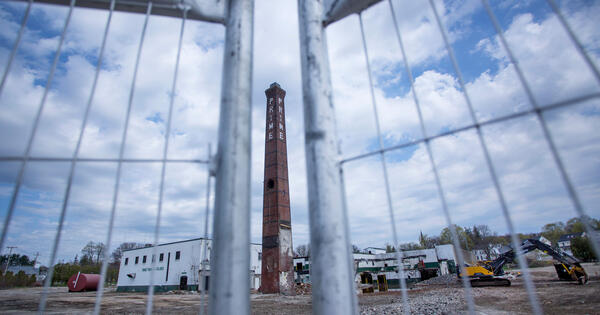
Around the corner from one of Cameron LaPoint’s favorite sushi restaurants is a parking lot that looks much like any other. But LaPoint recently learned that a portion of this particular parking lot in New Haven is classified by the Environmental Protection Agency as a brownfield, a property thought to contain a hazardous substance, pollutant, or contaminant.
Right now, the lot “probably isn’t suitable to be used for other things, because if you dig up what’s underneath, it could create a bigger problem,” says LaPoint, an assistant professor of finance at Yale SOM. But he suspects the land could be put to better use with the help of some TLC: “There’s not that much need for parking there.”
Around the United States, up to 15 million acres of land sit similarly vacant or underused. “These sites are everywhere, and you may not know it,” LaPoint says. “It’s something that’s really under our noses.”
Brownfields are usually contaminated because they were previously the site of illegal dumping or home to businesses that work with toxic substances, such as automotive repair facilities, dry cleaners, gas stations, and manufacturing plants. But compared to Superfund sites, their better-known and more dangerous cousins, brownfields are easier to clean up and return to productive use.
In fact, it turns out that relatively modest federal grants for brownfield remediation can significantly boost the economy near a previously contaminated site by creating jobs, boosting entrepreneurship, and increasing home values, among other benefits. That’s one of the findings of a new working paper co-authored by LaPoint, Aymeric Bellon of the University of North Carolina at Chapel Hill, and Jason Chen of Auburn University.
The research also provides evidence for a phenomenon economists call the flypaper effect—the idea that federal government funding within a municipality attracts additional investment, whether from other federal agencies, state and local governments, or private sources. And because the EPA’s grants for brownfield cleanup rarely cover the full cost of the project, these additional funds are essential.
To study the economic effects of brownfield remediation, LaPoint and his co-authors took advantage of several aspects of how the EPA funds and administers the brownfield cleanup program.
For instance, the passage of the Better Utilization of Investments Leading to Development (BUILD) Act more than doubled the size of the maximum EPA cleanup grant, which jumped from $200,000 in 2018 to $500,000 in 2019. That allowed the researchers to compare employment near sites that received grants in 2018 to employment near sites that received much bigger grants just a year later, in 2019.
There’s no reason to think anything was fundamentally different about the sites that applied in 2018 versus 2019, so this comparison was a tidy way to “isolate the incremental value of the funding expansion,” LaPoint says. “If I give you more dollars, conditional on getting funding, what is that going to do in terms of job growth?”
In another part of their analysis, the researchers looked at the grant proposals submitted to the EPA. These proposals describe particular brownfield sites and what they need, including factors such as the severity of contamination and the potential for future use. The agency scores each proposal and sets a minimum score for funding that varies from year to year; proposals above the cutoff receive grants. In their statistical analysis, the researchers zoomed in on proposals that scored just above and below the cutoff, which are otherwise very similar.
“Those are good treatment and control groups,” LaPoint explains, “because otherwise you might just be comparing two sites where one was on a really strong growth trajectory and one was not.”
Then, within each grant cohort in their sample, the researchers compared job growth, new firm entry, and home prices near sites that barely missed out on funding to sites that barely scored high enough to receive it. They also examined the non-EPA sources of funding received by these two groups of sites.
Together, these analyses told several compelling stories. The researchers found that cleanup grants meaningfully benefit local economies, increasing employment within three miles of a funded site by approximately 5-6%. These effects lasted well beyond the active cleanup period, suggesting that the increase isn’t simply the result of jobs being created during the work. What’s more, the benefits accrued mainly to people living near funded sites, rather than commuters coming from elsewhere. Grant funding also increased new firm entry—the number of new businesses created—by 1.6 percentage points.
In addition, home prices within a half mile of funded sites increased—by about 5% 7 years after the grant was received and about 10% 10 years after.
LaPoint highlights a possible relationship between these two sets of findings. Economists have long known that home values influence entrepreneurship. “If you’re fixing the unemployment problem in the area and people’s home values are going up, they can leverage their home values to take out home equity lines of credit,” he says. “That can be the seed money for starting a new business.”
Finally, the researchers found, receiving EPA grant funding increases the overall amount of non-EPA money flowing to a site by between $3 and $5 million. In other words, “giving grants to these sites seems to help them accumulate millions more on top of that,” LaPoint says.
Notably, LaPoint says, the economic benefits of brownfield remediation are similar to those stemming from more conventional government subsidies to municipalities. Typically, these place-based subsidies aim to encourage a large employer to set up shop in a particular town through tax breaks. Often, however, multiple areas end up competing for the same manufacturing plant or warehouse, offering sweeter and sweeter deals. The result is that taxpayers lose out on a significant amount of money in exchange for a relatively small number of jobs.
Brownfield remediation, the researchers suggest, may offer more bang for the public buck—and provide an environmental benefit along the way. The cost per job created by EPA funding ranged from $7,500 to $19,700, depending on how the researchers calculated it, a figure that is in line with or lower than conventional place-based subsidies.
By unlocking land in places that need it, LaPoint says, “you’re not subsidizing firms directly—you’re really subsidizing the area.”
“The Yale School of Management is the graduate business school of Yale University, a private research university in New Haven, Connecticut.”
Please visit the firm link to site