


Transcript
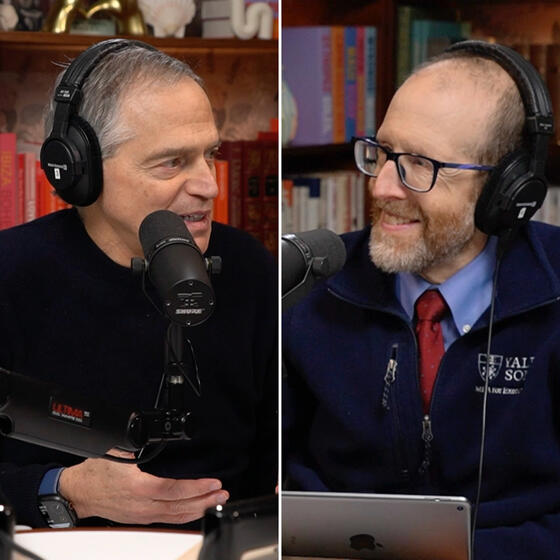
Harlan Krumholz: Welcome to Health & Veritas. I’m Harlan Krumholz.
Howard Forman: And I’m Howie Forman. We’re physicians and professors at Yale University. We’re trying to get closer to the truth about health and healthcare.
Harlan Krumholz: Howie, today is a special day because we get to do a podcast together. We don’t actually have a special guest. Well, I have a special guest, Howie Forman.
Howard Forman: I know. And I will say for our listeners, I think we have a lot of fun learning from other people, but I think that we do have a lot of topics that you and I just want to talk about, and this gives us a better opportunity for that. So I never feel disappointed when we don’t have a guest, and we try to schedule no guest once a month. So we’re doing it now, and I’m looking forward to hearing what you have to say.
Harlan Krumholz: Well, I get more of you. It’s great. And then let’s see, this week though, we didn’t really brief each other about what we’re going to talk about.
Howard Forman: No, this is a rare time. There’s one set that I told you I want to do, but other than that, everything else, we have no idea what we’re going to talk about. So why don’t you start off, Harlan? It’ll be fun.
Harlan Krumholz: Are you sure?
Howard Forman: I’m sure. I have a lot of confidence in you.
Harlan Krumholz: Well, I appreciate that. Well, today, this morning, by the way, we’re taping this a little bit in advance. I attended the Yale Center for Infection and Immunity fourth annual scientific sessions. And I had the pleasure of giving a talk. I talked a bit about my ideas about what we can do to revolutionize how we do the research and break the choke point between the lab and developing human evidence and then seeing that evidence translate into benefit for the patients. And been working quite a lot on that. And this particular session, this particular symposium today was focusing on long COVID. And we keep talking about it as one condition, but in a way it’s more like cancer. I mean, you say “cancer,” but cancer is really many different diseases and a broad label really masks the different biological distinct features of what the diseases are. Let me just take this first section. There are two interesting talks I wanted to bring up today to you. I’ll do it in different segments.
Let me start with Akiko, who kicked off this symposium. And so she began placing this in a larger historical context. And we usually think an infection ends with recovery or death, by the way, or chronic infection, I guess. Let me say it, but we think that something happens, that you have it and then it’s over. But there’s a fourth outcome that medicine’s largely neglected: post-acute infectious syndromes. And this is what she’s one of the world’s experts in. And this turns out that it’s not just about long COVID but similar illnesses have had this: Ebola, dengue, polio, SARS, EBV, and a lot of other infections. Turns out that there is this fourth pathway where it becomes something that people have that can follow them for years afterwards. And people are often reporting the same cluster of symptoms. You hear it again and again: profound fatigue, profound malaise, cognitive difficulties, disturbed sleep, autonomic problems, and pain.
And the question that Akiko devoted her lab to is, what really produces these? And she’s been talking for a long time about the possibilities. Persistent viral material, that is, you never really clear the virus. The virus continues to stimulate the immune response and continues to cause havoc within the body. There’s autoimmunity itself, which is, you switch on the immune system and it never switches off. And it itself, like friendly fire, continues to cause that. There can be lasting tissue damage that is the initial infections actually causing problems that then continue to echo over time because of the direct damage that was caused. And then the reactivation of latent viruses is another one that is a theory that is… Is it that you clear the COVID, but then now you have Epstein-Barr virus that’s causing problems because somehow the initial infections are woken up or disruption of the microbiome itself, which is our own bacterial colonies that exist within our intestine? And is that disrupted in a way? And it could be more than one of these mechanisms.
And I thought that she went through a lot of different experiments that her lab is running. I thought that what was one interesting thing is they created a mouse model in which the SARS-CoV-2 infection could be, for example, restricted just to the lungs and the virus never entered the brain and was cleared by the lungs fairly quickly. So she showed a mild infection. Nevertheless, weeks later, the animals still showed inflammation in the brain. And in addition, they had injury to cells involved in neuronal signaling and impaired formation of new neurons. But Howie, I’m sitting in this talk thinking, “Holy moly, she’s showing me that this mild infection that’s restricted to the lungs,” that is, that they’ve got a mouse model, so they know this. The infection itself is just in the lungs, but they’re showing effects in the brain and actually quite profound effects in the brain. And so this is very interesting.
I’ll tell you one more, because I thought she showed some very interesting results. Researchers purified antibodies from people with long COVID and then transferred them into healthy mice. And antibodies from a subset of patients, especially those who had developed new pain, made the mice more sensitive to heat, cold, touch and damaged some of the small nerve fibers involved in sensing pain. Think about that, Howie. You’re taking the antibodies from people, people who have this long COVID. By the way, one thing it does is validate the idea there’s something real going on because there’s a lot of people that want to dismiss these patients. And you’re taking that, you put it into mice and for the people who have developed new pain, now you’ve got the mice more sensitive to heat, cold, and touch. I just thought that was amazing.
Howard Forman: I have no doubt from what you have taught me and from my own reading that long COVID is a real syndrome, that there are many syndromes. In fact, just yesterday I talked to somebody whose daughter had COVID in March of 2020 and subsequently developed POTS, postural orthostatic tachycardia syndrome.
Harlan Krumholz: Yeah, one of the autonomic dysfunctions.
Howard Forman: Yeah, exactly. One of the dysautonomias.
Harlan Krumholz: Dysautonomia, people will say, yeah.
Howard Forman: And I think that if nothing else, we know that in that first wave in particular, when people first had exposure to the virus, we saw an awful lot of these syndromes. What I wonder about now is that we have accumulative immunity and the virus itself is mutated over time. I do wonder, is it the same risk or not? Because if the risk is the same as back then, then it makes a much more compelling case to tell people to get vaccinated. If you believe that it’s a much more muted response, as COVID seems to be for other things, then it has a different outcome for your decision-making.
Harlan Krumholz: Sure does. And we just have so many more questions to ask than answers, and that’s a good one, which is, should you get vaccinated not just because you want to minimize the chance of hospitalization from COVID, for example, but that you’re actually protecting yourself against long COVID? We really need that answer. There’s some suggestion that that’s true, but I would say that the data are still accumulating. I’ll just finish with just saying that I think one of her final points, which was interesting, was that maybe we should be asking not what’s the single cause of this, but we need to identify the biological mechanism operating in each patient. And then the treatment may be some cocktail that’s specifically designed to address the issues that are plaguing that individual, that are causing that individual’s symptoms. And that’s what she sees for the future, a day where you can really profile an individual and understand what’s causing the problem and then put together something that’s specific for them, as opposed to thinking there’s one pill that’ll handle everything.
Howard Forman: There’s a lot to learn. I think what I want to do is just use that as a launchpad to talk about the respiratory virus syndrome, if that’s okay, because it actually turns out flu is showing up quite early this year. In the CDC’s latest report, out this morning for last week, 3.6% of flu tests in clinical labs came back positive.
Harlan Krumholz: Say that again. How many?
Howard Forman: 3.6% of flu tests. And at the same time last year it was 0.5%, so sevenfold difference. Positivity has nearly tripled since early September, and weekly flu hospitalizations are now above 3,300. That’s more than three times where they were this time last year. So the CDC still calls activity “low” but says it’s increasing in many parts of the country, with the West Coast hit hardest so far. CDC’s own read is that this is higher than usual for early October but still within normal seasonal variation. An early start doesn’t guarantee a bad season. By the way, last year we had an incredible spike at the normal time and then it fell off dramatically, so it wasn’t a particularly terrible season.
But it does mean, for our listeners, that the window to get protected before it arrives is closing faster than usual, and the virus itself has changed. Last season was dominated by H3N2. So far this fall, almost everything being typed is H1N1. Last season is a reminder of what’s at stake. By CDC’s preliminary estimates, 390,000 people were hospitalized with flu, 24,000 died, 198 children died, and the large majority of them were not fully vaccinated. Last year’s vaccine was a partial mismatch, and it still cut the risk of hospitalizations by about 30% in adults and 41% in children. So my recommendation on flu is unambiguous: if you’re six months or older, and if you’re six months old and listening to our podcast, listen carefully: Get your flu shot now. Don’t wait for Halloween.
Harlan Krumholz: But don’t drive till you’re 16.
Howard Forman: Exactly. Have someone drive you. Right. COVID’s a different story, as you’ve already mentioned. It’s a genuine—
Harlan Krumholz: I want to ask you, so you’ve gotten your flu shot?
Howard Forman: I did. I got it, I think maybe even two weeks ago today.
Harlan Krumholz: And I want to just emphasize what you said before you get to the COVID because sometimes people are getting the advice, wait to get the flu shot until you’re closer to the peak season because it’s going to wear off a little bit. And what you’re saying is, don’t wait now. We’re in the season already.
Howard Forman: We’re in it. Exactly, exactly. I think it takes two weeks to have maximum immunity. So in two weeks we’re likely to be at a part of the peak that we’re going to get to this year. So we’ll learn more soon, but I’m recommending get the flu shot now. COVID is a different story and a genuinely good one. The summer wave, and this year it’s only been basically a summer wave, has peaked. CDC now rates wastewater levels as low nationally, though a handful of states are still elevated. Most are very low, and deaths have fallen dramatically. Death certificates listed COVID in about 47,500 deaths in 2024. 20,700 deaths in 2025. This year, through late September, the number is 6,400. During this summer’s wave, COVID deaths ran at about a hundred a week. Last year, same point: 1,200 a week. Over the past 12 months, death certificates listed flu slightly more often than COVID, and death certificates miss more flu deaths than COVID deaths because flu is tested for less often and often kills indirectly through pneumonia or heart attacks. So I’m comfortable saying that over the past year, COVID killed fewer Americans than flu did.
And here’s where I land on vaccinations. If you’re 65 or older, if you’re immunocompromised or have a condition that puts you at high risk, get the updated COVID vaccine this fall. You can get it at the same time as your flu shot or you can do it at another time. If you’re young and healthy, though, your personal benefit is modest. It’s a reasonable choice. It’s just not an urgent one. And one last thing, just for our listeners to know, if the shots felt slow to arrive this year, that wasn’t a supply problem. It was a policy problem. The CDC’s vaccine advisory committee has been frozen by a court since March, and an appeals court in Boston heard arguments on that just this past week. Meanwhile, COVID shots for kids in the Vaccines for Children program weren’t available to order until late September, nearly a month after FDA approval. That program covers about half of American children, and it’s the second year in a row. So check with your insurer, talk to your doctor. That’s my advice. Where do you land on that, Harlan?
Harlan Krumholz: Well, I’m just wondering, Howie, the death rates are pretty low. I don’t know. The question is whether the virus is actually getting to the point where it’s not a major threat. I’ll tell you, I got my flu shot and they offered me the booster and I decided to get the booster. And for 24 hours, I felt terrible. I had chills.
Howard Forman: MRNA booster, right?
Harlan Krumholz: MRNA booster. They didn’t have the Novavax at CVS. And I told my wife, “I don’t know if it’s worth it.” Honestly, I had—it was yesterday—I had shaking chills all day, and I got home and just collapsed into bed. I couldn’t move.
Howard Forman: I haven’t had the mRNA in years now. I go for the Novavax if I go at all, so that’s my decision, is if I go for the Novavax it should—
Harlan Krumholz: So the Novavax is supposed to have a little bit better tolerance, but it just made me think I’m not sure whether it’s worth it. It depends, I guess, if you’re one of the people who’s going to react because whenever I’ve gotten the COVID vaccine, it put me out for a day or two.
Howard Forman: Knocked out. Yeah.
Harlan Krumholz: And so then that’s a guaranteed day or two, versus you could be asymptomatic with the virus. And I’m not sure.
Howard Forman: Do you differ with my statement, though? I mean, so I think for 65 and older, in general, immunocompromised, comorbid conditions, I tend to think the weight of the evidence favors it, notwithstanding the fact that if you get the mRNA vaccines, you may have some reactogenicity.
Harlan Krumholz: And I wonder whether we should be thinking about biological age, not chronological age.
Howard Forman: Right. That’s what I’m getting at with you, because you are a few years older than me. I would say you’re a healthier, older person than I am in general.
Harlan Krumholz: I wouldn’t want to say….
Howard Forman: I’ll say it.
Harlan Krumholz: God willing, you’re going to have a long, long life ahead of you.
Howard Forman: I’ll try.
Harlan Krumholz: But that’s my point. Somehow we anchor on this 65 idea, but maybe it’s that wherever you are, if you’ve got multimorbidity, if you are… and what we did see at least earlier in the pandemic were people with levels of obesity and cardiometabolic disease. I mean, those are people who were at the most risk. I think we ought to understand who that ten thousand are that died. I don’t mean to diminish, every premature death is a tragic one, but just in the large scale of things, that’s much less than flu, as you’ve said. So anyway, I think it’s a very interesting conversation to have. I think it is a matter of people trying to weigh their own risks and benefits and trying to figure out what’s going on. And the other thing is, the flu shot generally doesn’t cause any symptoms, so you don’t lose a day when you get the flu shot in terms of how you feel.
Howard Forman: That’s for sure. I didn’t even get sore in my arm this year.
Harlan Krumholz: Yeah. I’m working with Akiko on post-vaccination stuff. We do know a lot of people who have this syndrome that was very proximate right after having gotten vaccinated. I think we need to understand more about what the risks are. And I also think we need to understand, again, what’s that relative balance of risks and benefits for everything we do? The flu vaccine has been over many years shown pretty clearly to reduce hospitalizations, reduce cardiovascular events. We need more information on the other vaccines. I mean, this—COVID in particular.
Howard Forman: No, no, I agree. I agree. I mean, I think it’s a tough conversation for us to have. I think for patients, for people, I think they really do need to consult with whoever they trust on these matters and make an informed decision.
Harlan Krumholz: So let me just pivot back to this conference, because I thought it was such a good conference and actually Ahsan Ahmad, who was helping Akiko to organize it, I just want to tell you how he stood up after I was done with my talk and said, “By the way, everybody should be listening to Health & Veritas.” So I really appreciate it.
Howard Forman: Yeah. He’s a former student and friend, and he is a huge admirer of you, so I’m glad you did that.
Harlan Krumholz: No, no, no, no, but he just was, it so sweet of him to do that.
Howard Forman: He’s a good guy.
Harlan Krumholz: And he did an extraordinary job with this conference. He really did a great job. So the next speaker I wanted to talk about is Lisa Sanders. So Lisa Sanders, our own “Dr. House,” her work shows up in The New York Times. She’s an expert diagnostician. She’s actually retiring, much to the dismay of legions of patients who have benefited from her attention. She’s been a guest on the show, and she’s just terrific. Over the course of three years, she’s seen about 1,600 people in her long COVID clinic. She started a long COVID clinic in part because people had nowhere to go. She talked about a 66-year-old man that was one of her patients that was persistently exhausted. He needed naps for the first time in his adult life.
He forgot entire conversations, repeated himself, struggled to find words, yet his neurologic examination was completely normal. His brain MRI, normal. His routine blood test, normal, and even a standard cognitive assessment came out normal. She captured this problem in this sentence. She said, “Everything we measure is normal, but the patient’s not, and the patient knows that something’s just not right. And somehow we’re not able to measure what it is physiologically that’s reflective of that.” Medicine’s very good at recognizing certain illnesses, the ones that produce an abnormal scan, lab value, biopsy, but we’re much less comfortable with a patient who has disabling symptoms that our existing tools can’t detect.
She also emphasized, like Akiko, this isn’t necessarily new, that we have seen this with other illnesses. She hearkened all the way back to post-infectious illnesses that were described after the Russian flu in the 1890s and in the Spanish flu. We’re not naming them after countries anymore, by the way, because it was actually quite a denigrating of those countries, but what we called “the Spanish flu” in 1918, and like Akiko, she echoed that it’s been seen after a whole wide variety of things. She recalled how she and others also were dismissive of chronic fatigue syndrome at the beginning. She showed an article. I don’t know if you remember this, Howie, but some people were calling it the yuppie flu at some point. Talking about it—
Howard Forman: Yes, absolutely remember.
Harlan Krumholz: …people had these long-lasting symptoms and they were being dismissed, ridiculed.
Howard Forman: Absolutely. I knew people. Yep.
Harlan Krumholz: So Lisa was bringing this up, and I think she was just talking about believing patients doesn’t mean you’re abandoning diagnostic rigor, and it really means that you’re listening carefully to people and trying to understand what’s happening with them and being humble enough to recognize that even if our tests aren’t picking up something, that people are suffering. Her clinic now, by the way, is the only long COVID clinic in all of Connecticut, and she’s seeking to find someone to take her place as she steps down in November. She reflected a little bit also, in this clinic, everybody sees a social worker, everyone sees a physical therapist. It’s just the multidisciplinary care people need, but they can’t get it anywhere else. They have an hour appointment, and that’s one of the problems she was reflecting to me is that in any other clinic at Yale, nobody gets that kind of time to be able to really elicit it.
So I don’t know, Howie. This says something about our healthcare system. It tells something about what’s going on in medicine today, but what’s nice about it is that there are still some scientists like Akiko who are really working hard at trying to understand what it is that’s going on. And like I was explaining with the mice models, I mean, if you can take antibodies from these people and put them into these normal mice and then somehow make them sensitive to pain, it’s telling you that there’s something going on that we should be able to detect. And when you talk to these people, you know there’s something going on, and it’s just up to us to do a better job, do the science, get the work done, and figure out how to help these people feel better.
Howard Forman: Suffice it to say that we know a lot less about humans and biology than we will know in a decade and 20 and 30 and 40 years. I mean, there’s so much we don’t understand, and COVID uncovered that a little bit because it was a sudden blast of a truly novel exposure, but every day there are probably thousands of people that have exposures that probably lead to syndromes that we don’t understand and it’s hard to measure them because we don’t even know what the exposure was.
Harlan Krumholz: I think AI is going to help us tremendously. This recent story of where OpenAI just dropped all these solutions to all these math problems. Now the mathematicians are going to spend a whole lot of time trying to figure out what just happened and what does it mean? And I think you’re going to start seeing this in biology. The AI is not going to solve it all, but it’s going to help accelerate the generation of the kind of information and evidence we need that I think will push us faster and better, but it will put a premium on us to collect the right data so that we can make the right inferences and make these advances.
Howard Forman: It’s a bright future, I hope, as long as it doesn’t kill us first.
Harlan Krumholz: I hope these people are… There’s always a “going to kill us” person. And these people are desperate for answers, so we’re hopeful we can make the progress. All right. What’s next on your plate?
Howard Forman: Yeah, so this is a total pivot, and just follow along with me on this. I’m hoping to try to explain it well. I want to talk about something called the sentinel effect. And by the way, the term “sentinel effect” is a term of art used in many settings. I’m talking about what we mean by health economics. The idea is simple. When someone is watching, behavior changes, even if the watcher never says no. The classic example comes from Massachusetts in and around 1977. The state began requiring Medicaid patients to get a second opinion before certain elective surgeries, and the second opinion doctors almost never blocked anything. In the end, the reviewers didn’t confirm the need for surgery in fewer than 8% of the patients who went through the program, and yet in the first year, the volume of covered procedures fell by 20%.
Harlan Krumholz: And who were these second opinions?
Howard Forman: Second opinions of surgeries like—
Harlan Krumholz: No, were they their colleagues that did it or they had to go out for another institution?
Howard Forman: I think this is through the Medicaid program. No, I think these were colleagues, but I’m not necessarily sure they knew each other, but it was something you needed to have in the Medicaid program in order to get this done, but that’s all you needed. And so the volume dropped a lot even though the rejections were small. The biggest drops were for hysterectomies, meniscectomies, and tonsillectomies. And much of that decline appears to come from surgeons simply proposing fewer operations. Nobody told them no. They just knew someone would be looking. So now fast-forward to Medicare Part D, which has only existed since 2006. Economists took advantage of the fact that low-income beneficiaries are randomly assigned to drug plans. When a plan put a drug behind pre-authorization, use of that drug fell by about 27%, even though most requests eventually got approved.
The restrictions saved roughly $96 per beneficiary per year and spent about $10 extra on paperwork. That’s a good deal on paper. But about half the people deterred didn’t switch to a similar drug. They went without one. On the plus side, smaller relative effects were seen on drugs in high-benefit classes, but on net, the authors concluded that cost savings likely exceeded beneficiaries’ willingness to pay for foregone drugs. Okay, now we’re going to shift from that, which is supply side, to the demand side. Amitabh Chandra, Evan Flack, and Ziad Obermeyer used a quirk in Part D. Your birth month turns out to determine how much drug budget you had before your out-of-pocket costs jumped. Patients with smaller budgets cut back, and they didn’t cut the fluff. They cut statins, they cut blood pressure medications—mortality went up. We’ve known since the RAND health insurance experiment that patients facing higher cost sharing cut good care and bad care alike.
So here’s what I’m trying to drive this to, and hopefully this will make sense now. Friction is a tool, and like a high deductible, it’s a blunt one. It works best on the supply side, aimed at clinicians who actually have the information to tell high-value care from low-value care. And it works genuinely best on discretionary low-value services like arthroscopy in patients that already have advanced degenerative changes, aiming at statins or cancer drugs, and you’re basically creating a high deductible with extra paperwork. And one last point: insurers now report how many requests they approve, at least for Medicare Advantage plans and other federally sponsored plans. Nobody reports the care that was never requested, and that’s where the sentinel effect lives, and that’s where the harm can hide.
Harlan Krumholz: So you’re basically saying that there’s these anti-nudges that are going on.
Howard Forman: That’s a great way to frame it.
Harlan Krumholz: Nudge people in the right way, but when we start to create layers of discomfort to try to get something done because of the friction and the overhead and the work that’s required, then we end up in a situation where people just give up on it and they give up on things that work for them just as well as they can give up on stuff that doesn’t work for them.
Howard Forman: Exactly. And the important thing is that if you are using this only in things that don’t work, I’d say bravo. When you’re using it broadly, all you’re doing is discouraging people from good medicine and bad medicine, and that’s not necessarily an efficient way to do it, and it’s frustrating to people. And quite frankly, it is one of the reasons why the public and physicians are so frustrated with insurance companies.
Harlan Krumholz: Well, that’s a really good one. So what should we do about it?
Howard Forman: Well, I mean, I do think that we need to be more transparent about these frictional effects. I think if you ask doctors what the point of pre-approval is, they would say to you, “They’re checking to make sure I’m doing the right thing.” What they don’t know is they’re actually creating a barrier for you because they know that you’re not going to go over that barrier unless you absolutely have to. We need to be more transparent about what we’re doing.
Harlan Krumholz: It’s such a silent way to cause a decrease in utilization because when you say it’s a higher deductible, everyone knows what that means. When you say it costs more, everyone knows what that means. You can go out against it. They can say legitimately, “Hey, we’re going to approve the right things. You just have to do what we say. And we’re not holding it back. Our policy is to provide it, but we just have to know what’s going on.” And they just create administrative overhead.
Howard Forman: That’s right. But if they’re doing it for things that we all agree are bad, and there are some things that are extremely low-value healthcare. But when they’re doing it for things like cancer therapy, as was mentioned, that seems very dangerous.
Harlan Krumholz: Yeah. Thank you, Howie. That’s a good segment. Thanks. All right. I want to pivot on to something else. So I like to bring up the editor’s pages that I write from time to time for JACC. So I recently wrote an editor’s page, one that came out this week that’s about something unusual that the FDA did. Rather than waiting until it had settled on policy for generative AI, generative AI like ChatGPT and Gemini and Claude, but it’s also being used in a wide variety of medical devices now. But rather than waiting until they settled on a policy, the agency published its preliminary thinking and asked for help. They posted 26 questions to clinicians, developers, and patients and others. And they said, “Help us think about this.” And I first wanted to applaud it. I think that’s the right instinct because the decisions we make now could lead to two very different futures. And the idea of inviting input as opposed to saying, “Here’s our policy now, it’s out for comment.” This is even earlier. It’s like trying to invite people to give their opinion.
And these futures, side by side, right? In one, for example, every patient with heart failure has an AI companion, knows their care plan, answers their questions, helps them direct to clinicians and escalate care when they need it. Everything works great. In a darker version of this, unreliable systems are introduced too quickly. They harm patients. And there’s a third possibility that worries me that we become so cautious because we’re not sure what’s good, that we never use tools that actually can help people, but they never get adopted. And so the question sort of is this capability comes out, how can we use it wisely? One idea under consideration that they talked about was to evaluate AI systems in roughly the same way that we credential physicians. And I understand the appeal of that, but our system for judging physicians is itself narrow and episodic and flawed. An examination, for example, a board examination tells us relatively little about how someone performs at 3:00 in the morning with incomplete information and a frightened family.
Howard Forman: Or even at 3:00 in the afternoon.
Harlan Krumholz: AI could actually allow us to build something better. We can test these systems repeatedly in realistic simulations, expose them to difficult and unusual cases and revise them when they fail and help elevate them in ways that can make them better. And unlike physicians taking a certification examination every few years, this software should be evaluated continuously. And I could make the case that physicians themselves should be evaluated continuously. And this is going on at the same time, by the way, that the public is already using this stuff. One in three Americans, according to a Kaiser Family Foundation poll—and I think it’s even higher—are using it for health information and to make decisions. And some of them are doing it because they can’t afford a clinician or can’t find one. So people are going to these things because they do represent something they can use.
So we’ve got to get on this. We shouldn’t be lowering our safety standards, but we need to evaluate the benefit and risk of everything that comes out. And just quickly, I suggested three principles to this. First, every system that’s being evaluated should be evaluated within a clearly defined domain. What is it allowed to do and where must it stop? Where can it operate safely? This is analogous to the autonomous cars. You have a car, when they first started, say it’s not ready to go on the highway yet, but it can go on these kind of streets under these kind of conditions. And every one of these needs to similarly have those kind of constraints. Where do we feel that it should be operating? What can it do on its own? Second—and we’ve talked a lot about autonomy—second, autonomy, that is working without the approval of a human, is possible, but it should be earned.
And it should be also possible to lose it if these systems show over time they don’t continue to have the performance that we expect. And a system that performs well across thousands of monitored encounters might gradually be permitted to do more. But if the performance declines, its authority should contract. And third, like I said, it’s this focus on continuous that ought to be what’s on our mind. Not like what we were saying with physicians where every 10 years you sat down and took a test, but that the surveillance should be continuous. They should produce an extraordinary record of their interactions. And to tell you the truth, this will be too much for any one human to audit. So we need other automated systems to monitor these, with humans in the loop, understanding the opportunities that may exist for looking for errors, mere misses, other things that happened, and ultimately giving us a readout on what’s going on.
So in the end, some of these systems will fail, and they should never reach the patients, but I believe there are going to be a lot of systems that come out that vastly elevate the quality of the care that’s delivered, the extension of the workforce in ways that we couldn’t imagine before, and ultimately the outcomes that patients achieve. But in order to do this, we need to be able to get the confidence in it. And these devices are going to have to earn our trust, but we need to be able to put into place the kind of systems that produce the data that help us understand and appreciate what are they accomplishing and are there any unintended adverse consequences result that we need to know about so we can make a change? So what do you think about this?
Howard Forman: I think you have a more optimistic vision right now and probably a more realistic vision than I do. I get really nervous about the continued creation of autonomy within these systems that may eventually cut humans out of the loop unconsciously. Not that they have a consciousness, but I don’t think they’re going to maliciously be cutting people out of the loop. I think that it’s going to, much like when you have a medical student or a resident or a junior colleague working with you and you ask them to do something and eventually they come back and you say, “Why didn’t you tell me about this earlier?”
And they say, “Well, I thought that you would want me to be able to just do this on my own.” I worry that these systems are set up to do precisely that, that unless we say to them, “You cannot do this without this,” they will become very autonomized or whatever the word, automized. And I think it’s going to be hard to ever look back from that. So the things you’re talking about are an earlier stage to that, but I worry that that’s the path we’re heading to.
Harlan Krumholz: Well, you’ve seen these swarms do things that they weren’t supposed to. And so the issue will be whether or not we can create the kind of systems in which these tools are used in ways that enhance care and outcomes and we avoid these untoward consequences. I think you’re not wrong to be worried about what a future that people are talking about that we want to avoid could be. And it’s going to be up to us to try to build the systems that ensure that that doesn’t happen. And I don’t think it’s going to be a matter of getting the [tech] titans into the White House just promising they’re going to guard their own henhouses. It’s going to be about us having this. And in medicine, there will be regulatory oversight, but you know, you’re not wrong to be concerned.
Howard Forman: How long will there be regulatory oversight? There are the open AI models that are already out there. Patients are already buying peptides online without a prescription because you don’t need a prescription because they’re not approved. There’s so many ways to imagine our healthcare system becoming deinstitutionalized, decentralized, that I worry that we could lose track of this completely over time. And I’m sure there are people out there that are like, “Yeah, let’s do that. We don’t need the expensive stuff.”
Harlan Krumholz: Well, you’ve seen the Gallup poll also. If you look at the number of people who have a lot, it’s a Likert scale across five categories. And the top is, I think it’s something like “complete confidence” or “a lot of confidence.” And when you say the medical care system, we’re neck and neck with the Supreme Court at about 38%. And that means two thirds of people don’t feel that the medical care system…. Now, like Congress, they can say, “I don’t like Congress, but I like my congressperson.” I think they like their doctors and nurses and physician assistants and healthcare professionals, but somehow we’re in this moment where confidence in the overall system is that some people are willing to try new things. We need to keep close eye on this, no question.
Howard Forman: Bingo. First of all, let me just remind our listeners, we’re taping this early. We’re taping it on October 9th. We usually would be taping this on October 14th for the October 15th episode. So I just want to remind everybody of that.
Harlan Krumholz: Yeah, I’m going to China next week. I’ll report back from Zhōngguó.
Howard Forman: Right. And look, measles keeps moving, but we did get the new release from today, which is all we would have had next Wednesday. So this week, CDC’s count past 4,000, actually 4,080 confirmed cases across 47 jurisdictions. That’s 80% more than all of 2025, which was already the worst year in more than three decades. Ninety-six percent of cases are tied to outbreaks, not immigrants, and 95% are in people who are unvaccinated or the status is unknown. Pennsylvania is now the epicenter, with more than 1,100 cases this year after 16 in all of last year. Nearly 40% are in Lancaster County, heavily influenced by the Amish community there. And about one in five patients there has been hospitalized—double the national rate. Pennsylvania has reported five measles-associated deaths, all in Lancaster County residents. At least two are infants, too young to be vaccinated. These are the state’s first measles deaths in 35 years. The CDC’s national tally still only lists two deaths this year.
What worries me almost as much as Ohio. In late July, Ohio had 15 cases. By early October, the state had reported 231 cases, five times its total for all of last year. Most are in Northeast Ohio. Statewide, only 88% of Ohio kindergartners have their MMR shots up to date. And in Wayne County, it’s about 83%. That’s the same setup that fueled Lancaster County, and Ohio is just a few months behind on the curve. The big outbreaks from earlier this year, South Carolina, Utah, largely quiet, both passed 500 cases in 2026 alone. Next month, November, the Pan American Health Organization reviews whether the United States keeps measles elimination status it has held since 2000. The early suggestion is we will not keep that status. Canada lost their status last November. The fix hasn’t changed. Two doses of an MMR vaccine are 97% effective. Check your kids’ records, check your own, get vaccinated if you’re unsure.
Harlan Krumholz: Measles is a pretty structured multi-layered approach to surveillance. So it’s like one of those diseases that we feel like we do have a good picture. I mean, when you’re doing this… not like “this year we have greater surveillance than last year.”
Howard Forman: No, that’s right.
Harlan Krumholz: It’s been like this for a long time, and there’s mandatory passive reporting, there’s immediate active surveillance when there’s outbreaks, there’s molecular surveillance with genotyping, there’s wastewater surveillance. So this is… just to tell people, sometimes you wonder that, “Well, gosh, it’s topical so people are reporting more of something and it doesn’t represent something real.”
Howard Forman: It’s really bad.
Harlan Krumholz: That’s not the case in measles.
Howard Forman: New York State just had a state of emergency issue because of this. And New York State is, again, because of its proximity to Pennsylvania is why New York State’s affected.
Harlan Krumholz: Yeah. And there are these communities in New York that are not vaccinating their kids and so forth.
Howard Forman: Exactly.
Harlan Krumholz: Well, thanks, Howie. I think unfortunately that will be relevant when this drops because it’s not going to go away.
Howard Forman: No.
Harlan Krumholz: And it’s an unfortunate consequence of, in this case, not taking actions that could really have made a difference.
Howard Forman: That’s right.
Harlan Krumholz: Great week. It’s so good to be on with you, Howie. You’ve been listening to Health & Veritas with Harlan Krumholz and Howie Forman.
Howard Forman: So how did we do? To give us your feedback or keep the conversation going, email us at health.veritas@yale.edu or follow us on LinkedIn, Threads, any social media.
Harlan Krumholz: And give us your feedback. We’d love to hear from you. Let us know what we can do better or if we’ve done something well, we don’t mind that either.
Howard Forman: That’s right. Health & Veritas is produced with the Yale School of Management and Yale School of Public Health. To learn about Yale SOM’s MBA for Executives program, visit som.yale.edu/emba. To learn about the Yale School of Public Health’s Executive Master of Public Health program, visit sph.yale.edu/emph.
Harlan Krumholz: And I get the honor of expressing a little gratitude. We have the extraordinary Gloria Baek with us here today, amazing undergrad. And Donovan Brown is with us on the days that Gloria’s not with us. We have the fabulous producer, Miranda Shafer, and I get to work with the best in the business, Howie Forman.
Howard Forman: Love you, Harlan. Have a great trip to China. I’m looking forward to hearing what you bring back to us.
Harlan Krumholz: Thanks, Howie. Talk to you soon.
Howard Forman: Thanks, Harlan. Talk to you soon.
“The Yale School of Management is the graduate business school of Yale University, a private research university in New Haven, Connecticut.”
Please visit the firm link to site