


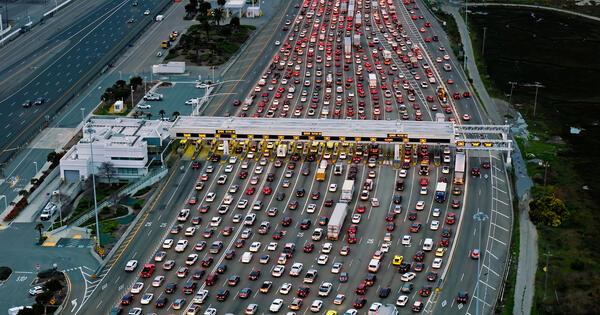
What problem does GridMatrix solve?
Cities, municipalities, and transit hubs like ports and airports have invested over the years in hardware like cameras and sensors. But they struggle to synthesize the information gathered by those sensors into useful insights. GridMatrix provides software that integrates with existing sensors of all types, deployed across pieces of critical physical infrastructure, and turns those sensors’ unstructured output into structured data.
The software ingests everything the sensors collect, combines that with other third-party data sources when available, and provides users over 40 key performance indicators (KPIs) on the performance of their infrastructure. City managers and officials can then analyze this data to derive important insights in multiple formats, including a real-time web dashboard, natural-language queries, or custom reports.
Your venture operates at the intersection of technology and transportation and logistics. Did you love toy cars and planes as a kid?
I’m a New York City kid. There’s probably a part of me that’s allergic to traffic, so I felt driven to create a data-driven product to fix it. Back in high school in the early 2000s, I had some early exposure to internet technologies we take for granted now. My friends and I would make our own web pages on the web-hosting service Angelfire and code the HTML and CSS ourselves. But I was also a humanities kid, and a philosophy major in college. My first job was in finance at McKinsey, in a group that manages the firm’s retirement assets. That was the first time I was exposed to anything resembling applied statistics and big data. My work involved analyzing public equity markets, which generate oceans of data. When I got to Yale SOM, I was interested in staying in finance and was planning to stay in New York.
What changed?
Tech recruiting was just getting started on campus, and I landed a summer internship at Google between my first and second years. My project there was projecting the sales of Google’s first smartphone, the Pixel. I was using a lot of data to make these forecasts, just like in my consulting work, but this was the first time I was exposed to the tech industry. It completely changed what I was interested in doing post-MBA. I loved that connection to the real world that comes with creating new products and features.
After graduating from SOM, I thought, “The smartphone thing is interesting, but I know a company that does it way better”—Apple. They originally turned me down, so I took a job in Amazon’s post-MBA rotational program. Six months into my time there, Apple called me and said, “Actually, we changed our minds. Move to Cupertino.”
What did you do at Apple, and how did that inform your next step?
I initially managed supply chains for the machines that they use to manufacture their products. Then I was promoted to be the global supply manager for radio frequency and wireless technology. That was a big year—we shipped the first 5G-enabled iPhone. The move to a new cellular standard only happens perhaps once a decade.
At that point, we were approaching the 2020 election. Biden was running on a platform of top-down infrastructure spending. My Apple colleagues shared my frustration with waiting for red lights with no one else approaching the intersection and thinking, “Well, this is dumb…and we have the technology to make it better.” We were talking about launching a hardware product for cities, and it was a good time to do so—especially once Biden got into office and passed the Infrastructure Investment and Jobs Act and the Inflation Reduction Act, which allocated hundreds of billions of dollars for infrastructure.
Given my experience sourcing sensors and radio frequency components, we thought we could make and deploy a network of cheaply integrated sensors into a bundle that would actuate traffic signal lights dynamically. And, being from Apple, we thought we could design it very sleekly relative to anything else on the market.
AI is vastly reducing the price of data-informed decision-making. Instead of cities or ports having a camera that just counts cars, our software uses that camera’s data to figure out how fast people are driving, how many people are in the cars, what situations are unsafe.
How did you go about testing this thesis?
As we were thinking through this, I was on calls with prospective customers. It was during the pandemic, and there were no vaccines yet, so I would get people to talk to me that probably wouldn’t take my phone calls now—mayors, city managers. Everyone was just sitting at home bored, and couldn’t wait to get a phone call or an email.
My co-founders and I understood these technologies, but we didn’t have a great sense of the potential applications. As we pitched the original hardware idea, the feedback we got from prospective users was that they had already deployed plenty of cameras and sensors. Cities weren’t lacking hardware or data; rather, that hardware was often outdated and limited. At one point, the Georgia Department of Transportation told us that they were still operating cameras that they installed for the Atlanta Olympics in 1996.
Instead of trying to sell more hardware, we decided to develop software that would make the existing hardware smarter, more connected, and more able to yield insights. Our software is hardware-agnostic; it can gather data from different kinds of sensors or inputs—for example, the video footage produced by cameras. We realized we could help our users make the most of their existing sensor networks. In this scenario, optimized dynamic traffic signal actuation would be just one use case out of many.
How did you go from identifying this need to getting your first customer?
In 2022, we were selected for a program in New York City called the Transit Tech Lab—essentially, a challenge-based procurement process. This one was about measuring emissions, and the Port Authority assigned an eight-week pilot project to see if we could gather meaningful data about emissions around the George Washington Bridge. We did that by connecting our software to existing public access cameras. At that point, our very basic product could integrate with existing cameras, process the raw feeds, and display them as information in a dashboard, all in real time. The information focused on roadways, and the KPIs we produced fell into three buckets: congestion, signal performance, and emissions.
After that pilot, the Port Authority asked us to work on the Lincoln Tunnel and Holland Tunnel, two of the most heavily trafficked throughways in the world. This time, the agency was primarily interested in safety. Working with them, we developed two major features we ultimately patented. One was the ability to detect near-miss traffic events, which are far more frequent than collisions themselves, and as a result are more helpful in quickly diagnosing problematic areas.
The second feature was the ability to integrate with pan-tilt-zoom (PTZ) cameras, which can be manipulated by control center personnel to monitor an incident—for example, a vehicle collision—that is not typically in a given camera’s field of view. This initially presented a huge challenge: for software to continuously produce a time series of accurate data from a camera’s raw feed, the camera generally has to view the same location over time. We solved this problem with proprietary and now-patented machine vision algorithms. They can automatically pause and resume data collection based on the position of a camera relative to its primary field of view, to ensure the data we provide is accurate and comparable over time—and, therefore, that the patterns it shows are meaningful.
What does artificial intelligence bring to this process?
From our first day, we used AI. Computer vision, for example, is a type of artificial intelligence that allows machines to process and analyze visual information. Tracking a car over time involves a statistically derived type of inference that operates according to algorithms—also a form of AI. More recently, the advent of LLMs has enabled us to move from a dashboard model to having a natural-language interface—basically a chatbot—to which you can say, “Hey, can you tell me where vehicle speeds were the highest during rush hour in the month of June?” Then our software will pull the data for you and present it to you in a way that’s easy to digest and share.
What we’re doing with AI is vastly reducing the price of data-informed decision-making. Instead of cities or ports buying single-use hardware—a camera that just counts cars—our software uses that camera’s data to figure out how fast people are driving, how many people are in the cars, what situations are unsafe. And you can do all that with the hardware you already have. People used to gather this information by hiring a consulting firm. We’re showing them that they can do it with their existing hardware.
We always come in with an attitude of humility, because we know we’re going to be lifelong students of our customers.
What kinds of results does this yield?
I think of running a complex physical facility like a port or roadway network as a three-layer pyramid. Data collection is at the base, and we make that faster and more economical. The next step is data interpretation at the narrower middle, which is where GridMatrix excels. Those two components enable a municipality or agency to reach the peak: taking action or making changes based on the team’s interpretation of the data.
For example, every city wants to reduce traffic incidents. Until now, most of them did so by looking for places where crashes have happened in the past. We worked with MetroPlan Orlando to measure not just collisions but near-misses. The patented technology I mentioned measures the amount of time that separates two moving objects from actually colliding, then calculates the frequency and severity of those events, and then makes it comparable across locations.
Through our analysis, MetroPlan Orlando found they had to change signal light timing to transform permissive left turns, which allow left turns while there is oncoming traffic, into protected left turns, which give drivers in the left lane their own light. Using data generated from our software and their cameras, they implemented those signal timing changes at specific intersections, and then observed an average 45% drop in near misses—up to a 70% drop in some locations.
Similarly, the Miami-Dade Innovation Authority gave us a $100,000 grant to deploy our software on the Port of Miami’s cameras to enhance cargo visibility. Between 2025 and 2026, we scaled from 8 cameras to 26, and our scope expanded to all-around facility operations monitoring. Working with eight different PortMiami teams, we found about 40 use cases, nearly double what we’d initially been brought on to analyze. In terms of specific findings, the teams used GridMatrix’s insights to identify which boats caused major cruise terminal congestion relative to their size, which allowed ground personnel to update their traffic direction and calming procedures. The software’s live alerting function also reduced response times to operationally significant events.
What’s next for GridMatrix—and for you?
The product is always evolving. Today, it’s also a tool for asset health monitoring, delivering information about which sensors are online, which are offline, and how much of the time they are in either condition. I always think in terms of problems that we’d like to solve. As we operate more and more in ports and airports, and those facilities expand, we’re seeing increasing use cases around curbside management.
At the same time, this is still new technology, and state and local government officials are just starting to think about how to operate and integrate it. Compared to other technology adopters, these clients are not in the business of taking risks. But they are the experts on their own facilities. A lot of them have spent their entire professional lives dealing with them, and all of them are going to want to see data combined and recombined in different ways that suit their use cases.
That’s spurred us to make the software as flexible and accessible as possible from a design perspective, so that every user can take all the ingredients off the shelf and bake the cake that they want. We always come in with an attitude of humility, because we know we’re going to be lifelong students of our customers.
Earlier this year, GridMatrix was acquired by new partners with extensive government experience, who are taking the company into its next phase. I’ve stepped out of the CEO role and continue to support the team as an advisor. For my part, I’m exploring what’s next in physical AI—the technology behind new robots, autonomous systems, and infrastructure. It’s the same connection to the real world that drew me to tech in the first place.
“The Yale School of Management is the graduate business school of Yale University, a private research university in New Haven, Connecticut.”
Please visit the firm link to site