


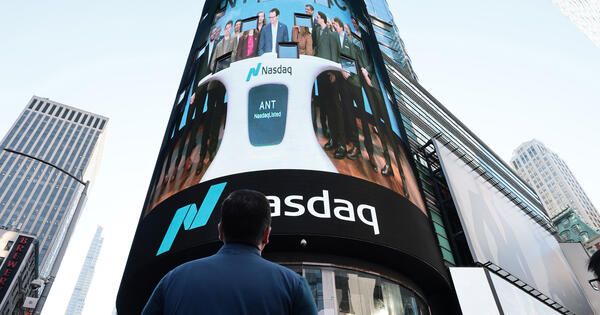
What did you learn from the market’s reaction to the IPO?
The market’s response was less enthusiastic than I expected. I assumed Anthropic had seen deep investor demand based on the confidence with which they moved forward in the face of headwinds that deterred others. After its initial peak early on Thursday, the share price declined a fair bit during and after trading hours and has stayed below $90 on Friday and the weekend.
Does the IPO say anything about the appetite for investment in AI?
Most tech stocks did poorly on Friday (the day after the IPO), and Anthropic did worse than average. I am speculating here, but it’s possible that the sector-wide declines would not have been as steep if Anthropic’s share price had remained high. The lack of investor confidence in Anthropic, signaled by its relatively steeper 9% stock price decline relative to the tech sector, may have spilled over to the tech sector.
What would have to go right for Anthropic to be worth $1.25 trillion?
Many things would have to go right, for many years into the future, for Anthropic to be worth about $95 per share—that is, $1.25 trillion divided by 13.2 billion shares outstanding. That valuation assumes very high profitability based on premium pricing and rapid growth. Let’s focus on profitability, because it’s a bigger concern. A simple competitive analysis suggests at least three threats to sustained high profitability.
First, there are a multitude of competitors, both extant and future entrants. While not all of them compete at the frontier that Anthropic operates at, their AI models might be sufficient for most tasks. The lower prices charged for open source/weight models and lower-quality models from smaller firms will likely exert downward price pressure. And the perceived need for overseas markets to develop their own AI models, for a host of reasons, restricts further the customer base for premium pricing.
If investors did their math correctly, a $95 share price implies that they valued Anthropic not at $1.25 trillion but at $1.7 trillion.
Second, powerful suppliers might extract some of the profits earned by Anthropic. Think of the high margins earned by Nvidia, which supplies chip design, and the handful of firms that supply chips and memory, including TSMC and Hynix. There is the potential that entry into these sectors might reduce supplier bargaining power. But that will likely take a few years, given their leads in expertise and functionality, the costs of switching, and the long periods required to build capacity.
Third, ordinary outside shareholders should not expect value maximization. Anthropic is a Public Benefit Corporation, and voting power is concentrated in share classes held by the founders and a trust, so Class A shareholders will have little control. Relatedly, 5% of fully diluted shares were handed to a Public Benefit Fund at the IPO and an additional 2% may be donated to the fund every time the share price increases by 50%. In essence, share prices should reflect a substantial discount to Anthropic’s “standard” valuation, which is based on traditional C corporations with few governance concerns.
Finally, investors should adjust the value created by operations (which investors derive from a valuation) because it is shared among various parties, beyond the 13.2 billion shares outstanding with economic rights. As noted by Anthropic in its IPO filing with the SEC, the value created by operations should be shared with an additional 5 billion equivalent shares, because of obligations to parties such as the employees holding restricted stock and options. If investors did their math correctly, a $95 share price implies that they valued Anthropic not at $1.25 trillion but at $1.7 trillion: $95 times 18.2 billion shares. More perceptive analyses (see Professor Shiva Rajgopal’s Substack) suggest that Anthropic’s calculations understate equivalent shares with claims on Anthropic’s operations by about an additional 3.2 billion shares. If so, a $95 share price implies that Anthropic’s operations are worth over $2 trillion: $95 times 21.4 billion shares.
In sum, a $2 trillion valuation is hard to justify because it’s hard to build a “moat,” given factors such as competitive pressure and supplier bargaining power. It is harder still to justify the additional valuation above $2 trillion required to cover the discount assessed because Anthropic is a Public Benefit Corporation with governance issues.
“The Yale School of Management is the graduate business school of Yale University, a private research university in New Haven, Connecticut.”
Please visit the firm link to site