


4 March 2026
Artificial intelligence is everywhere, and the workplace is no exception. But will it empower workers, or is it set to replace them? This blog post looks at the impact of AI use and investment on firms’ current and future hiring and firing decisions.
Artificial intelligence (AI) has the potential to significantly influence firms’ production processes. It could also profoundly reshape employment and the labour market. But how exactly? On the one hand, AI could replace workers, leading to a decline in employment. On the other hand, it could boost corporate profits and create entirely new types of jobs, complementing the new technology. Meanwhile, reports from the other side of the Atlantic point to thousands of job cuts at companies like Amazon and Target, citing AI as a contributing factor. Have firms already started to replace humans with AI? This blog post examines hiring patterns at European firms, comparing companies that use and invest in AI with companies that don’t. To do so, we draw on the results of the ECB’s survey on the access to finance of enterprises (SAFE) for the second and fourth quarters of 2025.
Widespread use, limited investment
While most firms use AI, few actually invest in it. Two-thirds of the 3,500 firms that took part in the survey reported that their employees use AI, with significant disparities across firm size (Chart 1). Almost 90% of businesses with 250 or more employees use AI, compared with 60% of those with fewer than ten employees. By contrast, a mere quarter of Europe’s companies invest in AI technology. This points to a crucial insight: firms do not necessarily need to invest in AI in order to use AI technology. Thanks to accessible online tools, the entry barrier for using AI is low, enabling broad adoption even among smaller firms.
Chart 1
AI use and investment by firm size
(percentage of firms; by firm size (number of employees))
Source: SAFE. Notes: Firms that did not respond were excluded. Observations for AI investment: second quarter of 2025. Observations for AI use: fourth quarter of 2025.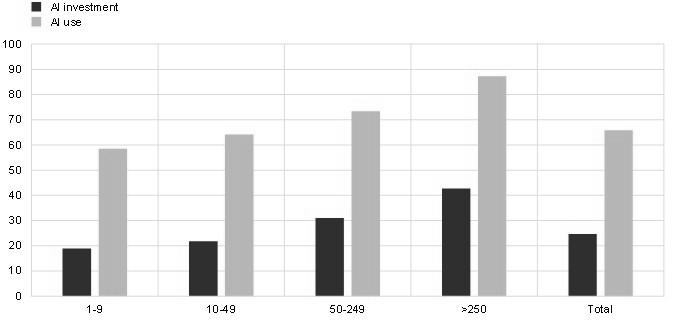
Are firms already replacing their workers?
We compare firms that use AI with those that don’t. We factor in a range of variables generally understood to drive employment growth. These include: firm size and age, current change in investment, turnover, profitability, the economic outlook of the firm, expected change in investment, sector and country.[1] Overall, in terms of job creation and destruction, we find no significant difference between businesses that report using AI and those that don’t (Chart 2). However, the picture changes when we separate firms that frequently use AI from those that rarely use it. Companies that make significant use of AI are about 4% more likely to take on additional staff. In other words, AI-intensive firms tend, on average, to hire rather than fire. Much the same can be said of investment in AI: firms that invest in AI are nearly 2% more likely to hire additional staff than those that don’t.
This suggests that investment in AI often entails a higher level of AI use, as well as a need to take on new workers to operationalise and support the technology. The effect is driven by small firms, while AI is neutral for large firms’ employment.[2] Some firms may see investment as a way of scaling up their output. This hypothesis would appear to be borne out when we look at why firms use AI. The overall growth in employment is driven by firms that use AI to promote research and development (R&D) and innovation – key determinants of business growth. Although it is not possible to ascertain the type of workers hired from the survey alone, many are likely to be highly skilled employees able to use and develop AI technology, since firms are looking to use AI for R&D. Conversely, firms using AI to cut their labour costs experience negative effects on hiring and positive effects on layoffs. However, only 15% of firms that use AI cite reducing labour costs as a factor, and this is insufficient to offset the overall positive effects observed to date.
Chart 2
Impact of AI use and investment on current hiring and firing
(percentage marginal probability of an increase in the workforce)
Source: SAFE. Notes: Chart 2 shows the marginal effect of the b coefficient from an ordered probit of the outcome “increase” in employment (see footnote 1 for more details on the regression). Columns 4 and 5 are the coefficients of dummies taking the value 1 if the firm declared the reason for using AI. Cross-sectional dataset of around 5,300 euro area firms. Observations for current AI investment: second quarter of 2025. Observations for current AI use: fourth quarter of 2025. 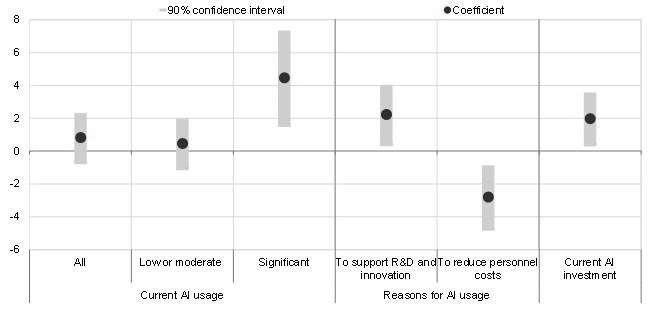
Hiring expectations: does AI matter?
So far, we have looked at firms’ current hiring and firing decisions. But what if we ask firms that are currently using or investing in AI about their plans one year from now? In short, we see no marked difference in overall hiring intentions (Chart 3). But when we look specifically at future AI investment, it’s a different story. Firms planning to invest in AI are more likely to have positive expectations for future employment growth, even when their overall investment expectations (in addition to investment in AI) are accounted for. This is true regardless of the level of planned AI investment and suggests that a pause in hiring due to investment in AI technology is also unlikely over the next year. However, these findings could change over a different time horizon. Indeed, a survey from the ifo Institute finds that many German companies expect AI to lead to some job cuts, albeit over a longer horizon of five years.
Chart 3
Impact of AI use and investment on hiring and firing expectations
(percentage marginal probability of an increase in the workforce one year ahead)
Source: SAFE. Notes: Chart 3 shows the marginal effect of the b coefficient from an ordered probit of the outcome “increase” in employment expectations. The control variables are the same as in Chart 2, with planned AI investment included in addition to AI usage. Expectations refer to the next year. Cross-sectional dataset of around 5,300 euro area firms. Observations for current AI investment: second quarter of 2025. Observations for AI use and future AI investment: fourth quarter of 2025. 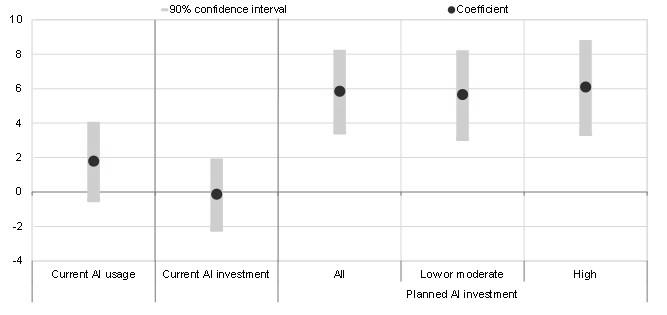
Conclusions
As things stand, based on firms’ overall hiring plans, investment in and the intensive use of AI are not yet replacing jobs. In fact, some firms are hiring additional employees – perhaps because they are looking to develop and implement AI technologies while maintaining their existing production processes, or because AI is a way to help them scale up more quickly. Looking one year ahead, the firms that plan to invest in AI are still planning to take on more people than firms that have no such plans. On balance, these findings hold. While some firms may use AI to replace workers, the average firm is more likely to take on additional staff to enable it to use and invest in AI.
So how can we square our findings with some of the gloomier studies? The literature on AI and employment yields mixed results, owing to variations in the time horizons over which the effects are likely to be felt, the geographical areas covered and the research topics explored. Notably, it is difficult to compare studies on Europe (the focus of this blog post) with those on the United States, since the scale of investment in AI, the extent and timing of AI adoption all differ significantly. Our results are in line with the findings of most of the existing studies in the small body of European research focusing on the current and near-term effects.[3]
Overall, the survey data explored in this blog post suggest that the effects of AI on employment are currently still positive. This is certainly the case as AI has not yet significantly transformed production processes. Given that this is set to change, the longer-term impact of AI on employment remains less clear.
The views expressed in each blog entry are those of the author(s) and do not necessarily represent the views of the European Central Bank and the Eurosystem.
Check out The ECB Blog and subscribe for future posts.
For topics relating to banking supervision, why not have a look at The Supervision Blog?
“The European Central Bank is the prime component of the Eurosystem and the European System of Central Banks as well as one of seven institutions of the European Union. It is one of the world’s most important central banks.”
Please visit the firm link to site