

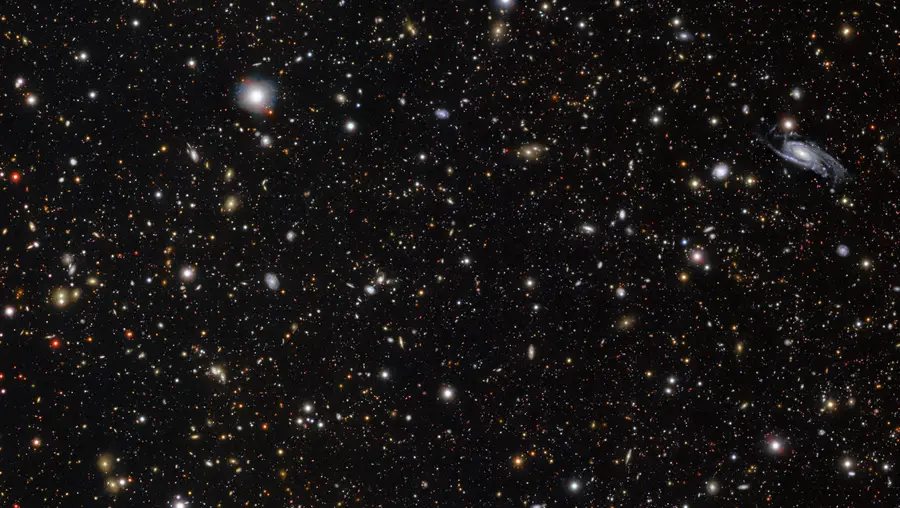
A Carnegie Mellon University-led team coordinated a global observing campaign that began within hours of the explosion and continued for months, using space- and ground-based telescopes to reconstruct the event in unprecedented detail. Their observations revealed that the supernova, designated SN 2026gzf, shares many characteristics with the powerful stellar explosions typically associated with gamma-ray bursts, yet showed no evidence of producing one. The findings, published in a new paper(opens in new window) in The Astrophysical Journal Letters, suggest that massive stars can die through a wider range of pathways than previously recognized.
The discovery began in March 2026, when China’s Einstein Probe space telescope detected a brief flash of X-rays from a galaxy 500 million light-years away. The Carnegie Mellon team and a team from the University of Maryland, College Park, identified the signal, named EP260321a, as a “shock breakout” — the first light released when a powerful shock wave, similar to a supersonic plane’s sonic boom, blasts through a star’s surface.
Shock breakouts are expected to occur in every supernova, but they are notoriously difficult to catch because they last only seconds to hours. Astronomers have confidently observed only one other clear X-ray shock breakout in the past two decades.
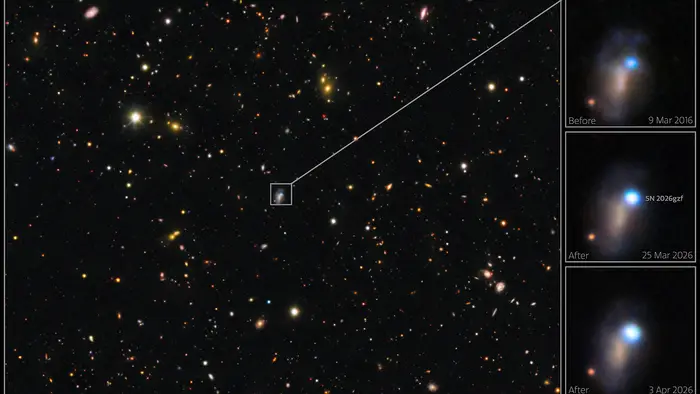
Within an hour of the detection, telescopes around the world began monitoring the source. Observations revealed a rapidly brightening supernova that belonged to a rare class known as a broad-lined Type Ic supernova. These energetic explosions are often associated with gamma-ray bursts, the most powerful explosions in the universe.
SN 2026gzf turned out to be different.
“SN 2026gzf looks remarkably similar to other energetic supernovae that have been previously linked to gamma-ray bursts,” said Brendan O’Connor, a McWilliams Postdoctoral Fellow at Carnegie Mellon’s McWilliams Center for Cosmology and Astrophysics(opens in new window), and first author of the new paper describing the results. “Yet follow-up observations found no evidence for a relativistic jet or the afterglow that is typically seen in those events.”
One of O’Connor’s biggest questions was whether the explosion had launched a jet that somehow escaped detection. To find out, he initiated observations with NASA’s Chandra X-ray Observatory(opens in new window), which searched for the fading X-ray afterglow expected if a powerful jet had successfully emerged from the star. This afterglow is produced as the jet collides with particles surrounding the star, generating radiation that can remain visible in X-rays for days, weeks or even months depending on the density of the environment and the total energy of the jet.
Chandra’s exceptional sensitivity and sharp imaging allowed the team to search for very faint X-ray emission precisely at the location of the supernova. No X-ray source was detected.
The observations were sensitive enough, however, due to the explosion’s relatively close proximity to Earth, that they would have detected nearly every known gamma-ray-burst X-ray afterglow. Combined with radio observations from the Karl G. Jansky Very Large Array, the Chandra data ruled out the powerful relativistic jets normally associated with gamma-ray bursts.
“The Chandra data show that SN 2026gzf did not produce a normal, powerful relativistic jet,” O’Connor said. “Instead, one possibility is that the jet was ‘choked,’ either by the surface of the star or by circumstellar material surrounding the star.”
The result makes EP260321a/SN 2026gzf the first high-energy breakout flash linked to a broad-lined Type Ic supernova that shows no evidence of a relativistic outflow. The finding suggests that stripped massive stars can die in more ways than astronomers previously thought.
“One of the central unanswered questions in the field is why some collapsing massive stars launch jets near the speed of light that escape the star and produce gamma-ray bursts, while apparently similar stars do not,” O’Connor said. “As we keep finding these things and building out the distribution of their properties, we are improving our understanding of how stars look at the end of their lives, which tells us about how they lived their lives.”
Carnegie Mellon researchers assembled a detailed picture of the explosion using a wide range of facilities. They acquired deep imaging of the supernova as it brightened and reached peak brightness using the Dark Energy Camera (DECam(opens in new window)) in Chile, an NSF NOIRLab(opens in new window) program.
Data from the Vera C. Rubin Observatory(opens in new window)’s Legacy Survey of Space and Time (LSST) helped track the supernova’s evolution and hinted at activity in the stellar system shortly before the star exploded. Continued observations by Rubin are expected to provide detailed, long-term records of the supernova as it evolves for years to come.
“With the start of the Rubin LSST, smaller wide-field imagers on smaller aperture telescopes may seem obsolete. Yet, these observations demonstrate, possibly for the first time, how powerful the synergies between DECam and Rubin can be,” said Antonella Palmese(opens in new window), an assistant professor of physics(opens in new window) at Carnegie Mellon and a co-author of the new paper. “The wealth of archival data and flexible follow up schedule by DECam enabled studies of the possible progenitor and a more continuous mapping of the supernova’s evolution.”
The Carnegie Mellon team also relied on the Dark Energy Spectroscopic Instrument (DESI(opens in new window)), mounted on the NSF Nicholas U. Mayall 4-meter Telescope at Kitt Peak National Observatory, to repeatedly observe the supernova as it evolved. Through DESI’s spare-fiber transient program, led by Carnegie Mellon physics graduate student Xander Hall, a co-author of the new paper, and Palmese, researchers collected a sequence of spectra that revealed how the explosion changed over time and helped confirm its classification as a broad-lined Type Ic supernova.
“DESI’s spare-fiber program gave us the opportunity to return to SN 2026gzf repeatedly and follow how its spectrum changed as the explosion evolved,” Hall said. “This sequence of observations demonstrates the power of using DESI’s spare fibers for rapid transient follow-up and classification as Rubin continues to ramp up its transient alert stream over the next decade.
The Carnegie Mellon team obtained additional observations from the Hobby-Eberly Telescope (HET(opens in new window)) and the Southern African Large Telescope (SALT(opens in new window)). Their first observation with both of these telescopes was only three days after the X-ray detection, providing one of the earliest views of the emerging explosion. Hall initially secured SALT observations through Carnegie Mellon’s partnership time funded by a 2023 McWilliams Center seed grant. To extend the campaign, Hall and O’Connor obtained Director’s Discretionary Time for continued observations. Together with DESI and HET data, the SALT spectra formed the backbone of the analysis, providing a detailed record of the supernova’s evolution and environment.
Beyond revealing a new way for massive stars to die, the discovery highlights the growing power of time-domain astronomy, in which many observatories across the globe work together to capture fleeting cosmic events in real time, before they disappear forever.
In addition to the Carnegie Mellon University scientists (Brendan O’Connor, Xander J. Hall, Tomás Cabrera, Antonella Palmese, Ariel J. Amsellem, Keerthi Kunnumkai and Konstantin Malanchev), an international team of astronomers contributed to the work, including Malte Busmann, Daniel Gruen, Julius Gassert, Ziyuan Zhu, Surya Shivaprasad, Mitra Maleki, Christoph Ries, Michael Schmidt and Silona Wilke, Ludwig-Maximilians-Universität München; Alberto Floris, University of Crete; Dylan Green, John Banovetz, Stephen Bailey and David Schlegel, Lawrence Berkeley National Laboratory; Christopher L. Fryer, Los Alamos National Laboratory; Roberto Ricci, Eleonora Troja and Yu-Han Yang, University of Rome Tor Vergata; Gregory R. Zeimann, University of Texas McDonald Observatory; Segev BenZvi, University of Rochester; Lei Hu, University of Pennsylvania; Simone Dichiara, The Pennsylvania State University; Hendrik van Eerten, University of Bath; Jeremy Hare and Michael J. Moss, NASA Goddard Space Flight Center; Christopher M. Irwin, Tohoku University; Adam D. Myers, University of Wyoming; Dheeraj Pasham, Eureka Scientific; and Geoffrey Ryan, Perimeter Institute for Theoretical Physics.
O’Connor’s study uses data obtained from several sources, including China’s Einstein Probe mission; the 2.1-meter Fraunhofer Telescope at Wendelstein Observatory; the Dark Energy Camera on the NSF Víctor M. Blanco 4-meter Telescope at Cerro Tololo Inter-American Observatory; the Dark Energy Spectroscopic Instrument on the NSF Nicholas U. Mayall 4-meter Telescope at Kitt Peak National Observatory; the Robert Stobie Spectrograph on the Southern African Large Telescope; the Low Resolution Spectrograph on the Hobby–Eberly Telescope at McDonald Observatory; the Zwicky Transient Facility at Palomar Observatory; the NSF–DOE Vera C. Rubin Observatory; NASA’s Chandra X-ray Observatory; and the NSF’s Karl G. Jansky Very Large Array, operated by the National Radio Astronomy Observatory.
“Carnegie Mellon University is a private research university in Pittsburgh, Pennsylvania. The institution was originally established in 1900 by Andrew Carnegie as the Carnegie Technical School. In 1912, it became the Carnegie Institute of Technology and began granting four-year degrees.”
Please visit the firm link to site