

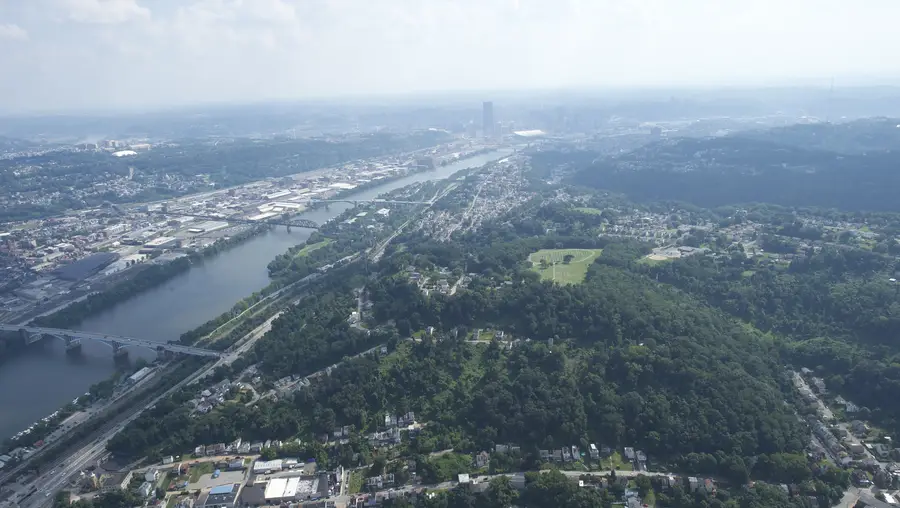
As Pittsburgh faces hotter summers and persistent air quality problems, Carnegie Mellon University researchers are turning environmental data into tools that residents, advocates and policymakers can use to identify risks, make smarter planning decisions, and improve the health of the city and its residents.
New environmental research from CMU offers new insights into which areas of Pittsburgh are the warmest and how different kinds of buildings and road surfaces can affect how a neighborhood weathers the summer heat. The research is the latest addition to CMU’s growing library of publicly available environmental data.

In a study of the city’s “heat islands” — geographic pockets where temperatures are notably higher than surrounding areas — CMU researchers found that poorer, historically segregated neighborhoods were nearly six degrees warmer on average than more affluent areas. That increase in temperature has negative impacts on at-risk populations(opens in new window), like children, the elderly and people with pre-existing conditions that make them more vulnerable to heat-related health issues.
“We know there are negative climate impacts when we remove natural soil and cut down trees to build things,” said Suzy Li(opens in new window), a recent graduate of the Ph.D program in the School of Architecture(opens in new window) and lead researcher on the project(opens in new window). “However, what people don’t usually think about is how the design and building materials can impact the temperature.”
More trees plus lighter streets equals cooler neighborhoods
By analyzing high-resolution satellite images and city data, Li found that a lack of trees and a higher proportion of dark, impervious surfaces like parking lots led to significantly warmer temperatures because they absorb more sunlight and emit more heat than light-colored infrastructure. In contrast, porous surfaces, like parks, green roofs and tree canopy lower the temperature of a neighborhood. Specifically, Li found that adding just 10% more tree coverage to a neighborhood can reduce temperatures by 3.4 degrees.
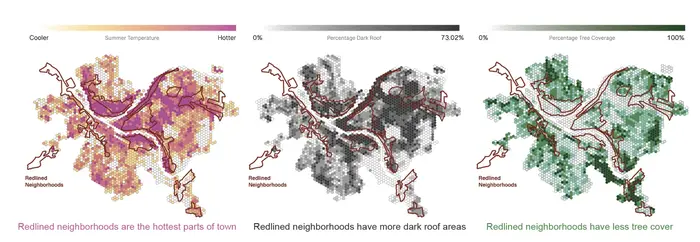
“My research offers a detailed analysis of the city’s surface materials by color and how they contribute to the surface temperature differently,” Li said. “The goal is not to avoid development at all, but to show how we can make smarter decisions and minimize our impact or integrate more green surface to shift it to a positive impact during our design.”
In her study of Pittsburgh, Li found that impervious surfaces including roads, roofs and parking lots cover 55% of the city. Just over half of the roads in the city are dark colors, a finding that seemed surprisingly low to Li, given that so many roads are typically dark in color. For comparison, Li is doing a similar study of the city of Los Angeles, where she found that 70% of streets are black.
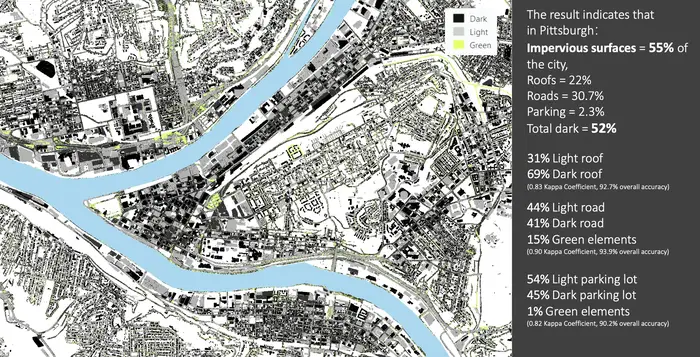
“My hypothesis is that asphalt tends to get lighter when it ages, and because Pittsburgh roads are not very frequently resurfaced, that might explain the higher percentage of light roads here,” she said.
The impact of leafy, light surfaces on a neighborhood can also have a big impact on temperature, Li found. On a hot day, a conventional, dark roof can be as hot as 165 degrees Fahrenheit, while a building with a living green roof can be 85 degrees.
Li hopes policymakers take these different options into account when building and planning for future Pittsburghers. To that end, she developed a Smart Surfaces Guide(opens in new window) about how to design and build homes and neighborhoods for a warming climate.
The guide shows how different choices — from planting trees, to using solar panels as shade sources in parking lots, to adding rain gardens that absorb water from storm runoff — can significantly reduce temperatures and improve a city’s infrastructure.
Data built by Pittsburgh, for Pittsburgh
Many of the same populations that are more negatively impacted by higher temperatures are also(opens in new window) vulnerable to the persistent air pollution problems Pittsburgh faces. Like heat, air pollution trends can be difficult for affected residents to quantify and turn into measurable data. But CMU researchers have created tools to tackle this challenge, too.
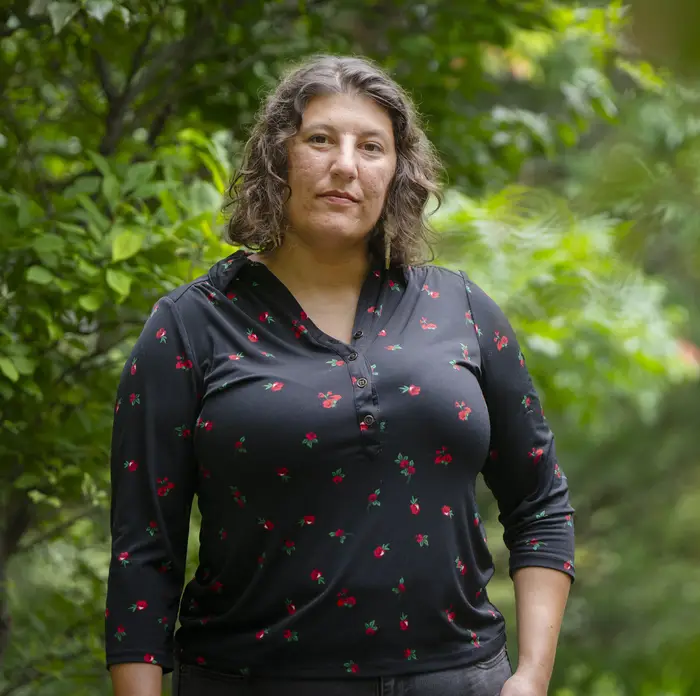
Just ask Ana Hoffman(opens in new window), air quality program director at CMU’s CREATE Lab(opens in new window).
“We take public datasets and turn them into something that can be used to inform policy and help decision makers make air quality better in Pittsburgh,” Hoffman said.
Hoffman oversees CMU-developed apps including PlumePGH(opens in new window) and SmellPGH(opens in new window), which aggregate residents’ reports of air pollution in the region. Her team overlays community-powered data with the most up-to-date government air dispersion models to understand how pollution plumes match up with known pollution sources.
[embedded content]
“We’ve seen a lot change locally,” Hoffman said. “Air quality has improved over the last 10 years, thanks to the work of the Breathe Collaborative, which we’re a part of, that brings together local advocacy organizations like the Group Against Smog and Pollution (GASP) and others. There have been measurable improvements that are visible in the data, but it’s definitely not all the way there.”
Hoffman pointed to high cancer and asthma rates(opens in new window) in Allegheny County as reasons for continued improvement. Still, she’s encouraged that the lab’s technology is spreading far beyond Pennsylvania.
The lab developed an extension of SmellPGH called Smell MyCity(opens in new window), which can be used in any city or state to track pollution odor. Hoffman said Louisville, Kentucky, Portland, Oregon and the state of Maryland have all started using the app as their official air quality odor reporting system.
“It’s incredible. We’re seeing people advocating for their government agency to incorporate the reporting data into enforcement policies,” Hoffman said. “To make change happen, it’s really important to collect this data, make sure it’s in the hands of the right people, and that it’s understandable.”
“Carnegie Mellon University is a private research university in Pittsburgh, Pennsylvania. The institution was originally established in 1900 by Andrew Carnegie as the Carnegie Technical School. In 1912, it became the Carnegie Institute of Technology and began granting four-year degrees.”
Please visit the firm link to site