

26 August 2026
Use of artificial intelligence at work has doubled over the last two years and people report significant time-savings. But an ECB survey shows that perceived productivity gains vary widely and there are still barriers preventing many from adopting this new technology.
How will AI affect employment and productivity?
That is one of the most pressing questions given AI’s potential to profoundly alter the way we work, and therefore to fundamentally reshape economies and societies. In this post we take stock of how workers use this new technology and how swiftly it is spreading in workplaces. We also examine the time people save using AI and consider the obstacles to further uptake. Our work draws on the ECB’s Consumer Expectations Survey, which every month captures the views of roughly 20,000 people across 11 euro area countries.
AI adoption continues to increase in the workplace
First, let’s look at AI’s footprint in Europe’s workplaces. There is an unmistakable trend. In just two years, the share of workers using AI on the job has doubled from 26% of survey respondents in 2024 to 41% in 2025, reaching 52% in 2026. A majority of workers now report using AI for work and, on average, they use it around three days per week.
Unsurprisingly, AI adoption varies across demographic groups (Chart 1). Younger workers and those with a university degree remain the most likely to use AI. For the education levels, we see a sizeable gap: adoption among highly educated people reached 61%, compared with 37% among those with lower levels of education. Similarly, younger workers are around 20 percentage points more likely to use AI than their older colleagues. Men also report slightly higher usage than women, though age and education remain the primary drivers of adoption. This pattern has remained consistent over the last three years. Interestingly, once workers open the door to AI, they integrate it into their routines at very similar rates. Average weekly use is slightly higher for younger and more highly educated groups, but differences are not large (with group averages between 2.5 and 2.9 days).
Chart 1
AI use by demographic group
(percentage of workers)
Sources: ECB Consumer Expectations Survey. Notes: This chart shows the share of employed workers reporting the use of AI in their work. The survey question was “Do you personally use artificial intelligence (AI) in your work (including tools such as ChatGPT, Claude, Gemini, etc.)?” 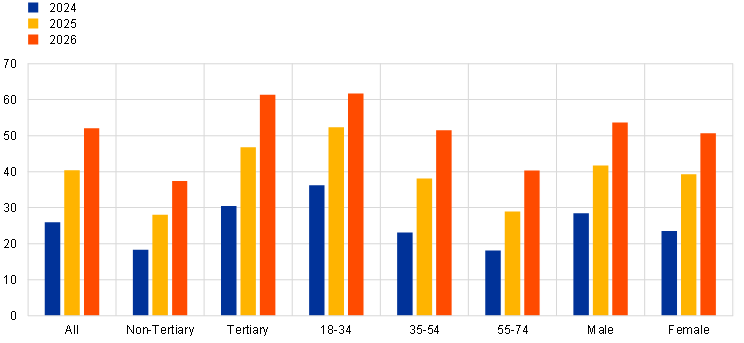
AI boosts productivity at work – with some caveats
So, does using AI at work actually save you time?
Yes – the median user reports saving three hours per week, or about 7.7% of median working time, although this overall figure contains a highly skewed distribution. Most users enjoy moderate time-savings, while a small number report very high efficiency gains.
Our findings align with those of a recent London School of Economics study by Daniel Jones and Grace Lordan. However, reported time-savings in our data are higher than those in a study by Alexander Bick, Adam Blandin and David J. Deming for the Federal Reserve Bank of St. Louis, which may partly reflect differences in question design and geographical coverage.[1]
The time saved already suggests that AI makes workers more productive. But for the three hours saved – or 7.7% saved working time – context matters, if we are to accurately assess the implications for the total economy productivity growth.
First, only half of workers reported using and saving time thanks to AI (48.8%). Thus, for the whole economy, the overall efficiency gain (in other words, the share of savings in working hours attributed to the use of AI) is closer to 3.8%.
Second, it’s worth noting that these time-savings only translate into higher productivity if workers turn the freed hours into extra output, rather than using them for less directly productive activities. Crucially, the productivity boost also depends on whether the employer is in a position to put that extra capacity to use.
In comparison, current estimates for additional annual productivity growth from AI over a ten-year period range between 0.1% and 3.4%.[2] Further ECB work on this topic estimates an AI productivity increase of around 0.35 percentage points per year on average for the euro area.
Efficiency gains delivered by AI vary considerably by task and the biggest gains do not always arise from the most common uses (Chart 2).
Generating or debugging code yields the largest gains, at nearly eight hours per week, although only around 8% of workers use AI for this purpose. A similar pattern emerges for data analysis, automation of routine tasks and creating audio or visual content.
By contrast, research, information gathering, writing and text editing are among the most frequently cited uses. Yet time-savings reported for these tasks are considerably lower than for more technical tasks like coding.
Chart 2
Tasks performed with AI and hours saved per week
(upper scale: percentage of workers using AI; lower scale: median number of hours per week)
Source: ECB Consumer Expectations Survey. Notes: The chart combines two questions: (i) “In a typical week last month, how many additional hours do you think you would have needed to complete the same amount of work without using artificial intelligence (AI)?” and (ii) “For which of the following tasks do you typically use artificial intelligence (AI) in your work?” Time saved per task represents the average total weekly hours saved by workers who reported using AI for that specific activity. Respondents can select multiple tasks, and those who reported saving significant time with AI are more likely to choose a greater number of tasks, which mechanically inflates the average hours saved.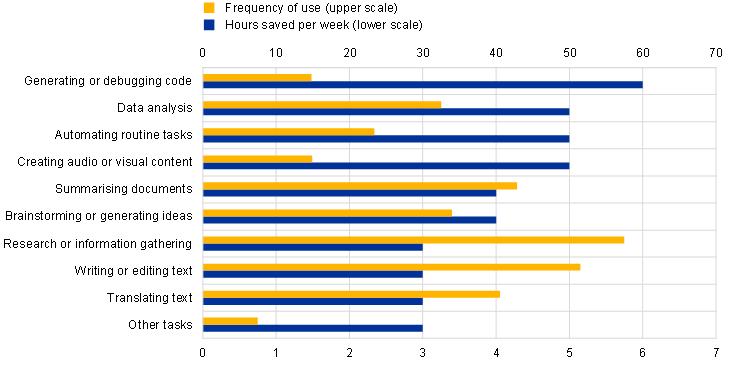
For most professions, workers do not see perceived efficiency gains as a threat to their jobs.
The occupations that have the highest adoption rates tend to save the most hours and have more positive views of AI. For example, managers use AI the most, save the most time in doing so and ultimately have the most positive perception of the technology; this places them in a good position to help steer AI adoption in the workplace (Chart 3).
Chart 3
Hours saved, adoption and sentiment about AI across occupations
(x-axis: percentage of workers; y-axis number of hours saved per week)
Source: ECB Consumer Expectations Survey. Notes: Dot colours represent net sentiment about the impact of AI on jobs, with red representing net negative sentiment and shades of blue indicating a scale of positive sentiment, with the highest net positive being dark blue. The chart contains information about three survey questions, (i) “In a typical week last month, how many additional hours do you think you would have needed to complete the same amount of work without using artificial intelligence (AI)?”, (ii) “Do you personally use artificial intelligence (AI) in your work (including tools such as ChatGPT, Claude, Gemini, etc.)?” and (iii) “Do you think that technological advancements (e.g. the increasing use of artificial intelligence, large language models, automation) will affect your current job or employment prospects in the next five years?”.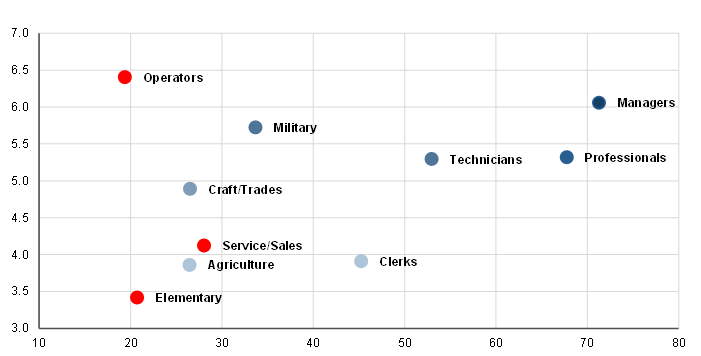
Overall, AI is perceived less favourably today than one year ago – the percentage of workers who viewed it positively dropped from 43% to 41%. This might be connected to an uncertain economic environment more broadly, as AI perceptions correlate with economic expectations.
Workers who hold negative opinions on AI are also more pessimistic about the economy, reporting higher expectations of unemployment one year ahead, greater fear of job loss and weaker expectations for income growth and spending.[3]
And the fear of being replaced by AI increases when labour market prospects are generally less favourable.
Barriers to AI adoption remain
Despite rising adoption, roughly half of workers still do not use AI. Understanding why this is the case is key to assessing the overall direction of travel when it comes to more people using AI.
With this in mind, the Consumer Expectations Survey was designed to ask workers directly about this topic.
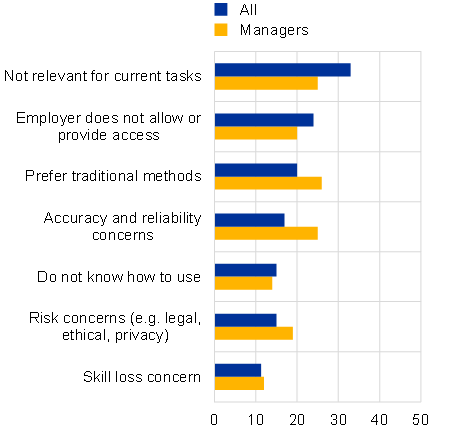
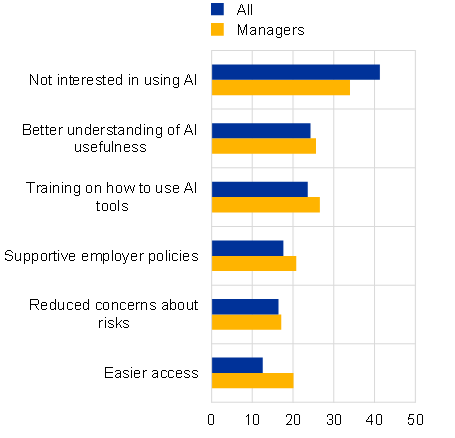
One-third of respondents do not use AI because it is irrelevant for their current tasks (Chart 4, left-hand panel). Other respondents prefer traditional methods or are discouraged by accuracy and reliability concerns or a lack of provision from their employer. More broadly, a substantial share of workers simply expresses no appetite for the technology: 41% are uninterested in using AI (34% of managers).
Chart 4
Barriers to AI use and solutions
|
Barriers to using AI |
Incentives for using AI |
|---|---|
|
(percentage of workers) |
(percentage of workers) |
 |
 |
Source: ECB Consumer Expectations Survey.
Notes: Left-hand panel: “What are the reasons why you are not using artificial intelligence (AI) in your work?” Right-hand panel: “What factors – if any – would encourage you to start using artificial intelligence (AI) tools in your work?”
When asked what would encourage them to adopt AI, around half of all workers point to better training on using AI tools and a better understanding of AI’s usefulness (Chart 4, right-hand panel).
Employers appear to be responding to some of these needs.
About half of firms plan to invest in AI training over the next 12 months (according to the latest SAFE survey wave), directly addressing the barrier most frequently cited by workers. Conversely, this means that around half of firms are not investing in training – this is possibly also affected by one-third of managers not being interested enough in AI.
Overall, there seems to be significant potential for better promotion of AI via more supportive firm-level policies.
Conclusion: boosting productivity to full potential means overcoming remaining obstacles
AI adoption in the workplace has doubled in two years and time-savings reported by users are already significant.
These savings might, even if only partially, be already partly visible in aggregate productivity growth numbers, which have been recovering in the euro area in recent quarters.
Nevertheless, these gains are far from uniform across tasks and adoption remains uneven across occupations.
Half of euro area workers already use AI. This is a significant number. Yet barriers to adoption deter the other part of the population from the use of AI.
Obstacles exist on both worker and firm sides. A large share of employees lacks interest or perceives AI negatively. And the same goes for parts of management that at times constrain the technology’s use. Moreover, while employers play a decisive role in pushing for and facilitating further adoption, many are still hesitant to invest.
To overcome these barriers, streamline integration and achieve productivity growth potential, employers – supported by national authorities – should maximise support for employees, in particular through training and easier access to AI tools.
The views expressed in each blog entry are those of the author(s) and do not necessarily represent the views of the European Central Bank and the Eurosystem.
Check out The ECB Blog and subscribe to receive future posts as soon as they are published.
Read our Supervision Blog for banking supervision topics.
“The European Central Bank is the prime component of the Eurosystem and the European System of Central Banks as well as one of seven institutions of the European Union. It is one of the world’s most important central banks.”
Please visit the firm link to site