


19 October 2026
From Keynes’s famous “digging holes” example to modern stabilisation policy, Economics has come a long way in understanding how governments can respond to crises. The 2026 Nobel Prize recognises that progress. This blog post explains the research behind it.
On 12 October this year, the Royal Swedish Academy of Sciences awarded the Sveriges Riksbank Prize in Economic Sciences in Memory of Alfred Nobel to Robert E. Hall and Michael Woodford “for microeconomic foundations of macroeconomic stabilisation”. After having honoured outstanding contributions in growth theory last year, this year’s award focuses on the second key aspect of economic policy: stabilising the economy in the short run.
From an economic policy perspective, economic theory needs to answer two fundamental questions:
First, where is the economy headed in the long run: is economic output growing, are consumers getting wealthier and able to increase their consumption over time? In other words, what are the general trends in the economy?
Second, what causes fluctuations around the trend in the short run? In other words, why can output be temporarily above or below its trend level? Economists call these situations economic booms and economic busts or recessions and refer to the short-run cycling of the economy between booms and busts as business cycles. They refer to the practice of decreasing both booms and busts to smooth out business cycle fluctuations as stabilisation policy. Monetary and fiscal policies are two leading examples of stabilisation policy.
Lessons from the Great Depression
Economists learned in the late 1920s that analysing the economy from a purely long-run perspective falls short. The long-run perspective, usually referred to as growth theory in economics, emphasises that the productive capacity of the economy is what determines economic outcomes such as output and prices. This perspective highlights the supply side since the productive capacity of the economy is ultimately determined by the production technology and the amount and quality of the factors of production (labour, machines, resources) available to producing firms. The experience of the Great Depression highlighted fundamental shortcomings of this perspective. It could not explain why economic output collapsed and unemployment surged on a scale that could not be explained by changes in the economy’s productive capacity alone.
In his seminal work, John Maynard Keynes provided an alternative theory of short-run economic fluctuations which emphasised the demand side of the economy instead.[1] A key element of the “Keynesian” theory is that no matter the productive capacity of the economy, if demand falls short of supply, output will fall below its trend level. As a result, economic policy needs to address the demand side of the economy. One way to stimulate demand, Keynes suggested, was by providing employment opportunities and hence income to consumers. The implementation of the New Deal in the United States following the theory Keynes later articulated in his book is widely regarded by economists as the first instance of stabilisation policy, and the Keynesian theory of the short run is considered the birth of business cycle theory.
A theory of consumption and a methodology for economic research
A cornerstone of the Keynesian theory is the demand for the consumption of economic goods and services. But Keynesianism lacked a theory of consumption behaviour beyond postulating general aggregate regularities, such as that aggregate consumption in the economy presumably increases when more income is available once households have paid off their running expenses. This gap in economic theory became especially clear during the oil crises of the 1970s when the economy did not behave as predicted by the postulated relationships between aggregate variables.[2] This led to the search for a theory of the economic behaviour of individuals that could be aggregated up to provide a theoretical foundation for the relationship between aggregate variables. Economists call the approach of providing a mathematical theory of individual behaviour for use in models analysing the macroeconomy the “microeconomic foundations” of macroeconomic models.
This is where Robert Hall’s groundbreaking work on the theory of individual consumption behaviour comes in. The starting point is the permanent income hypothesis, which suggests that consumers consider their expectations of their lifetime income when deciding on current consumption.[3] Common practice when empirically testing this theory was to derive a consumption function and then to estimate that using the available data. This approach led to many headaches, in particular because it required data on consumers’ expectations of their future lifetime income, something which is not observable.
Hall’s seminal contribution was to fundamentally rethink the approach of testing the theory of consumption, which not only has implications for that theory itself, but also for the way economists write down theories and go about testing them in the data.
Hall’s key idea, most prominently articulated in papers in 1978 and 1982, was to flip the approach to testing the theory of consumer optimisation. Like other economists, he started by writing down the optimisation problem of the consumer. However, instead of using the optimality condition that comes out of this mathematical exercise to derive a consumption function and then estimating that, Hall took the optimality condition itself to the data.[4]
What may appear to be a tiny step has profound implications for economic theory. On the one hand, together with the assumptions Hall postulated, the optimality condition implies that future consumption in the data should not be predictable by anything beyond current consumption (economists refer to this as the “random walk” property of consumption). This implies that testing the theory only requires data on consumption, resolving the headache surrounding unobservable variables. It also provides a sharp criterion for rejecting the theory, since the theory suggests that adding any other variables to the empirical analysis should not predict future consumption, nor add explanatory power to the empirical analysis.
On the other hand, using an optimality condition to test a theory empirically has a feature that revolutionised economic research. When estimating a mathematical equation, there is usually a gap between the theory and the data. Economists and statisticians refer to this gap as the error term. It is often considered to be a measure of what the theory does not explain and hence what economists still do not understand. Hall’s approach, instead, by suggesting that nothing should predict future consumption beyond current consumption, provides a theoretical interpretation for the error term as incoming information (“news”) that is, by definition, unpredictable. Having a theory of the error term not only helps determine what are valid tests of the theory, but it also provides clues to what elements of the theory need to be changed if the theory should be rejected by the data. This last aspect has since become the cornerstone of macroeconomic theory as it is developed and constantly examined against the data.
A unified framework for macroeconomic stabilisation policy
Economic research during the 1970s and 1980s relied heavily on both the microeconomic foundations of consumption behaviour and the research methodology proposed by Robert Hall to come up with unified frameworks that can explain business cycle fluctuations. But there was a missing piece. An important assumption of these models was that producers set product prices optimally and perfectly flexibly.
This assumption, however, had the implication that whatever disturbances happen in the economy, prices adjust immediately and perfectly, so that economic outcomes are once again fully determined by the supply-side. Thus, similarly as in economic theory prior to Keynes, these models did not feature demand-driven fluctuations. The issue with this from a stabilisation policy point of view is that supply-driven fluctuations constitute fluctuations in the trend itself, not fluctuations around the trend. In other words, this did not provide an explanation of business cycles, and hence no guidance for stabilisation policy.
The need for models featuring demand-driven fluctuations led to research modelling what economists call “sticky” prices: prices that do not adjust immediately and fully following economic disturbances.[5] Many economists embraced the sticky price paradigm and sought to embed it in microfounded macroeconomic models. This led to a new wave of Keynesian economics, and the modelling framework that combined sticky prices with microeconomic foundations for individual behaviour was aptly named the “New Keynesian” paradigm.
Michael Woodford’s 2003 book provided a comprehensive treatment of the New Keynesian paradigm, serving as both the leading exposition of the three-equation New Keynesian model and a rigorous analysis of its microfoundations and optimal stabilisation policy.[6]
One of the most striking features of the book is how its analysis pierces into the very minutiae of the model, and yet how Woodford still brings all moving parts together to offer the reader a big-picture understanding of the New Keynesian model and its policy implications. One other striking feature is how the book synthesises the key insights from both Woodford’s own research and that of others to offer a true synthesis of the New Keynesian paradigm.[7]
Already its intellectual depth and rigor render the book unique. But arguably its most groundbreaking contribution is putting the microfounded theory of demand-driven fluctuations to work in the analysis of optimal monetary policy. Since monetary policy is one of the main forms of stabilisation policy, the book thus provides answers to the second of the two fundamental questions of economics: how to conduct stabilisation policy in the face of demand-driven fluctuations?
The first key insight is that optimal policy should seek to close the gap to the trend, and that policy should announce commitment to a target. The second key insight is that the reason announcing commitment to the central bank’s target is beneficial is because it sets the public’s expectations in a way that aids the central bank’s stabilisation objectives. In this way, Woodford’s book is also seminal in pointing out the importance of expectations management for stabilisation policy, an idea that had been around since Keynes but had received no formal articulation in economics. It is in no small part due to Woodford’s book that the New Keynesian model has become the benchmark model for business cycle analysis both in academia and at various policy institutions and central banks.
Microeconomic foundations of macroeconomic stabilisation
Economic theory has two fundamental questions to answer in order to provide guidance for economic policy: on the one hand, the determinants of long-run growth, and on the other, the drivers of business-cycle fluctuations. This year’s Nobel Laureates have provided fundamental contributions to the architecture of the models that form the backbone of any analysis of both the sources and the stabilisation of business cycles.
That architecture consists of a modelling of the behaviour of individual economic actors that rests on firm microfoundations, together with a modelling framework of the macroeconomy where boom-and-bust cycles can and do occur due to price stickiness that prevents the instantaneous equalisation of demand and supply. This understanding of business cycles and the availability of a toolkit to analyse stabilisation policies contributed to a large extent to successful policy responses to the 2008 financial crisis (see Chart 1).
Chart 1
Peak inflation and unemployment during the Great Depression and the 2008 crisis in the United States
(percentage points)
Sources: Federal Reserve Economic Data.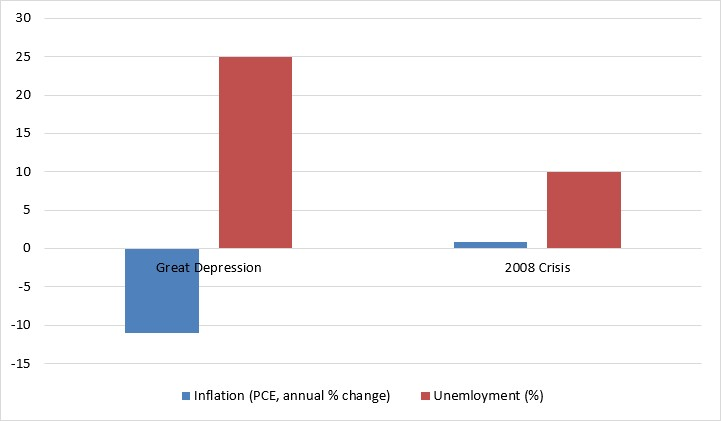
But by highlighting Robert Hall’s and Michael Woodford’s contributions, the Nobel committee also reminds us that the increasing availability of data cannot be a substitute for macroeconomic theory. It serves as a reminder that rigorous macroeconomic theory, which both takes seriously the microfoundations of individual behaviour and provides a way to aggregate it into a model of macroeconomic aggregates, is indispensable as a lens through which to see and make sense of economic data.
The views expressed in each blog entry are those of the author(s) and do not necessarily represent the views of the European Central Bank and the Eurosystem.
Check out The ECB Blog and subscribe for future posts.
For topics relating to banking supervision, why not have a look at The Supervision Blog?
“The European Central Bank is the prime component of the Eurosystem and the European System of Central Banks as well as one of seven institutions of the European Union. It is one of the world’s most important central banks.”
Please visit the firm link to site