


What decisions could we make today that would fundamentally change the future of health and care?
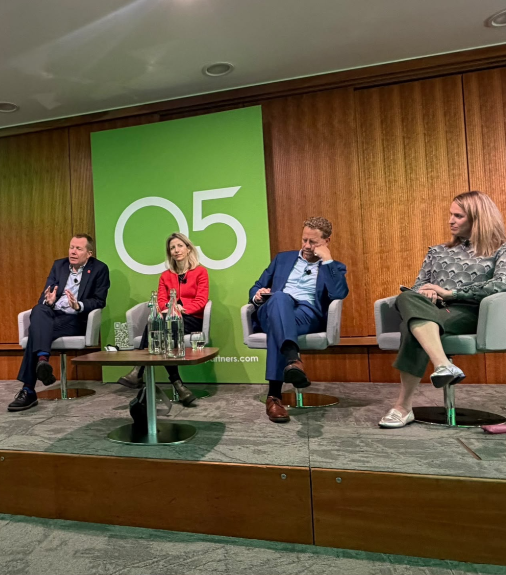
That was the question at the heart of the inaugural event in our Clairvoyant Series, bringing together leaders from across health, care and business to look ahead to 2035 and explore: what are the decisions we’ll wish we had made today?
Hosted by Scarlett Maguire, political commentator and analyst and Founder of Merlin Strategy, she was joined by an expert panel:
- Professor Jason Leitch, Chief of Defence Medical and former National Clinical Director for the Scottish Government
- Sarah Woolnough, Chief Executive of The King’s Fund
- Lord Nick Markham, former Health Minister
- Kate Adams, leadership adviser, author and Non-Executive Director at ParalympicsGB.
The conversation ranged from prevention, funding and social care to leadership, technology and the changing role of individuals in managing their own health.
Listen to the full Clairvoyant conversation below.
Here are five of the key themes that emerged.
1. Shift from treating illness to managing demand
With demand for health and care continuing to rise, simply adding more capacity is unlikely to be enough.
Professor Jason Leitch challenged the system to think differently about the problem, not only asking how we increase supply, but how we reduce and manage future demand.
That means focusing much more seriously on prevention, earlier intervention and delaying the onset of chronic disease, alongside improving the productivity and efficiency of the services already in place.
It also means looking further upstream. Health is shaped long before somebody enters a hospital or GP surgery, making housing, education, employment and wider public health increasingly important parts of the conversation.
2. Put more power in the hands of people
The panel also explored what a more person-led health system could look like.
Sarah Woolnough commented that health and care is still too often designed around what works for the system, rather than what works for individuals, families and communities.
Better access to health information, digital tools, diagnostics and more personalised services could enable people to take greater control of their own health. At the same time, more care could be delivered closer to home rather than automatically requiring a visit to hospital.
But putting people at the centre is about more than technology. It means making care easier to navigate, designing services around people’s lives and recognising the wider circumstances that influence their health.
3. Create the conditions for change
A recurring theme throughout the conversation was that many of the solutions already exist. The harder question is whether our systems allow leaders to act on them.
Kate Adams highlighted the tension between asking leaders to think long term while measuring them against immediate pressures and short-term performance.
Her challenge was simple: “What would you do if you really meant it?”
Whether the ambition is prevention, integrated care or shifting services into communities, funding structures, incentives and measures of success all need to support the change leaders are being asked to make.
As Kate put it, sometimes it is not the fish that needs to change, it is the water around it.
4. Use AI to make healthcare more human, not less
Technology and AI naturally played a major role in a conversation looking towards 2035.
The panel highlighted opportunities ranging from earlier diagnosis and continuous monitoring to ambient voice technology that can reduce the administrative burden on clinicians.
But there was also a clear message that success should not be measured by automation alone.
Used well, AI could give clinicians more time for the parts of healthcare that remain deeply human: listening, building relationships, exercising judgement and caring for patients.
Making that transition successfully will require trust and transparency, particularly as roles change. Leaders will need to involve their workforce in the conversation, explain the trade-offs openly and support people to adapt.
5. Treat health as a whole-society challenge
Perhaps the broadest theme of the evening was that better health outcomes cannot be delivered by the NHS alone.
Housing, education, employment, social care, businesses and individual behaviour all influence the health of the population.
The panel pointed to examples from across the UK and internationally, including Scotland, Denmark, Japan, Singapore and the Netherlands, showing that many of the challenges facing the system have already been approached differently elsewhere.
The opportunity is therefore not always to invent something new, but to become better at learning from what already works and adapting those lessons across organisational and geographical boundaries.
The future of health and care undoubtedly brings difficult decisions. But the discussion also offered plenty of reason for optimism: many of the ideas, tools and examples we need already exist.
The challenge now is creating the conditions to act on them.
If anything from the discussion sparked a question or you’d like to explore what becoming future-ready could mean for your organisation and workforce, please feel free to get in touch with Nick Mathew or Charles Penny.
We are all about organisational health, which separates good organisations from the great. Whether our clients are at the top of their game (and want to remain there) or are in ‘turnaround’ mode, we all need to work on our organisational health.
Whatever the situation, be it a strategic conundrum, a market opportunity, or an operational gripe, we combine the art and science of organisational health to help our clients improve and excel.
Please visit the firm link to site