

2 September 2026
Synthetic securitisation can free up bank capital. But does that mean banks lend more to firms? This ECB Blog post explores the effects of loan securitisation. We find that banks that issue synthetic securitisations lend marginally more, but also tend to pay more dividends.
In theory, the securitisation of bank loans can strengthen the lending capacity of the banking system, which, in turn, can help stimulate economic growth. The review of the European regulatory framework for securitisation reflects this hope, making securitisation the first legislative proposal under the savings and investments union. But can securitisations really meet expectations for more lending? Could revitalising this market even create new risks? We will endeavour to provide some answers by focusing on synthetics – the fastest growing segment of the securitisation market.
What is securitisation and how can it benefit the real economy?
Securitisation refers to banks packaging pools of loans (such as mortgages or loans to companies) before selling them as tradeable securities to investors. These packages are split into segments or tranches, with different risk profiles paying different yields. If some of the underlying loans are not repaid, the losses are borne by the investors holding the securities, rather than by the bank that originated the loans. That is why securitisations reduce banks’ exposure to credit risks and free up capital.
There are two main types of securitisations. Traditionally, banks package the loans and sell them to an entity created specifically for this purpose, which then issues securities to investors. Since the loans are transferred to this outside entity, they are removed from the bank’s balance sheet entirely. In this blog post, however, we focus on synthetic securitisations. These are where the bank keeps the loans on its balance sheet and only transfers the risk that some of the loans default to investors via credit derivatives. Both types of securitisation can free up capital, which can potentially be used to extend additional new loans to firms.
European securitisation today: the growing role of synthetics
The European securitisation market has experienced a modest revival in recent years. Synthetics have been a main driver of this growth, almost tripling in volume since 2021. Chart 1 shows that while synthetics have taken off, the volume of traditional securitisations has remained stable. More importantly, synthetics have become banks’ workhorse product for bundling and selling loans to corporates and small and medium-sized enterprises (SMEs). At the end of 2025 the overall outstanding value of synthetics backed by SME loans was around €480 billion, compared with €380 billion for traditional securitisations.
Chart 1
European securitisation landscape – outstanding amounts of synthetic and traditional securitisation, and composition of underlying portfolios
(EUR Billions)
Source: COREP data.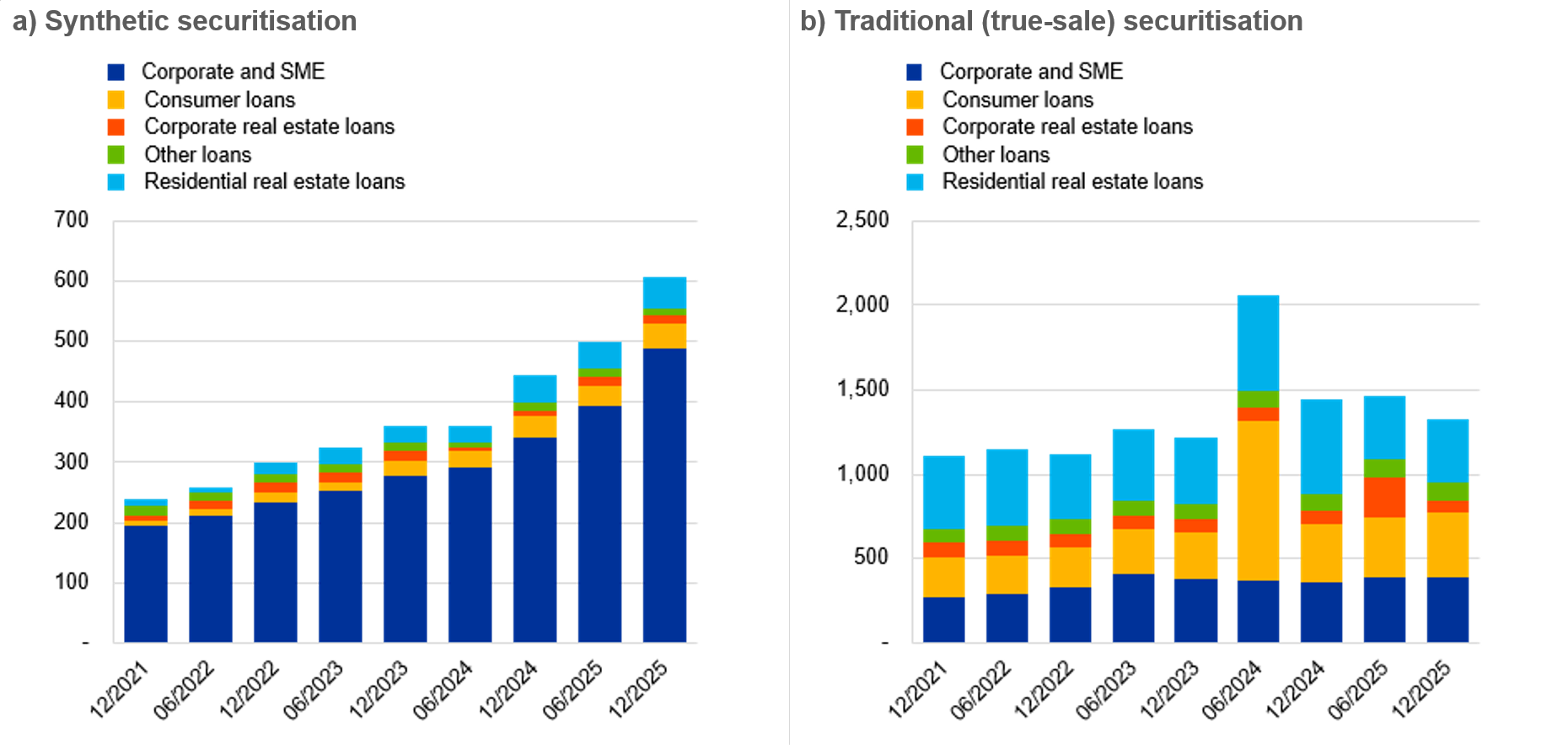
In principle, securitisation can be a powerful tool to generate additional lending and improve the access to financing of credit-constrained firms. But this is not necessarily the reality. Banks can choose to keep the capital or give it back to their owners as dividends instead of granting new loans.
The economic literature presents mixed evidence here. On the positive side, research indicates that securitisation can lower firms’ cost of credit and increase lending during normal economic conditions. For instance, some research finds that securitisation can enhance entrepreneurial activity by alleviating credit constraints.[1] However, securitisation may also have its downsides. Osberghaus and Schepens (2026) argue that when banks redeploy capital freed up through synthetic securitisation, this leaves them less capitalised and they reduce their efforts to monitor borrowers. It can also create stronger links between banks and non-bank financial entities, increasing the risk of stress spreading through the financial system. So while securitisation can ease credit constraints under normal conditions, it may worsen credit shortages during economic downturns or crises.
The crucial question therefore remains: can securitisations lead to extra lending? Chart 2 does offer some hope. It shows that average corporate loan growth for banks that issued securitisations (both traditional and synthetic) was around 5% between 2018 and 2025, versus around 1% for banks that did not.
Chart 2
Average corporate loan growth for banks issuing securitisations (both traditional and synthetic)
(Percentages)
Source: COREP. Notes: Average corporate loan growth for issuers of securitisations compared with that of non-issuers. Annual data are for December of the respective year. Dashed lines denote average across displayed years.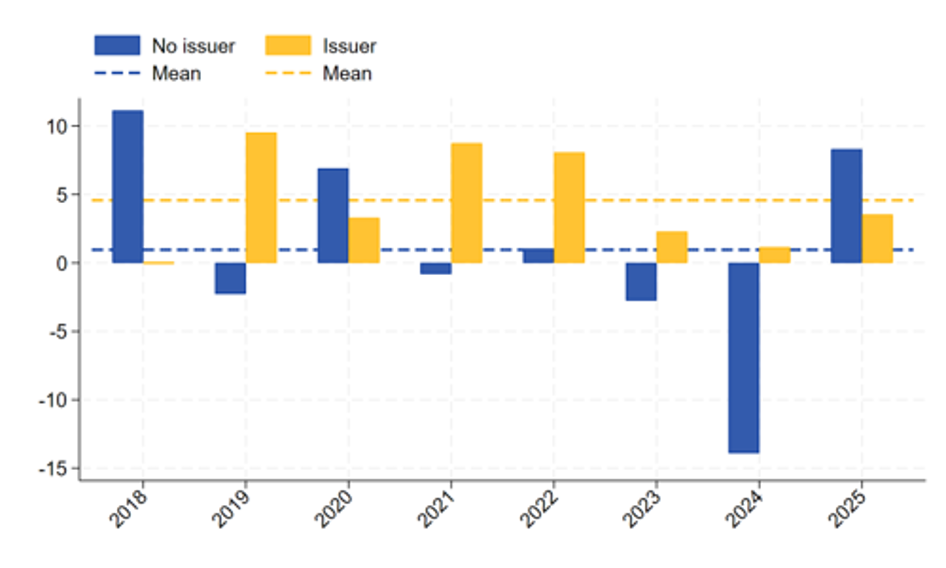
However, this simple comparison ignores other factors that influence loan growth, such as bank size and level of capital, and broader economic conditions. And given the rapid growth of the synthetic segment, we also want to understand its specific contribution to corporate loans. Looking more closely at the data, our analysis isolates the effect of synthetics on corporate loan growth while controlling for other factors. Our model finds that when synthetics issuance increases by 1%, the growth in corporate loans goes up by about 0.02%. The magnitude of this effect is too small to have a meaningful or substantial economic impact.
So synthetic securitisation on its own is unlikely to enable banks to provide lending to the real economy in substantial amounts, and certainly not at the scale needed to boost the European economy, let alone meet the €750-800 billion annual investment gap identified in the Draghi report. This is particularly true given the abundant liquidity environment of recent years, which may have subdued the overall contribution of synthetics to lending. This dynamic could shift if funding constraints become more binding and banks need to rely more on markets to seek financing and capital relief.
The ongoing revision of the prudential framework for securitisation may help further revive the market if it achieves two key objectives: stimulating greater demand for securitisation products and facilitating genuine risk transfer outside the banking sector. However, this effort should not be focused solely on reducing banks’ capital charges for securitisation. Overall, financial markets and equity investors may be better suited to financing novel but risky projects. Bank lending, on the other hand, tends to be directed towards the real estate sector, which contributes only marginally to productivity growth.[2] This makes developing and integrating capital markets – especially equity markets – a particularly important goal for the savings and investments union.
What are the risks of synthetic securitisations?
If banks that securitise assets do not greatly increase their lending, what else do they do with the capital they free up? If banks retain the capital, their regulatory capital ratios may appear relatively strong, which seems positive on the face of it. But this can also obscure underlying rollover and counterparty risks related to the securitised loans. These risks can materialise if the protection seller, who is supposed to bear the default risk for securitised loans, fails to renew the credit protection or is unable to absorb losses – for instance when credit protection is unfunded.
The situation becomes even more concerning when banks choose to pay out the capital to their owners as dividends, as this effectively increases the leverage on their balance sheets. Chart 3 shows that banks active in the synthetics market distribute higher dividends on average, and markedly so in both 2024 and 2025. We find that the impact of synthetic securitisation issuance on dividend payouts is significantly greater than its effect on corporate loan growth. Specifically, the increase in dividend payouts is three times larger, with a 0.07% rise compared with a 0.02% increase in corporate loans for every 1% increase in synthetics issued.
Chart 3
Ratio of average dividend payouts to total assets, broken down by banks’ securitisation issuance (focused on synthetics)
(Percentages of total assets)
Source: COREP data.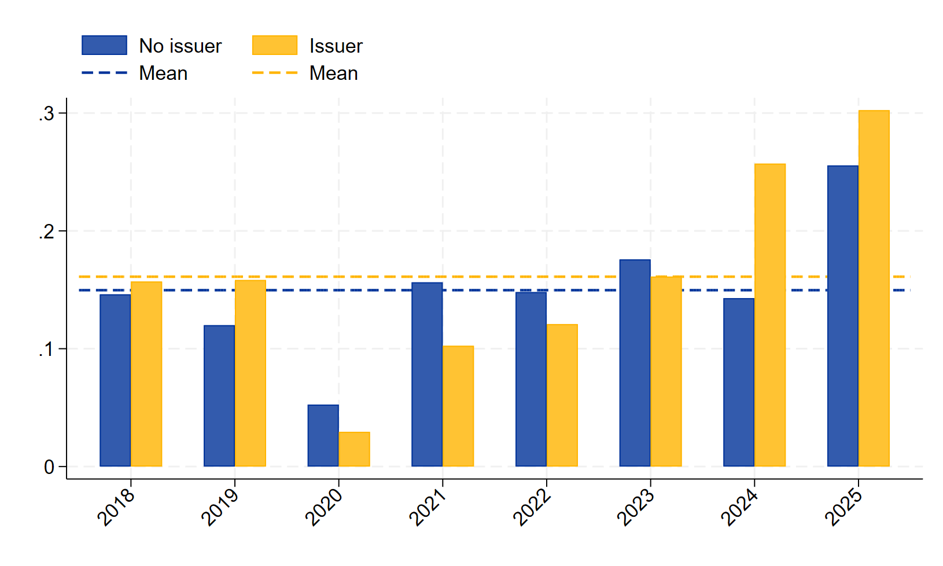
Notes: The chart displays the dividend payouts for banks that issue synthetics versus those that do not. Annual data are for December of the respective year.
Overall, synthetic securitisation can make a positive contribution to banks’ capital management and risk mitigation. It can improve diversification and reduce concentration risk. And by transferring credit risk to investors, banks can free up regulatory capital. However, our evidence shows that banks use just a small part of the released capital for extra lending. Securitisation also enables banks to operate with a more efficient capital structure and pay out more dividends. That can be strategically important for maintaining investor confidence in a competitive market. The overall impact on the real economy depends on whether synthetics lead – as our analysis suggests – to a lower capital position or increased leverage that would ultimately weaken banks’ ability to withstand shocks. In conclusion, the expected positive effects for the economy should not be overstated.
The views expressed in each blog entry are those of the author(s) and do not necessarily represent the views of the European Central Bank and the Eurosystem.
Check out The ECB Blog and subscribe for future posts.
For topics relating to banking supervision, why not have a look at The Supervision Blog?
References
Baradwaj, B., Dewally, M. and Shao, Y. (2015), “Does Securitization Support Entrepreneurial Activity?”, Journal of Financial Services Research, Vol. 47, No 1, pp. 1-25
Berg, T., Streitz, D. and Wedow, M. (2024), “Credit Supply Shocks: Financing Real Growth or Takeovers?”, The Review of Corporate Finance Studies, Vol. 13, No 2, pp. 428-458
Carbo-Valverde, S., Degryse, H. and Rodríguez-Fernández, F. (2015), “The impact of securitization on credit rationing: empirical evidence”, Journal of Financial Stability, Vol. 20, pp. 36-50.
Furbach, N. (forthcoming), “The role of securitisation in enhancing EU credit supply”, Working Paper Series, ECB.
Keys, B.J., Mukherjee, T., Seru, A. and Vig, V. (2010), “Did Securitization Lead to Lax Screening? Evidence from Subprime Loans”, The Quarterly Journal of Economics, Vol. 125, No 1, pp. 307-362.
Nadauld, T. and Weisbach, M. (2012), “Did securitization affect the cost of corporate debt?”, Journal of Financial Economics, Vol. 105, No 2, pp. 332-352.
Norden, L., Silva Buston, C. and Wagner, W. (2014), “Financial innovation and bank behavior: evidence from credit markets”, Journal of Economic Dynamics and Control, Vol. 43, pp. 130-145.
Osberghaus, A. and Schepens, G. (2026), “Synthetic, but how much risk transfer?”, Working Paper Series, No 3210, ECB.
“The European Central Bank is the prime component of the Eurosystem and the European System of Central Banks as well as one of seven institutions of the European Union. It is one of the world’s most important central banks.”
Please visit the firm link to site